Triple-Axis Spectrometer
Mission Statement
Probing the dynamic response of solids with tailorable resolution and high neutron flux.
Instrument Description
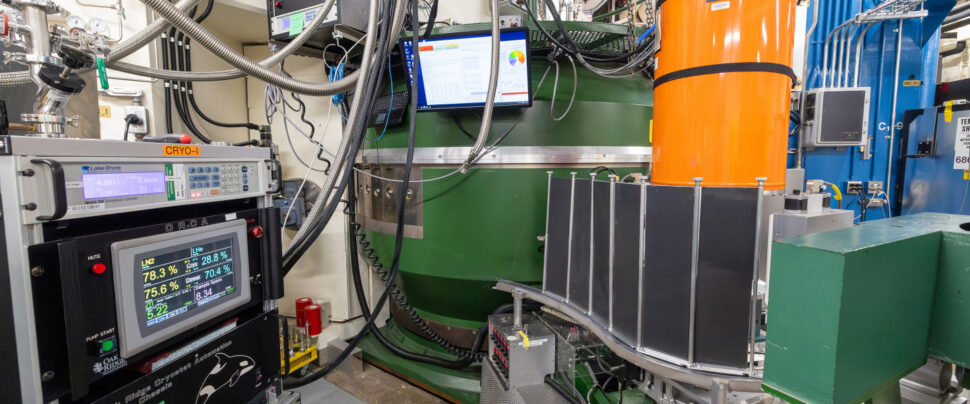
Using Bragg’s Law, a triple-axis spectrometer (TAX) selects the wavelengths of neutrons before and after they hit the sample, which directly probes the energy and momentum response of various materials. TAX provides a very high neutron flux thanks to its location directly at the end of the beam tube that is situated slightly away from the tangential path toward the reactor core. The beam diameter of the effective source that illuminates the monochromator is 4.625 inches. A sapphire filter is placed before the monochromator to reduce epithermal neutrons. Inside the drum, there are 3 monochromators mounted on a unit. They are pyrolytic graphite (PG 002), beryllium (Be 002), and silicon (Si 111), each of which is equipped with vertical focusing device that keeps the beam height at 1 inch over a wide range of incident energies at the sample position.
PG (002) provides the highest neutron intensity because it has a high neutron reflectivity. The unique high-quality Be (002) monochromator extends the energy range and provides good energy resolution at high energy transfers. Si (111) crystals have the advantage of an absent second-order reflection, thus providing a clean beam. The availability of these three monochromator crystal choices makes this spectrometer extremely versatile for a wide range of studies.
The momentum and energy resolution can be further defined by changing the horizontal divergence of the beam through Söller collimators. The in-pile collimation can be reduced from its intrinsic value of 48′ to a user-selectable value of 30′ at the push of a button via the shutter control panel. Collimators from the monochromator-sample, the sample-analyzer, and the analyzer-detector can be changed manually. The PG analyzer has a fixed vertical focusing optimized for the final energy of 14.7 meV. The single 3He detector is tall enough for the choice of various other final energies too.
Applications
- Spin and lattice dynamics in high-temperature superconductors
- Magnetic excitations in low-dimensional magnetic model systems
- Spin waves in magnetically ordered systems
- Phonon anharmocities and linewidths in thermoelectric materials and alloys
- Magnetic critical scattering in phase transitions
- Crystalline electric fields
Specifications
| Beam Spectrum | Thermal |
| Monochromators | Variable vertical focusing PG(002), Be(002), Si(111) |
| Analyzer | Fixed vertically focused PG(002) |
| Monochromator angle | 12 to 67° |
| Sample angle | +/- 180° |
| Scattering angle | -90° to 128° |
| Analyzer angle | -40 to 90° |
| Collimations (FWHM) | Premonochromator: 30′, 48′ Monochromator-sample: 20′, 40′, 60′, 80′ Sample-analyzer: 20′, 40′, 60′, 80′ Analyzer-detector: 30′, 70′, 90′, 120′, 210′, 240′ |
TAX Instrument Team
Please select link below to email the instrument team. Be sure to include your name and email address.
Contact the TAX Instrument Team
Songxue Chi – Instrument Scientist
Eleanor Clements – Instrument Scientist
Kyle Ma – Computational Instrument Scientist
Shirley Xu – Scientific Associate
Information for TAX Users
Shipping address for samples:
Please visit the ORNL User Facilities Sample Handling and Shipping page for the correct address https://neutrons-user-facilities.ornl.gov/shipping-guide/.
Access to HB-3 data:
All data can be accessed through ONCat or the analysis cluster.
Sample Environments:
HB-3 can accommodate a wide variety of sample environments. For more information, please visit the following page: https://neutrons-user-facilities.ornl.gov/sample-environments-at-sns-hfir/.
Scheduling of your experiment:
Once you are notified of an approved proposal, please update your impossible dates in IPTS as soon as possible to ensure that they are accommodated in our instrument schedule. Note that there will be limited scheduling flexibility for experiments requiring sample environments other than closed cycle refrigerators.
Neutron alignment station (CG-1B):
If you need to align a single crystal with neutrons before your HB-3 experiment begins, please email the HB-3 instrument team well in advance so alignment time can be reserved for you on CG-1B. Note that we have a first come, first served scheduling system for this instrument. If you need a quick introduction to single-crystal alignment using SPICE, here is a helpful link.
Links Related to Neutron Scattering and Crystallography:
a. Neutron scattering lengths and cross sections (http://www.ncnr.nist.gov/resources/n-lengths/index.html)
b. Calculate absorption, basic activation calculation (http://www.ncnr.nist.gov/resources/activation/)
c. Inorganic Crystallographic Structure Database (ICSD) (https://icsd.fiz-karlsruhe.de/search/basic.xhtml)
Experiment planning:
Several widely used software packages are available to help users simulate spectrometer geometry, plan scan trajectories, and evaluate resolution. Useful tools include DAVE, Takin, and vTAS, and links to these programs are provided below for your convenience:
DAVE: https://www.ncnr.nist.gov/dave/. ScanMapper is embedded in DAVE and can be found under TAS Tools in the Planning section. Here is a link to its quick start guidance.
Takin: https://github.com/ILLGrenoble/takin
vTAS: https://www.ill.eu/for-ill-users/support-infrastructures/software-scientific-tools/vtas
User publications:
a. As a condition for performing nonproprietary research, the US Department of Energy requires users to publish results from their research. Authorship of publications based on research from these facilities should reflect the normal considerations of recognizing collaborations. It is also important to take into account the considerable efforts of the instrument scientists in their role of designing, constructing, and/or operating the instrument and related facilities. Results are typically published in peer-reviewed journals, proceedings, or presentations at technical conferences. Proprietary users are not required to publish.
b. Credit line: The HB-3 Triple Axis Spectrometer should be acknowledged with this required statement:
“This research [or, A portion of this research] used resources at the High Flux Isotope Reactor [and/or Spallation Neutron Source, as appropriate], a DOE Office of Science User Facility operated by the Oak Ridge National Laboratory. [If applicable: The beam time was allocated to [Instrument] on proposal number IPTS-XXXXX.X.]“
c. Publication Record: Please submit publications, thesis, patents, etc., to PuSH (Publications of SNS and HFIR) to assist us in recording your contribution. Both the credit statement and links to PuSH are on the Neutron Sciences Publications website.
Capabilities of the TAX Instrument
The HB-3 is a high-intensity triple axis spectrometer that is ideal for measuring magnetic excitations in solids, up to 150 meV and for measuring structural and magnetic order parameters in bulk materials. This instrument is most beneficial to the condensed matter and materials science communities. Due to its versatility and easy access this instrument can be used for parametric studies using a variety of ancillary sample environments to provide a complete control of thermodynamic variables such as temperature, magnetic field, and pressure. During the last few years most of the demand for this instrument has been focused in studies of quantum magnets, thermoelectrics and unconventional superconductors.
Examples of typical experiments carried out at HB-3 over the last few years are listed below:
- Elastic neutron diffraction measurements on the square-net magnet EuGa2Al2 resolved multiple incommensurate magnetic phases despite the exceptionally strong neutron absorption of Eu, which normally makes single-crystal neutron studies very challenging. This absorption problem was overcome by exploiting the wavelength/energy flexibility of a triple-axis spectrometer: most measurements were carried out on HB-3 using relatively high neutron energies (35 meV incident and final, with PG(002) monochromator and PG filter) to reduce Eu absorption, with a limited set of higher-resolution scans collected at 9 meV using a Si(111) monochromator. The diffraction maps and temperature evolution of magnetic satellites showed that EuGa2Al2 hosts distinct zero-field incommensurate noncollinear phases: a higher-temperature helical state (AFM1) and a low-temperature cycloidal state (AFM3), separated by an intermediate mixed-wave-vector regime (AFM2). Complementary SANS measurements (CG-2 at ORNL) tracked the field evolution of the incommensurate peaks, while magnetotransport revealed a pronounced topological Hall signal maximized in an intermediate-field “A phase,” consistent with the emergence of a noncoplanar (potentially topological) spin texture. (J. M. Moya, S. Lei, E. M. Clements, C. S. Kengle, S. Sun, K. Allen, Q. Li, Y. Y. Peng, A. A. Husain, M. Mitrano, M. J. Krogstad, R. Osborn, A. B. Puthirath, S. Chi, L. Debeer-Schmitt, J. Gaudet, P. Abbamonte, J. W. Lynn, and E. Morosan, “Incommensurate magnetic orders and topological Hall effect in the square-net centrosymmetric EuGa2Al2 system” Phys. Rev. Materials 6, 074201 (2022).)
- High-pressure neutron diffraction on MnP was performed to establish the magnetic ground state immediately below the pressure-induced superconducting region, by measuring magnetic Bragg peaks up to 7.5 GPa under hydrostatic conditions. This is challenging because the ordered Mn moment is small and decreases further with pressure, so magnetic scattering becomes very weak inside a bulky pressure environment. The high flux of HB‑3 is crucial for obtaining sufficient counting statistics to resolve weak incommensurate magnetic satellites through pressure-cell background/attenuation. Diffraction shows that the helical‑b magnetic structure (propagation along b) remains long-ranged and robust up to 7.5 GPa, i.e., right up to the vicinity of superconductivity near ~8 GPa. With increasing pressure, the ordered moment decreases while δ increases. First-principles + Monte Carlo results qualitatively support the pressure evolution of magnetism and highlight increasingly important further-neighbor exchanges at high pressure. (S. E. Dissanayake et al., “Helical magnetic state in the vicinity of the pressure-induced superconducting phase in MnP” Phys. Rev. Research 5, 043026 (2023).)
- Inelastic neutron scattering measurements on the triangular-lattice magnet FeI2 were used to track how spin excitations evolve across a wide temperature range spanning the Néel transition and into the paramagnetic regime, providing a stringent benchmark for finite‑temperature modeling of quantum magnets. The study shows that reproducing the measured dynamical spin structure factor S(q,ω) over this quantum-to-classical crossover requires a temperature-dependent renormalization of the “classical” moment magnitude (chosen to enforce the quantum zeroth-moment sum rule ∫dω,dq,S(q,ω)=NsS(S+1). Because FeI2 hosts coupled dipolar and quadrupolar dynamics (effectively S=1), the approach was implemented with SU(3) coherent-state Landau–Lifshitz dynamics, which captures both conventional magnonlike modes and single-ion bound-state excitations and their temperature broadening. Comparing simulated and measured spectra from deep in the ordered state through TN and up to ∼10TN demonstrated that the sum-rule-constrained, temperature-renormalized semiclassical dynamics yields substantially improved agreement with experiment in both intensity and bandwidth versus unrenormalized treatments. (D. Dahlbom, F. T. Brooks, M. S. Wilson, S. Chi, A. I. Kolesnikov, M. B. Stone, H. Cao, Y.-W. Li, K. Barros, M. Mourigal, C. D. Batista, and X. Bai, “Quantum-to-classical crossover in generalized spin systems: Temperature-dependent spin dynamics of FeI2” Phys. Rev. B 109, 014427 (2024).)
- An inelastic neutron scattering study of elemental iridium mapped temperature-dependent phonon dispersion curves from 100 to 700 K, overcoming the material’s very large neutron absorption cross section. Measurements on ~3 g of coaligned Ir single-crystal disks (10 mm diameter × 0.6 mm thick, [110] normal to the disk) were performed using TAX (HB3) and together with the ARCS time-of-flight spectrometer at SNS to resolve phonons along the Γ–K–X direction. The data reveal a low-temperature Kohn anomaly (a dip/kink) in the TA1 branch near the K-point, indicating strong, wave-vector-selective electron–phonon coupling that weakens and disappears on warming. By tracking phonon softening with temperature and volume, the study further extracted unusually large mode-specific Grüneisen parameters, highlighting unexpectedly strong anharmonicity in Ir. DFT/DFPT and EPW calculations connect the observed anomalies to Fermi-surface nesting, and Boltzmann transport modeling shows that electron–phonon interactions play a key role in both electrical resistivity and (especially) suppression of the lattice thermal conductivity in Iradium. (S. Wang, S. Thebaud, D. H. Moseley, J. R. Torres, M. E. Manley, Y. Cheng, S. Chi, D. L. Abernathy, G. E. Granroth, A. T. Savici, A. F. May, P. Raghuvanshi, L. Lindsay, and R. P. Hermann, “Kohn anomalies and phonon anharmonicity in iridium” Phys. Rev. B 112, 184305 (2025).)
Related Research Highlights


December 15, 2020
Extended Anharmonic Collapse of Phonon Dispersions in SnS