Polarized Triple-Axis Spectrometer
Mission Statement
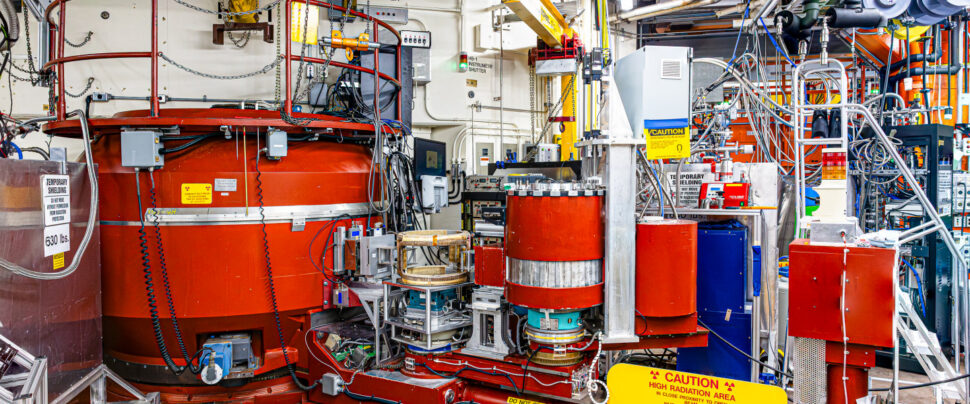
HB-1 is a versatile spectrometer to study static and dynamic properties of spin and lattice using polarized neutrons..
Instrument Description
Of the four triple-axis spectrometers installed at HFIR, HB-1, which accommodates the vertical focusing Heusler monochromator, is specifically designed for polarized diffraction and inelastic scattering measurements. The instrument offers a choice of Heusler analyzer (for full-polarized experiments) and PG analyzer (for half-polarized experiments). The polarized setup is designed to be compact enough to accommodate all available sample environment equipment, including a 4He/3He dilution refrigerator, standard 4He flow cryostats, a cryofurnace, and a variety of closed-cycle refrigerators. Using the Wollaston Prisms setup, ultra-high energy and Q resolution measurements have become possible (https://fankangli.ornl.gov/). The spherical neutron polarimetry (SNP) enables the measurement of full polarization change in the scattering process, providing a unique way to study complex magnetic structures (Contact: [email protected]).
Note: HB-1 is dedicated to polarized neutron experiments with thermal neutron beam. For unpolarized thermal neutron studies, the use of HB-3 or VERITAS is recommended.
Applications
HB-1 is suited for parametric studies of spin and lattice excitations in specific areas of energy and momentum space in materials, such as multiferroic materials, thermoelectric materials, high-temperature superconductors, geometrically frustrated magnets, and quantum magnets, using high flux polarized neutrons. It can accommodate a wide variety of sample environments including high temperature furnaces (< 1770 K), ultra-low temperature cryostats (> 0.03K), vertical field cryomagnets (< 8T), pressure cells (< 2GPa), and bipolar electric field sticks (< 10kV). The half polarization technique is used to map out spin density distributions in magnetic compounds and observe chirality in frustrated magnets. The longitudinal polarization analysis is used to determine detailed spin direction and also separate magnetic and nuclear components in magnetic materials. The materials best suited for study on HB-1 facilitate power and data transmission in computers, cell phones, and power lines; impact the capacity of computer memory (hard disk); improve the efficiency of electric devices and power plants; and are vital to the eventual development of a quantum computer.
Specifications
| Beam Spectrum | Thermal |
| Monochromators | Polarized Heusler(111) (vertically focused) |
| Analzyers | Polarized Heusler(111) (horizontally focused)Unpolarized PG(002) (vertically focused) |
| Monochromator angle | 2ΘM = 14 – 45° |
| Sample angle | +/- 180° |
| Scattering angle | –10 – 110° |
| Analyzer angle | –10 – 90° |
| Collimations (FWHM) | Premonochromator: open (48′) Monochromator-sample: 20′, 40′, 60′, 80′ Sample-analyzer: 60′ Analyzer-detector: 20′, 70′, 90′, 120′, 210′, 240′ |
PTAX Instrument Team
Please select link below to email the instrument team. Be sure to include your name and email address.
Contact the PTAX Instrument Team
Masaaki Matsuda – Instrument Scientist
Avishek Maity – Instrument Scientist
Kaleb Burrage – Scientific Associate
Information for PTAX Users
Shipping your samples:
Please visit the ORNL User Facilities Sample Handling and Shipping page for the correct shipping addresses.
Access to PTAX data:
All data can be accessed through ONCat or the analysis cluster.
Sample Environments:
A list of equipment available at PTAX can be found in the Sample Environment Equipment Database. The database contains detailed equipment specifications and images, drawings and other related documents.
Planning for your experiment:
- Scheduling your experiment:
Once you are notified of an approved proposal, please update your impossible dates in IPTS as soon as possible to ensure that they are accommodated in our instrument schedule.
Note that there may be limited scheduling flexibility for your PTAX experiments requesting the use of extreme sample environment (e.g. cryostats, cryomagnets, ultra-low temperature inserts) due to our sample environment block scheduling system.
- Sample preparation: single crystal pre-alignment
If you need to pre-align your single crystal samples using the neutron alignment station (CG-1B) or the Laue machine at SNS before your PTAX experiment begins, please email the PTAX instrument team well in advance so alignment time can be reserved for you on the appropriate instrument. Note that we have a first come, first served scheduling system for CG-1B. Also, please let the PTAX instrument team know if you are experienced with sample alignments or if you will require significant assistance.
Acknowledgement Statement for User Publications:
- Intent to publish:
As a condition for performing nonproprietary research, the US Department of Energy requires users to publish results from their research. Authorship of publications based on research from these facilities should reflect the normal considerations of recognizing collaborations. It is also important to take into account the considerable efforts of the instrument scientists in their role of designing, constructing, and/or operating the instrument and related facilities. Results are typically published in peer-reviewed journals, proceedings, or presentations at technical conferences. Proprietary users are not required to publish. - Credit line: Research should be published acknowledging ORNL and the facility, or facilities, with this required statement:
This research [or, A portion of this research] used resources at the High Flux Isotope Reactor [and/or Spallation Neutron Source, as appropriate], a DOE Office of Science User Facility operated by the Oak Ridge National Laboratory. [If applicable: The beam time was allocated to [Instrument] on proposal number IPTS-XXXXX.X.]
In addition, users are asked to credit the instrument(s) used in the body of the paper.
Contribute to Our Publication Records: Please submit publications, theses, patents, etc., via the Publications Portal to help us track instrument publications. Both the credit statement and PuSH link are on the Neutron Sciences Publications website.
Links Related to Neutron Scattering and Crystallography:
- Neutron scattering lengths and cross sections: https://www.ncnr.nist.gov/resources/n-lengths/
- Calculate absorption, basic activation calculation: http://www.ncnr.nist.gov/resources/activation/
- Inorganic Crystallographic Structure Database (ICSD): https://icsd.fiz-karlsruhe.de/search/basic.xhtml
Capabilities of the PTAX Instrument
The HB-1 triple axis spectrometer is an excellent instrument for polarization analyses on magnetic structures and magnetic excitations in solids. This instrument is most beneficial to the condensed matter and materials science communities. Due to its versatility and easy access this instrument can be used for parametric studies using a variety of ancillary sample environments to provide a complete control of thermodynamic variables such as temperature, magnetic field, electric field, and pressure. During the last few years most of the demand for this instrument has been focused on studies of unconventional superconductors, quantum magnets, thermoelectrics, and multiferroics.
Examples of typical experiments carried out at HB-1 are listed below:
- Half polarization – ferromagnetism
“Magnetic structure of Fe16N2 determined by polarized neutron diffraction on thin-film samples“, Physical Review B, 102, 104402 (2020).
“Isotropic parallel antiferromagnetism in the magnetic field induced charge-ordered state of SmRu4P12 caused by p-f hybridization“, Physical Review B, 102, 214444 (2020). - Half polarization – chirality
“Unique Helical Magnetic Order and Field-Induced Phase in Trillium Lattice Antiferromagnet EuPtSi“, Journal of the Physical Society of Japan, 88, 013702 (2019).
“Electric-Field Manipulation of Magnetic Chirality in a Homo-Ferro-Rotational Helimagnet“, Advanced Science, 11, 2402048 (2024). - Longitudinal polarization
“Polarized neutron scattering study of the multiple order parameter system NdB 4“, Physical Review B, 97, 17, 174416 (2018).
“Dual Nature of Magnetism in a Uranium Heavy-Fermion System“, Physical Review Letters, 121, 5, 057201 (2018). - Larmor diffraction
“New capabilities in high-resolution neutron Larmor diffraction at ORNL“, Journal of Applied Crystallography, 51, 3, 1-7 (2018)
“Symmetry Breaking and Ascending in the Magnetic Kagome Metal FeGe“, Physical Review X, 14, 1, 011043 (2024). - Inelastic neutron spin echo
“High-resolution phonon energy shift measurements with the inelastic neutron spin echo technique“, Journal of Applied Crystallography, 52, 755-760 (2019).
“Temperature-dependent phonon linewidths and shifts in bismuth from inelastic neutron scattering“, Physical Review Materials, 9, 125403 (2025). - Spherical neutron polarimetry
“Development of a portable high-Tc spherical neutron polarimetry device at the Oak Ridge National Laboratory“, Scientific Reports, 15, 17194 (2025).
PTAX Sample Environments
PTAX can accommodate a wide variety of sample environments. For more information, please visit the Sample Environment Equipment Database. The database contains detailed equipment specifications, images, drawings and other related documents
Temperature Control Devices
- Closed Cycle Refrigerator – Bottom Loading (4 – 300 K)
- Liquid Helium Cryostat (1.5 – 300 K)
- 3He-insert (0.3 – 300 K)
- Dilution Fridge (0.03 – 300 K)
- Furnace (Room temperature – 1500 °C, 303 – 1773 K)
Magnet System
- 6 T and 8 T vertical field cryomagnets (0 – 8 T, with temperature ranges 1.5 – 300 K, 0.3 – 300 K with 3He-insert, or 0.03 – 300 K with dilution fridge insert)
High Pressure
For detailed information, please visit the high-pressure sample environment page https://neutrons.ornl.gov/high-pressure-and-gas-handling/home.
- Hydrostatic pressure:
- Clamp & gas pressure cells ( 2 GPa)
- In-situ uniaxial pressure:
- Compressive force up to 300 lbs (1.5 – 300 K, 0 – 6 T)
Custom Sample Environments
Additional custom sample environments (e.g. current, electric field, uniaxial strain cell, etc.) can be accommodated on PTAX. Users are strongly encouraged to discuss experiment needs with the PTAX instrument team before requesting custom sample environments for their proposals.
Related Research Highlights


April 13, 2020
Heavy Fermion Behavior in d-Electron Antiferromagnet Mn3P