Neutron Spin Echo Spectrometer

Mission Statement
SNS-NSE is an ultrahigh resolution neutron spectrometer for characterizing the slow dynamics of soft condensed matter.
Applications
The SNS-NSE instrument is a high-resolution neutron spin echo (NSE) spectrometer optimized for probing slow dynamical processes and resolving molecular motions across nanoscopic and mesoscopic length scales. It offers unique insight into the mobility of molecular structures governed by thermal fluctuations. A key advantage of NSE is its capability to selectively “label” specific substructures via H/D contrast variation, allowing direct access to the characteristic timescales of targeted molecular components.
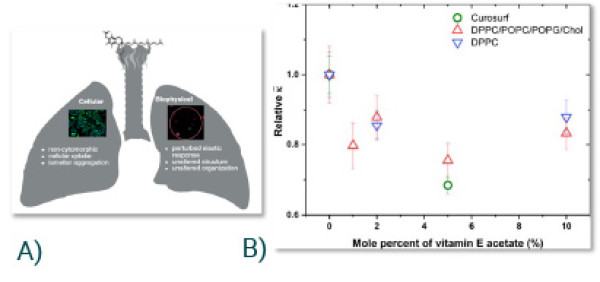
Typical applications in soft-matter research include relaxation processes in polymer melts, networks and rubbers, interfacial fluctuations in complex fluids and polyelectrolytes, and transport phenomena in polymer electrolytes and gel systems. In biophysics, the instrument enables studies of protein domain dynamics and enzyme motions, structural and dynamical properties of lipid assemblies and biological membranes, the impact of anti-inflammatory agents on membrane organization, and transport processes across cell membranes.
The spectrometer also grants access to slow magnetic fluctuations in spin glasses and topological spin structures, supporting research in condensed matter physics, materials science, and magnetism.
Specifications
| λmin [Å] | λmax [Å] | τ min [ps] | τ max [ns] | Qmin [Å-1] | Qmax [Å-1] P2 | Qmax [Å-1] P4 |
| 2 | 5 | 0.1 | 13 | 0.08 | 2.3 | 3.1 |
| 5 | 8 | 1 | 50 | 0.05 | 0.9 | 1.4 |
| 8 | 11 | 5 | 130 | 0.03 | 0.5 | 0.9 |
| 11 | 14 | 12 | 280 | 0.03 | 0.4 |
| Field Integral | Jmax [T m] | 0.56 | |
| Scattering Angle | 2θmax [deg] | 40.0 | at P2 |
| 79.5 | at P4 | ||
| Source to Detector | L [m] | 21.3 | at P2 |
| 27.3 | at P4 | ||
| Field Homogeneity | H [Å2/ns] | 0.7 | |
| Repetition Rate | f [Hz] | 60 |
NSE Instrument Team
Please select link below to email the instrument team. Be sure to include your name and email address.
Contact the NSE Instrument Team
Laura Roxana Stingaciu – Instrument Scientist
Piotr Zolnierczuk – Instrument Scientist
Mary Odom – Scientific Associate

User Guidance
For a comprehensive overview of the SNS-NSE instrument and its scientific applications, please consult the review article provided in the first link of the reference documents. Please contact the instrument staff for additional guidance.
Instrument Description
The SNS-NSE is a time-of-flight instrument in which the Larmor precession of the neutron spin in a magnetic preparation field encodes the individual velocities of the incoming neutrons into corresponding precession angles. If the neutron velocity remains unchanged upon scattering from the sample (elastic scattering), a symmetric decoding region compensates for the accumulated precession angle, restoring the initial polarization through spin rephasing, the so-called spin – echo.
If the sample alters the neutron velocity (inelastic scattering), the rephasing becomes incomplete, resulting in a measurable reduction in polarization. This loss of polarization reflects the distribution of differences in neutron flight times through the encoding and decoding precession regions. The precise control of the neutron spin enables the use of an intense beam with a broad wavelength distribution while maintaining sensitivity to relative velocity changes smaller than 10-4.
The SNS-NSE spectrometer features a modern design based on superconducting technology, providing highly homogeneous magnetic fields. It further incorporates state-of-the-art field correction elements, advanced polarizing benders, and optimized magnetic shielding to ensure reliable and precise operation.
Reference Documents:
- Overview of science cases: “15 years of spin-echo spectroscopy at SNS-NSE: Looking back and looking forward”, iScience 28, 113017 (2025).
- Reduction algorithms: “Efficient data extraction from neutron time-of-flight spin-echo raw data”, Journal of Applied Crystallography, 52, 1022-1034 (2019).
- Detailed description of the spectrometer: “The spin-echo spectrometer at the Spallation Neutron Source, SNS”, Nuclear Instruments and Methods in Physics Research Section A, 696, 85-99 (2012).
- General introduction to NSE: “Neutron spin echo spectroscopy”, Nature Reviews Methods Primers 6, 55 (2026).
Main Features
NSE is of the original generic IN11 kind, which is the technique with the largest potential to extend the resolution beyond current limits. The instrument possesses a number of unique features:
- Ultrahigh resolution: τ_max ≤ 350 ns (Δħω = 2neV)
- Huge dynamical range extending up to 1:10^6
- Field compensation and magnetic shielding for high magnetic stability
- Highest Q resolution ΔQ/Q = 1%
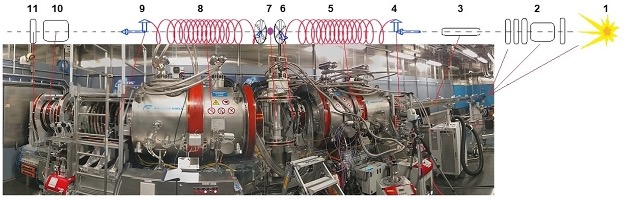
1 = neutron source; 2 = choppers-bender-polarizer-secondary shutter system; 3 = beam transport guides; 4 = pi/2 flipper for first 90° spin-turn; 5 = first precession zone; 6 = pi flipper for 180° spin-rotation; 7 = sample area and sample environment (cryo-furnace is shown here); 8 = second precession zone; 9 = pi/2 flipper for second 90° spin-turn; 10 = analyzer; 11 = detector.
NSE Sample Environments
Temperature Forcing System TFS – Thermojet
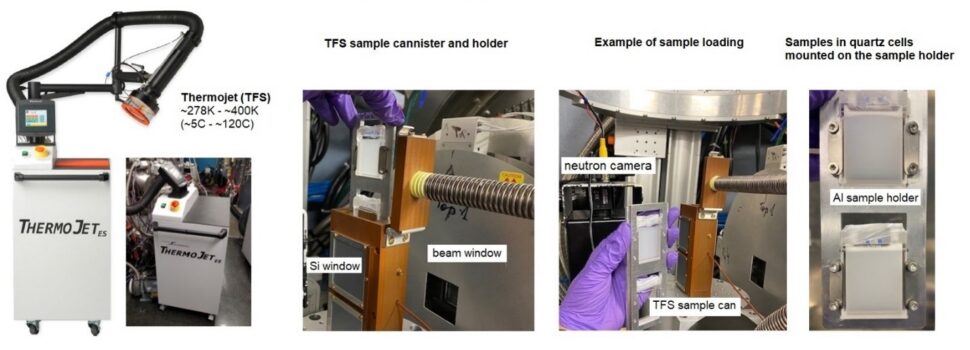
The ThermoJet is a mechanically refrigerated system designed to provide high volume, high velocity, temperature controlled dry airflow to an enclosed and thermally isolated sample cannister. TFS provides temperatures between 5°C and 120°C.
Janis CCR
Janis CCR is a closed cycle refrigerator system equipped also with a furnace to provide high temperatures. The temperature is controlled by the heaters and sensors mounted on both the sample tube and the sample stick. The CCR provides temperatures between 3.5K and 700K with options for high vacuum and inert gas environment. The sample stick can be equipped with a rotor for sample orientation.

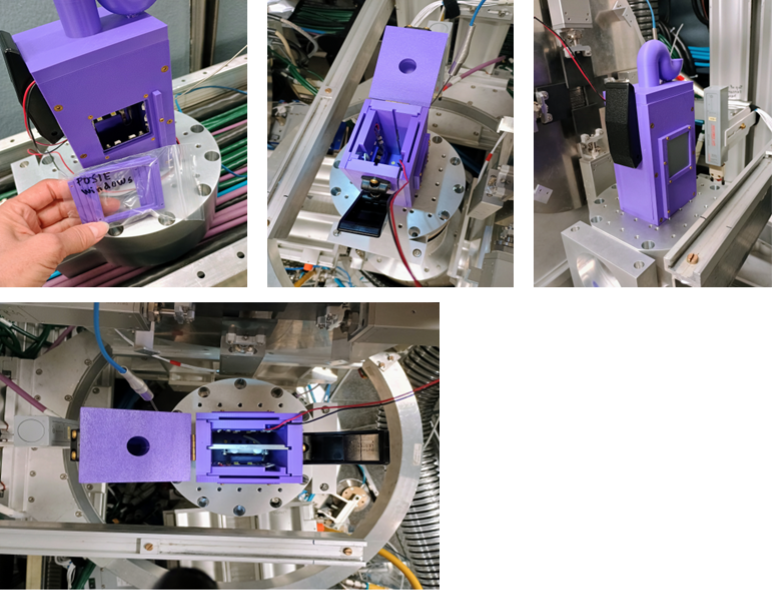
Illumination Environment
The Illumination Environment provides LED white lighting for photo-sensitive samples. The sample canister is designed to mount on the TFS -Thermojet system.
Sample Cells Collection
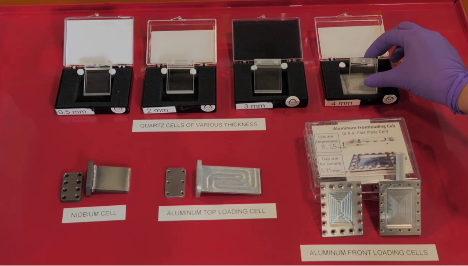
The NSE sample cells are rectangular, measuring 30mm in width and 40mm in height. They are available in various thicknesses and are fabricated from different materials, depending on the required temperature range and the available sample volume.
Quartz/Hellma cells are top loaders of 0.5mm – 4mm thickness mostly used for liquid samples and positive temperatures < 80°C.
Aluminum Flat cells of 0.1mm – 3.5mm can be used for loading viscous samples.
Extreme high and low temperatures require Nb or Al cells.