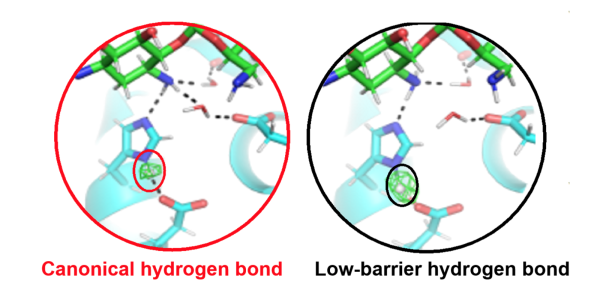
Active site of an antibiotic inactivating enzyme determined with neutron crystallography. In the catalytic triad, the position of the hydrogen atom (circled) controls enzyme specificity and activity. When a low-barrier hydrogen bond is present (right)
Scientific Achievement
The work revealed how a low-barrier hydrogen bond (LBHB) enhances enzyme catalysis 30-fold more than when a canonical hydrogen bond is present.
Significance and Impact
This is the first report of an LBHB and a canonical hydrogen bond being observed in the same active site and a direct demonstration of the catalytic enhancement proposed for LBHBs 30 years ago.
Research Details
- Neutron diffraction was used to differentiate structural details of five antibiotics invisible to X-ray diffraction.
- A single hydrogen atom involved in the catalytic enhancement was directly observed with neutron diffraction.
“Low-Barrier and Canonical Hydrogen Bonds Modulate Activity and Specificity of a Catalytic Triad,”
P. Kumar, P.K. Agarwal, M.B. Waddell, T. Mittag, E.H. Serpersu, M.J. Cuneo,
Angewandte Chemie International Edition, 131 (2019), DOI: https://doi.org/10.1002/anie.201908535
Key NScD Contributors
Matthew Cuneo