Macromolecular Neutron Diffractometer

Mission Statement
The Macromolecular neutron diffractometer (MANDI) is a single crystal diffractometer optimized for high signal to noise data collection by exploiting wavelength resolved Laue diffraction coupled with a 30m flight path. The wavelength bandwidth is Δλ=2.15 or 4.3 Å which can be selected anywhere between 1-10Å. The divergence of the neutron beam can be selected between 0.12 to 0.80° FWHM at the sample position. Data can be collected on samples of 0.1mm3 or larger with unit cells in the range of 30-300 Å on edge. An experimental temperature range of 60 to 400K is provided by an in built Oxford diffraction cryostream.
Instrument Description
MANDI uses a 24 m-long curved and tapered neutron guide to deliver neutrons to the sample position, which is located 30m from the neutron moderator. Three bandwidth choppers are located at the start of the instrument to select the wavelengths of neutrons that will be used in the experiment. The neutron guide has a radius of curvature of 1200m that provides intrinsic sample protection in the case of an upstream bandwidth chopper failure. The last 2.4 m of the neutron guide are interchangeable and are mounted on a neutron optics table. This enables different neutron guide optics to be used in unison with two sets of absorbing slits at each end of the optics table to alter the incident beam divergence at the sample position. The sample position itself is surrounded by a spherical detector array frame that is currently populated with 40 out of a total of 46 possible Spallation Neutron Source (SNS) Anger camera detectors, with a sample-to-detector distance that varies between 39 and 45 cm, currently giving a detector coverage of 4.1 sr.
Applications
A range of very different crystalline materials from small compounds to large protein molecules can be currently be studied on MANDI.
MANDI Instrument Team
Please select link below to email the instrument team. Be sure to include your name and email address.
MANDI Sample Environment
MANDI Sample Mounting Guidelines (Capillaries):
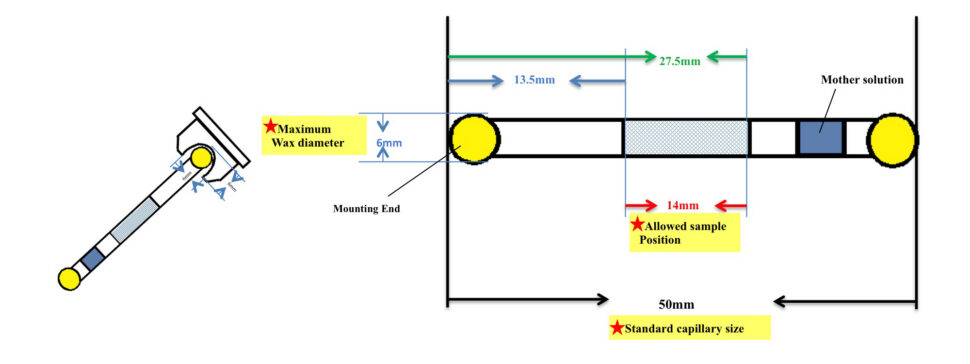
- Mount the sample within the region of the capillary as specified below.
- Be sure that the sample is secure in that region.
- The mother solution should be in the other side of the capillary that is far away from the mounting end.
- Be sure that the wax diameter is smaller than 6mm.
- Capillaries should not be longer than 50mm and the outer diameter should not be any larger than 4.0 mm.
- DO NOT use borosilicate capillaries. Quartz is preferred.
MANDI Cryogenic Sample Mounting Guidelines (pins):
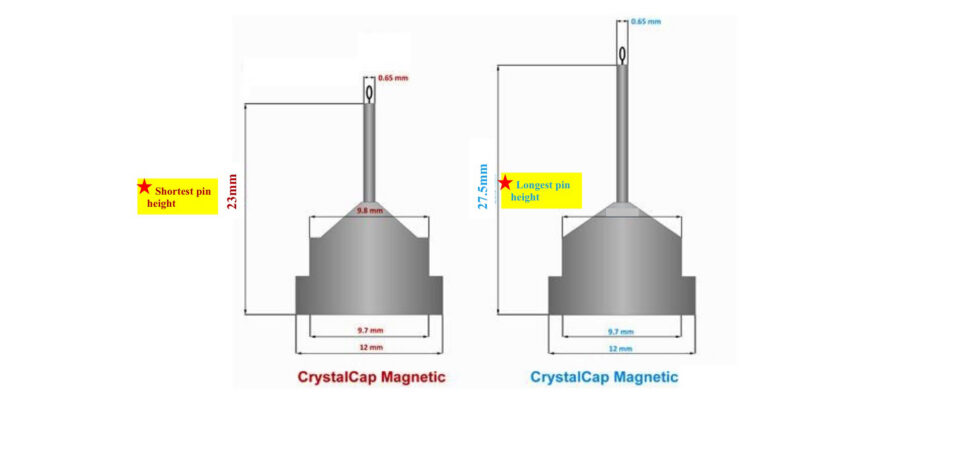
- The standard crystal cap magnetic is from Hampton Research. The height, that is from the bottom of the base to the top of the pin, should be 23-27.5mm.