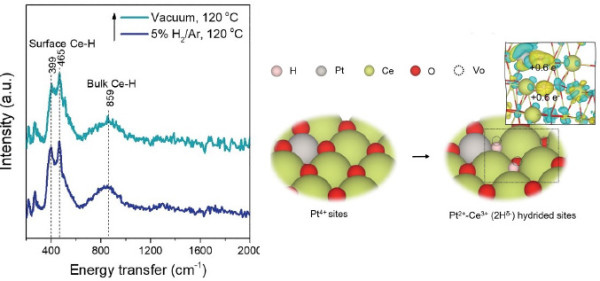
VISION spectra (left) show the formation of hydrided sites (right bottom) from the original sites (right top).
Scientific Achievement
Catalytic Pt1/CeO2 single sites were modified into hydrided (Pt2+-Ce3+Hδ−) and hydroxylated (Pt2+-Ce3+OH) sites that exhibit much higher reactivity and selectivity for several reactions.
Significance and Impact
The achieved 9-fold increase in the reaction rate for carbon monoxide oxidation and 2.3-fold improvement of propylene selectivity for oxidative dehydrogenation of propane provide a major boost for the catalyst performance.
Research Details
- The atomic structure and reaction steps of the catalytic sites were determined with in situ and ex situ spectroscopy techniques and theoretical methods.
- VISION data proved stability of Ce-H hydrides on the surface and in the bulk and ruled out surface species such as adsorbed water.
“Formation of hydrided Pt-Ce-H sites in efficient, selective oxidation catalysts,“ Science 388(6746) (2025) 514-519
https://doi.org/10.1126/science.adv0735
KEY NScD CONTRIBUTORS
Luke Daemen, Yongqiang Cheng, Zili Wu