Vibrational Spectrometer
Mission Statement
Picking up vibrations: characterizing molecular vibrations in materials
Instrument Description
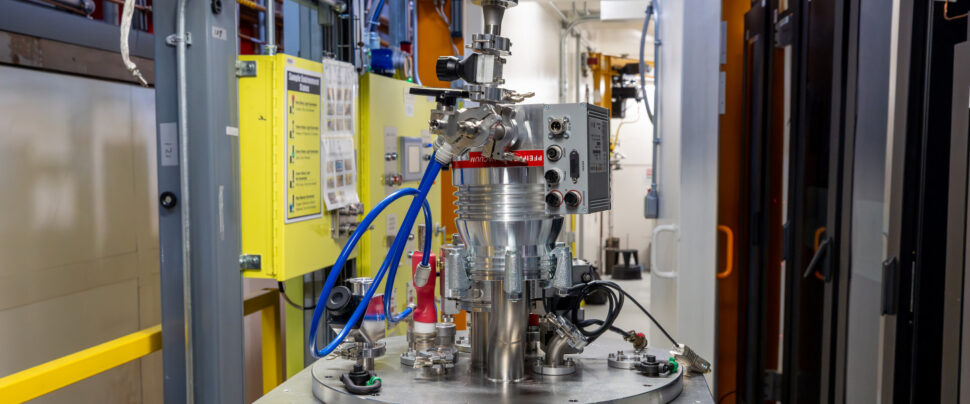
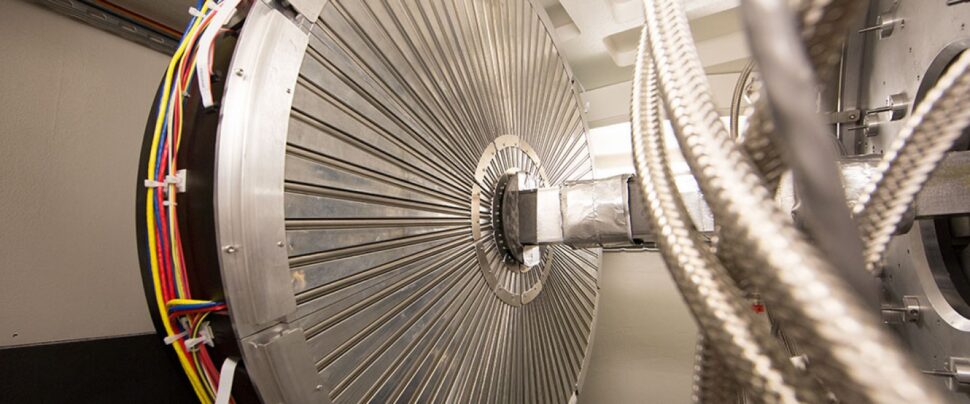
Vibrational spectroscopy is an analytical technique that provides information about molecular structure, chemical bonding, and intermolecular interactions. Infrared absorption and Raman spectroscopies are well-known examples of this widely used form of spectroscopy. VISION uses neutrons rather than photons as a probe of molecular vibrations. This approach has several advantages over optical spectroscopy, including high sensitivity to hydrogen, absence of selection rules, ease of computation of the vibrational spectrum, isotopic sensitivity, no energy deposition in sample, and high neutron penetrability through bulky sample environment. VISION is optimized to characterize molecular vibrations in a wide range of crystalline and disordered materials over a broad energy range (> 5 to < 600 meV). This inverted geometry instrument offers enhanced performance by coupling a white beam of incident neutrons with two banks of seven analyzer modules, equipped with curved pyrolytic graphite crystal analyzer arrays that focus neutrons on a series of small detectors. This arrangement leads to improved signal-to-noise ratio. The overall inelastic count rate is more than two orders of magnitude beyond that of similar spectrometers currently available to users. VISION is equipped with two large diffraction detectors with scattering angles near 90o and backscattering (Q-range: 1.5 to 30 A-1) offering good resolution and high count rates. Simultaneous powder diffraction and inelastic scattering provides a detailed description of sample structure and dynamics in suitable samples. VISION offers a variety of sample environments: high pressure, in situ gas adsorption, and low temperatures. Additional capabilities can be developed in collaboration with users. VISION relies on state-of-the-art hardware and software to compute vibrational spectra and assist users with spectral interpretation. Modeling and computational assistance is offered to users, as necessary. The simplicity of the neutron-nucleus interaction permits the easy calculation of the neutron vibrational spectrum: mode frequencies and mode intensities. The similarity of neutron vibrational spectroscopy with its well-known optical counterparts makes VISION an easy-to-use instrument for scientists already familiar with Infrared and Raman spectroscopies.
Applications
VISION can be used for leading-edge studies in disciplines such as nanotechnology, catalysis, chemistry, biochemistry, geochemistry, and condensed/soft-matter science. Contemporary popular themes comprise hydrogen storage, hydrogen bonding, molecules adsorbed on surfaces and porous materials, thermoelectric and photovoltaic materials, hydrous minerals, metal-organic frameworks, drugs and pharmaceuticals, polymers, proteins, catalysis, and batteries.
VISION Instrument Team
Please select link below to email the instrument team. Be sure to include your name and email address.
Information for VISION Users
Sample Enviroments
Closed Cycle Refregrators (CCR):
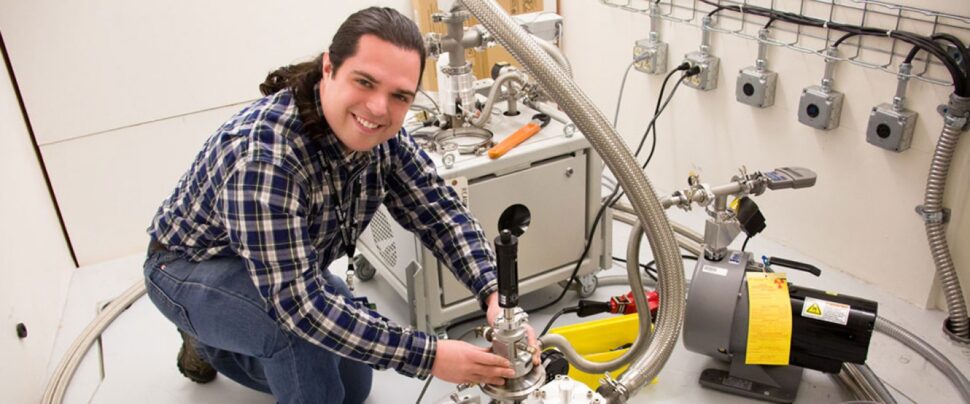
VISION has two dedicated closed-cycle refrigerators (CCRs), CCR20 and CCR29. Both systems are designed to achieve a base temperature of approximately 5 K; however, CCR20 typically demonstrates better cooling performance and reaches its base temperature more efficiently. One of the primary differences between the two systems is the size of the variable temperature insert (VTI). CCR20 has a smaller VTI bore diameter of 85 mm, whereas CCR29 has a larger bore diameter of 104 mm. In addition, CCR29 has a greater insertion depth than CCR20. The larger bore and increased depth of CCR29 provide greater flexibility for accommodating complex sample environments, including multi-sample changers and other specialized experimental setups. However, these design features also result in a larger thermal load, which can impact the cooling efficiency and base-temperature performance compared to CCR20.
Sample Containers:
There are a wide range of sample cans that are used at VISION. The most commonly used sample containers are vanadium PAC cans. We use 6 mm, 8 mm, and less commonly 10 mm diameter depending on the amount of sample available. Some users conduct experiments at both BASIS and VISION, in which they will usually use BASIS style aluminum cylindrical cans. We also have a series of cylindrical aluminum and steel cans that are used for gas loading and high temperatures. A more complete list of cells:
- Vanadium PAC cans (usually 6 mm and 8 mm but sometimes 10 mm)
- Steel cylindrical cells, conflat flanges with copper or aluminum gasket (gas loading or pressure up to 100 bar, )
- Cylindrical aluminum cells (0.25, 0.325, 0.5, 0.625 inches diameter)
- Aluminimum flat plate cells
- BASIS aluminum cylindrical cans with various insert sizes
- Quartz tubes/quartz capillaries (made/sealed on demand)
- Clamps for aluminum pouches or other solid samples
Sample Changer:
VISION has an operational sample changer based on the chain-style design used on the TOSCA spectrometer at ISIS. The system is primarily designed for flat-plate sample cells, although adapters are available to accommodate PAC cans. Up to 23 samples can be loaded simultaneously. During operation, only the sample positioned in the measurement location is maintained at the requested temperature. The remaining samples are held at temperatures that vary depending on their position along the chain. Due to its size and complexity, the sample changer can only be used with CCR29. The smaller variable temperature insert (VTI) of CCR20 does not provide sufficient space to accommodate the sample changer assembly.
High Pressure Sample Enviroments:
The following high pressure cells are used at VISION:
| Cell type | Max Pressure | Minimum T | Maximum T | H2 rated |
| CuBe Cell | 5 kbar | ULT | 100 0C | yes |
| Autofrettage cell | 4.8 kbar | ULT | 100 0C | No |
| BASIS Al pressure cell | 100 bar | ULT | 100 0C | Yes |
| Pre-stressed Clamp cell | 2 GPa | ULT | 100 0C | No |
| Diamond Anvil Cell | 10 GPa | ULT | 100 0C | N/A |
*ULT: Ultra Low Temperature
All cells can go to ultra-low temp, and we are generally not concerned with our pressure cells below 100 0C If the user need to go above that, we can discuss and likely come up with something safe within a P-T envelope. It’s on a case-by-case basis. Moost of the high pressure experiments are set up by the high pressure sample environment group and uses the SITEC and/or Teladyne pressure intensifier. Using this intensifier, pressure changes have to be performed manually. When using hydrogen. gas, a CuBe high pressure cell needs to be used. Other gases are able to use a stainless steel autofrettage cell. There is one dedicated stick to be used for high pressure gas experiments.
Gas dosing and gas handling:
Many experiments conducted on VISION involve reactions or measurements under controlled gas environments. To support these studies, a dedicated gas handling panel is installed on the wall of the sample environment cave. The panel has a maximum operating pressure of 69 bar and is rated for hydrogen service. The system is equipped with two pressure gauges to provide accurate pressure measurements over different operating ranges. One gauge is optimized for pressures below 6 bar, while the second gauge is used for pressures above 6 bar. The VISION team is currently developing a more advanced gas handling panel that will provide enhanced capabilities and operational flexibility for future experiments. At present, the VISION sample environment cave has limited ventilation capacity. As a result, the use of certain gases is restricted, particularly toxic gases (e.g., SO₂, SO₃, and CO) and highly toxic gases (e.g., NO, NO₂, N₂O, and other NOₓ species). To address these limitations, SNS is commissioning a new gas handling system designed to meet the specific requirements of VISION. Once implemented, this system will significantly expand VISION’s capability to safely handle a wider range of toxic gases within the operating limits and safety ratings of the system. Until the new system becomes operational, experiments involving toxic gases are supported on a case-by-case basis within limits approved by SNS safety personnel and the instrument team. Users planning experiments involving hazardous gases are encouraged to contact the VISION instrument team early in the proposal and experiment planning process to discuss feasibility, safety requirements, and available capabilities.
Para Hydrogen Covertor:
VISION has a ortho-parahydrogen converter that can be used to dose samples with up to 1 bar of parahydrogen. A displex head cools a catalyst below 20 K where the hydrogen condenses on the surface of the catalyst and converts to parahydrogen. Heating the system to evaporate the hydrogen will allow you to dose the sample with parahydrogen.
High temperature Furnace (HOT-20):
VISION has its own dedicated compact furnace based on the MICAS design. The furnace have a number of sample sticks available for gas loading, rapid cooling, and will be capable of reaching a maximum temperature of 1000oC. The sample environment group at SNS/HFIR is responsible for the design, fabrication, and maintenance of the furnace.
In-situ photo stick:
VISION is equipped with an operational photochemistry sample stick that enables in situ photochemical studies using inelastic neutron scattering (INS). The system incorporates a laser diode source, which can be readily exchanged to provide different excitation wavelengths depending on the experimental requirements. The laser light is directed and focused onto the sample while neutron measurements are performed simultaneously, allowing real-time monitoring of light-induced structural and chemical changes. This sample environment is particularly well suited for investigating in situ photodimerization processes, photoactive materials, optically excited states, and photoinitiated chemical reactions. By combining controlled optical excitation with INS measurements, researchers can directly probe changes in molecular structure, dynamics, and vibrational properties under operating conditions.
VISION instrument lab:
VISION is equipped with an Instrument Support Laboratory located on the ground floor in Room TA-1165. The laboratory houses Raman spectroscopy and X-ray diffraction (XRD) systems, which are primarily used for preliminary sample characterization as well as the analysis of irradiated samples. In addition to characterization capabilities, the laboratory serves as a workspace for minor troubleshooting, maintenance, and assembly of sample environment equipment and associated components. This facility provides valuable support for both instrument operations and user experiments by enabling rapid diagnostics and preparation of experimental hardware.
Modeling INS Data
Comparison of simulated INS spectra to VISION experimental data using aClimax and Mantid software.
- 2climax.tar.gz – This script converts the calculated phonon modes (by various first-principles software packages) to .aclimax format.
- cvs2nxs.tar.gz – This script converts the simulated INS spectra (output of aClimax, in .cvs format) to .nxs format for comparison to experimental data.
- nxs2dat.tar.gz – This script converts multiple processed .nxs files to ASCII format (.dat).
VISION Data Reduction Guidelines
VISION Mail-In Program
Overview
- Proposals are accepted at any time, independent of the semi-annual general user program proposal call.
- A number of days are reserved from the general user program each cycle.
- It is expected that samples are ready before the mail-in proposal is submitted.
- A maximum of 24 hours can be requested in each cycle.
- A maximum of 8 samples can be measured.
- Temperatures between 5K and 400K can be requested but the total time cannot exceed 24 hours. Temperature scans will reduce the number of samples that can be measured.
- Once approved, vanadium sample cans are sent to the users to be filled and returned to the SNS.
- Samples should be returned to SNS within two weeks of receiving the empty cans. All sample cans received must be shipped back to the SNS.
Mail-In Proposal Process
- Make sure your samples are ready
- Prepare your proposal. The statement of research should contain approximately two paragraphs explaining the motivation, answers sought from the experiment, and experimental measurement conditions. Please contact the instrument staff if you have any questions.
- Submit your proposal through IPTS. Be sure to select Mail-In as the proposal type.
- If your proposal is accepted, you will receive an email with additional information, and empty sample cans will be sent to the address you specified in the proposal.
- Load your sample cans, according to the instructions linked below, and fill out the sample loading spreadsheet in IPTS (refer to the loading spreadsheet document below).
- Ship the samples and loading spreadsheet back to the address linked in the notification email.
- Your samples will be measured at the first available opportunity, on a first-come, first-served basis.
- You will receive an email when data collection is complete. Follow the directions and linked guides on the VISION User Guidance page to download and analyze your data
- All publications resulting from your data must include the SNS acknowledgement and should be submitted to the PuSH publication tracking system.
- After 30 days, your samples will either be wasted or shipped back to you, based on what you requested in the proposal.