Engineering Materials Diffractometer –

Mission Statement
Understanding engineering and functional materials behavior under complex environments.
Instrument Description
VULCAN is designed for deformation, phase transformation, residual stress, texture, and microstructure studies. Load frames, furnaces, battery chargers, and other auxiliary equipment for in situ and time-resolved measurements are integrated into the instrument. As a time-of-flight diffractometer at the world’s most intense pulsed, accelerator-based neutron source, VULCAN provides rapid volumetric mapping with a sampling volume of 2-600 mm3 and a measurement time of minutes for common engineering materials. In extreme cases, VULCAN has the ability to study kinetic behaviors in sub-second time frames.
A virtual tour of VULCAN can be accessed here: Virtual Instrument Tour
Applications
VULCAN covers a broad range of applications in materials science and engineering, from residual stress determination in engineering components to understanding the fundamental aspects of material behaviors during synthesis, processing, and service. Research areas that can benefit from VULCAN include but are not limited to the following:
- In situ studies of materials behavior during processing or synthesis: phase formation, temperature distribution, texture changes, stress development, precipitation.
- In situ loading studies of crystalline/amorphous materials at high temperatures: phase transformation, fatigue damage, creep behaviors, and other deformation mechanisms in nanostructured materials, piezoelectric and shape-memory alloys.
- In situ/operando studies of a working system such as batteries and hydrogen storage devices.
- Nondestructive residual stress (in AM), texture, and microstructure investigation in engineering components and new alloys.
- Stacking faults energy, line profile measurment and analysis etc.
Specifications
| Selectable chopper speed and bandwidth | 60 Hz, 1.44 Å; 30 Hz, 2.88 Å; 20 Hz, 4.32 Å ( for measurable d range in 90-degree detectors, divide the bandwidth by 1.414). ~0.35Å < d-spacings <~4 Å. |
| Sample stage | Rotation: 360°, X,Y, +/-250 mm, Z +/-300 mm. Weight capacity: 2000 kg. Positional precision: < 25 μm for loads < 200 kg; 100 μm for loads between 200 and 2,000 kg. Standalone horizontal and vertical rotation motors. |
| Detector | +/-90° 3He linear-position-sensitive detectors (LPSDs), measure two orthogonal strain components simultaneously, and 120° and 150° high angle detector for high-resolution applications. 60° low angle detector for large d measurement. Optional downstream MCP detector for transmission measurement of ~150-micron spatial resolution. |
| High-intensity and high-resolution exchangeable guides | For 90° banks, ~0.45% (HI) and ~0.25% (HR) Δd/d resolution. For high angle detector ~0.10% for both modes. (Q dependence can be found in the User Guidance page).Half polarization beam is available for wavelength > 2 Å. |
| Beam size | 0.2-12 mm horizontal and 0.2-12 mm vertical incident slit. 2 mm and 5 mm receiving radial collimators. |
Sample Environment Capabilities
The open space of the instrument can host a variety of sample environments to provide flexible capabilities for broad research. Below is the shortlist of the capabilities. We also accept user’s sample environments or special setups. Sample preparations and offline characterizations are also available via SNS users lab, such as microscopy, x-rays, DSC etc.
1. Dedicated in-situ mechanical loading with VULCAN MTS Loadframe, +/-100KN tension/compression, and 400Nm torsion, +/-100mm stroke, 270o rotation. Centroid control. 30Hz rated cyclic loading, and uniaxial movement as low as 10-6 mm/s. Induction heating in the air with loading. Heating temperatures can go from room to >1200oC and are limited by materials oxidation resistance and induction coupling. Controllable cooling+loading is from 100K to ambient. Resonant ultrasound spectroscopy (RUS).
2. Resistive heating furnace with gas enclosure (RHEGAL), 300A DC.
3. Battery cycler, +/- 5V, a various current range including large current booster up to 100A. Electrochemical Impedance Spectroscope. 10KV HV AC fields – that can be coupled with mechanical loading.
4. Bottom mount controlled atmosphere (N2, O2, Ar, etc) furnace from SNS/HFIR sample environment pool, ambient to 1500oC.
5. Bottom mount ILL vacuum furnace from SNS/HFIR sample environment pool, ambient to 1600oC.
6. Liquid N2 cooling and resistive heating jar with controlled cooling and heating from -80K to 500K.
7. Other standalone sample environments such as cryogenic furnaces can be found in the SNS sample environment pool. Check with the instrument team for details.
8. Can accomodate users supplied devices.
VULCAN Instrument Team
Please select link below to email the instrument team. Be sure to include your name and email address.
Contact the VULCAN Instrument Team
-

Yan Chen – Instrument Scientist
-

Ke An – Instrument Scientist
Become a VULCAN User
- Contact us for capabilities, experiment design, and development of proposals.
- Refer to VULCAN Proposal Key Points before writing the proposal.
- Submit your proposal in IPTS.
Experiment Capability
Refer to the overview and proposal pages for problems that VULCAN is used for.
Approved Proposals
You will be notified of an experiment date and will need to confirm the date by replying to the email and the experiment including samples in the IPTS system.
Prepare and Ship Your Samples
Sample Geometry
Typical sample geometry is recommended for different types of measurement in the document links below. Contact the instrument team for other sample geometry if your sample needs customization.
- Powder measurement
- Bulk measurement
- Mechanical test
- Tension-Bar (room temperature, high temperature)
- Tension-Plate (room temperature, high temperature)
- Fatigue-Bar (room temperature)
- Compression-Rod (room temperature & high temperature)
- Texture mapping
- Furnace test
- Battery test
- Pouch-cell (No coin cell)
- Residual stress mapping
Ship your samples
Shipping samples is recommended and shipping instructions are available on the For Users page and do not forget to confirm your samples in the IPTS system. before shipping.
We recommend VULCAN standard samples. If you cannot provide standard sample geometry, please prepare grip adapters.
Ship back your samples after an experiment
An official address will be required if you want irradiated samples to be sent back to you. For some cases, samples containing a large fraction of certain elements( e.g. Co) cannot be cleared from radioactivities, and only certified facilities can receive those radioactive samples.
Plan Your Trip for on-site Experiment
The User Office will contact you about the site access and proper training. You have the option to stay at the ORNL Guest House, which is located on the SNS site. For complex experiments, two to three users are recommended.
On-site training
Before you can conduct an experiment, you will be asked to conduct a few on-site and facility training. Instrument-specific training will be given by instrument staff, including safety, operations, and data reduction, etc. Tutorial videos are available.
For Remote Experiment
For a remote experiment proposal, you will be notified to prepare your samples accordingly, and you may also be required to prepare a clear testing plan, for example, mechanical loading curve or temperature heating profile for an in-situ experiment, or measurement locations for mapping experiment. You and your team members may be invited to participate in the experiment remotely. Please note, this still requires a normal site access pass, which our user office will contact you.
Monitor your experiment and data collection progress.
You can monitor the experiment by any means, either for the remote or on-site experiments, see the Neutron DAQ Status and Instrument Status for more information.
VDRIVE: VULCAN Data Reduction and Interactive Visualization software
- Get an XCAMS account (the same one that you used in IPTS system). If you do not have an account, you can request one.
- Go to http://analysis.sns.gov and follow the instructions for remote window access.
- Use VDRIVE to perform data reduction or analysis. The VDRIVE manual is a good reference and log on the data analysis computer for the up-to-date version ( https://analysis.sns.gov/ ).
For computer access issues contact [email protected]. For use of the VDRIVE software, contact VULCAN instrument team. Some instruction videos are:
Note: for data collected after Feb 2021, load VDRVE by typing @vdrivex in IDL.
- How to remotely open VDRIVE in idl on data analysis computer?
- How to access the VULCAN data folder?
- How to VIEW single Vulcan data in VDRIVE?
- How to chop Vulcan data in VDRIVE?
- How to VIEW sequential data in 2D or 3D plots in VDRIVE?
- How to do single peak fitting in VDRIVE?
- Batch Rietveld Refinement – I. Create GSAS Refinement Template for VDRIVE
- Batch Rietveld Refinement – II. Use VDRIVE to Refine in Batch
- How to convert the data format from .gda for GSAS to .xye for TOPAS?
VULCAN Instrument Performance (Instrument broadening)
The VULCAN instrument uses time-of-flight powder diffraction to understand the properties of the materials. Plots of the typical instrument resolution for a standard powder setup at VULCAN can be found below. The resolution may vary with different sample environments and experiment setups. Users may contact the VULCAN team to request the specific instrument broadening calibration for their experiments.
Download/Upload Your Data
Client mode: Use an SFTP client to transfer data between your own computer and the data on the server. FileZilla and Cyberduck are free ones that work across different platforms. The server is analysis.sns.gov; the port for SFTP is 22.
Publish Results
Please review your primary obligations regarding the facility acknowledgment statement and notifying the User Office. Contact the User Office with questions.
VULCAN Sample Environments
To support a broad range of research applications, VULCAN is compatible with a variety of sample environments. Contact us with any questions on sample environment capabilities.
Sample Positioning System (SPS)
- Foundation of all sample environments
- 2 ton capacity
- 3 axis translation + 1 axis rotation
- 50 µm movement accuracy
Mechanical
MTS Servo-hydraulic load frame
- up to 100 kN applied axial force
- supports in situ induction heating
- supports in situ cryogenic cooling
MTS Small electrical load frame*
- up to 25 kN applied axial force
- Force control rate from 0.3 N/s – 5000 N/s
- Displacement control rate from 0.5 mm/h – 5 mm/s
- Force control accuracy ±5 N (loading) and ±1 N (holding)
In-house Mini load frame
- up to 5 kN applied axial force
High-Temperature
Induction heating
RHEGAL furnace
Controlled atmosphere furnace (CAF)
Vacuum furnace
Tube furnace*
- Heating up to 1373 K with insulation
- Temperature variation <10 K within ±10 mm center zone
- Clear neutron flight path and sample visibility
Induction tube furnace*
- Heating up to 1373 K with a quartz tube
- Heating up to 1873 K with an MgO tube
- Fast heating and sample changing
- Clear neutron flight path and sample visibility
Thermogravimetric analysis (TGA) furnace*
- Heating up to 1773 K in air
- Heating up to 1663 K in vacuum
- Precise sample weight measurement within ±1 mg
Cryogenic
Compact cryogenic box
- Cooling down to 77 K
- Cooling rates up to 6K/min
- Stable temperature hold from 77 K – 298 K
- Mechanical loading up to 100 kN
Miniature cryogenic jar
- Cooling down to 77 K
- Heating up to 673 K
- Heating & cooling rates up to 5 K/min
Closed cycle refrigerator (CCR)*
Cold/hot air system*
Processing & Handling
Texture stage
Potentiostat
Gas handling system
- Supplies compressed air, N2, Ar2, and O2
- Precise flow control from 0.01 SLPM – 10 SLPM
- Flexible gas mixing
OpeN AM system
Flash sintering system
Automated arc melter system*
- Automated experiment control and sample change
- 36 pellet sample holders
Smart Robotic Interface Control and Handling (RICH) system*
- Vision-aided sample change and positioning
* : in commissioning
VULCAN Instrument Status
View-only experiment web interface can be accessed via the link below (under development and some information may not show up properly.)
VULCAN instrument snapshot is updated every 30s via this link
VULCAN sample environment values are updated in realtime via this link
SNS beam status can be accessed via this link
SNS beam production schedule is posted via this link
VULCAN Neutron Data Status
Neutron event data are collected, streamed, translated with metadata to event NeXus data, reduced to GSAS format for every single run including a summary (AutoRecordData.txt). All the data are stored under the ‘shared’ folder under IPTS proposal folder and can be accessed via analysis.sns.gov with your user account. Further reduction, visualization, and analysis can be done by using the VDRIVE(X) software on the analysis server (analysis.sns.gov). The stored data, as well as analyzed data, can be downloaded via SFTP. See the guidance page for more details.
Here you can find out current neutron data collection via the links below.
- VULCAN neutron status provides you a live screenshot of the current data collection in detector view.
- VULCAN live data plots view provides you a live sliced diffraction data of different banks.
You also can log on to analysis.sns.gov and open a command line then type “css” for view-only VULCAN data collection.
SNS data reduction monitor can be accessed via your IPTS user account. This monitor also indicates the status of data translation ( from raw data stream to nexus event data storage and reduced GSAS data).
- SNS data reduction monitor and
- ONCat service for the web based data record.
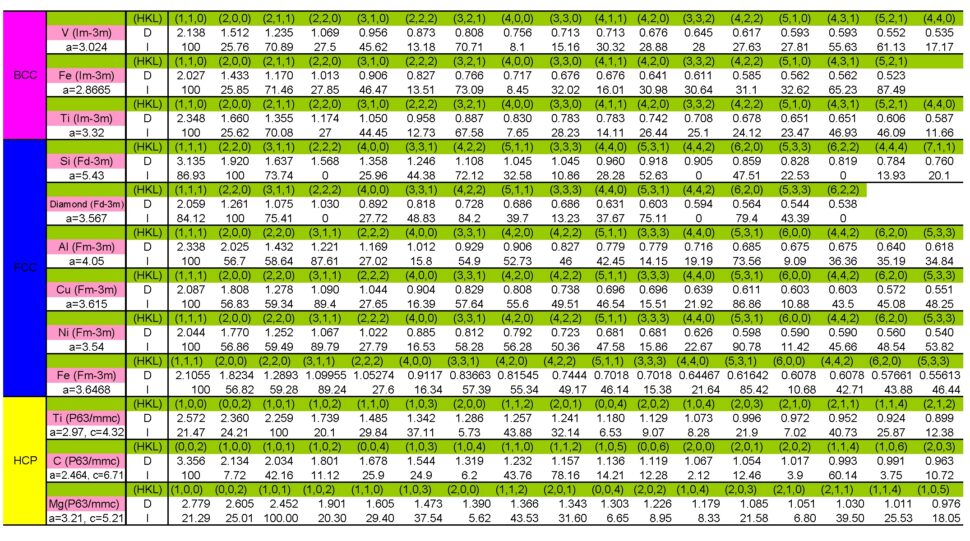
Peak positions for common materials and structures are shown below:
VULCAN Proposal Information
There have been many types of experiments that could be conducted on the instrument. For example, stress/strain/phase mapping either by ex-situ or in-situ. Deformation and hardening mechanisms. Thermomechanical behaviors with loadframe. Phase transformation kinetics during synthesis and under extreme. Atomic occupancy, cation mixing, ordering and disordering in energy materials, and many more. A good practice of learning what this instrument can be used for your research is to find a relevant publication from the instrument page. We also welcome new experimental ideas. Before writing proposals, if you have any questions about your experiment needs, please contact the instrument staff directly.
VULCAN accepts general user proposals, industrial application program proposals, proof-of-principle proposals. For the general user proposal, follow the two calls every year, which are in springs and falls, and the conduction of the approved proposals are in fall-winter, and spring-summer beam production cycles. The industrial application program is available throughout the year around given beam availability. The proof-of-principle proposal is usually for quick testing of ideas and sample statistics and is limited by 1 day of beam time.
For preparing a proposal, the proposal template can be found in the IPTS system. In addition to the standard requirements in the proposal, the key points below are essential elements the Scientific Review Committee (SRC) considers when assigning a rating to your proposal for beam time on VULCAN. They apply to the Statement of Research, i.e., after the specified sections: Title, PI, abstract, facility requested, days requested, student involvement, experiment team, samples, and sample environment.
Consideration of the key points will 1) encourage you to think through the feasibility and reasonableness of your proposed measurement and 2) provide relevant information to the SRC so they can make a sound judgment.
VULCAN now accepts mail-in proposals! For how to prepare a mail-in proposal please go to the next “mail-in program” page.
Key points to include in your Statement of Research
- What scientific question are you trying to answer?
- Have you interacted with the VULCAN instrument team?
- Why neutrons versus other techniques? Such as contrast, penetration, bulk measurements, etc.
- What aspect(s) of VULCAN is/are being exploited: intensity, mapping, event-based data acquisition, open environment, temperature, time?
- Details of the proposed experiment, including:
- Sketch of sample and measurement geometry (for loading experiment, recommend the use of VULCAN sample geometries.)
- Sample characterization, e.g., grain size, composition, shape, size ( if less than a few nanometers, it would be hard to measure, if in mm sale, the signal would be spotty).
- Size of the beam, ( refer to instrument spect for the instrument beam size range).
- Method of obtaining stress-free d-spacings (for residual stress measurement).
- Applied load, temperature, or other environments.
- Data to be collected and how it will be analyzed, e.g., single peak vs. Rietveld, multiple orientations for tensor determination, load only or load-unload, peak breadths, step-measurements, or event-based continuous data acquisition.
- Preliminary work using neutron scattering or other techniques that support feasibility.
- Stress-strain curves for proposed in-situ loading experiments are one of the important pieces of information for successful experiment planning.

Mail-in Program
The available mail-in beamtime is very dynamic with a fractional upper cap each cycle, and also depends on the availability of requested sample environments. Before submission, check first with VULCAN team for those details. For proof-of-principle, do not use this mail-in program. For proprietary work, contact industry liaison first.
- Mail-in proposals are reviewed continuously, allowing for a very short turn-around time. You can apply for a mail-in proposal at any time using the Integrated Proposal Tracking System. Choose ‘Mail-in’ as a proposal type.
- We recommend one mail-in per team per cycle. However, if there are open days left, different science proposals from one team can be submitted. If the requested time exceeds the number of available beam days, priority is given to new users.
- Once approved, users will be notified of the approval, and users must follow the administrative instructions requiring timely response and must provide samples according to the planned sample format in the proposal.
- A mail-in proposal will not be accepted if it competes with an approved General User Program proposal.
- Limit the proposal to one page. Mail-in proposals must be clear and short with a detailed measurement plan.
- One proposal cannot exceed 24 hours and can request a time period as short as 1 hour; typically, requests for a few hours are common. ( the IPTS system does not reflect the use of hours, so specify it in a proposal).
- The number of samples must be below the sample limits, depending on the experiment type. (See below for ‘Detailed requirements based on different experiments’.)
- When shipping samples, the sample loading sheet needs to be filled with VULCAN operation parameters for each sample.
- The data will be processed with the VULCAN auto reduction software, currently producing input files for GSAS. Users have the full responsibility to independently analyze data. refer to the VULCAN guidance page for how to access your data.
The mail-in proposal will cancel/expire and will not carry over given any of the circumstances below:
- Samples are not received on time to fit in the available beamtime.
- Samples are not in the right format of the proposed experiment.
- The requested sample environments are not available anymore. e.g. swapped out for current general user program cycle or need repairs, etc.
- Beam production is reduced or canceled due to any unpredicted reason.
- Main-in program beam days of current cycle have been used up.
Users will be notified of the cancelation/expiration, and are encouraged to resubmit the proposal.
Detailed requirements based on different experiments (please follow the instructions below or the proposal may not be accepted):
Users must provide a clear and concise measurement plan in the proposal. For heating and loading, the rate needs to be specified, and a laboratory testing curve must be provided for mechanical testing upon submission. For battery cycling, the testing plan must articulate the charge rate and cut-off voltage/current.
- Room temperature powder-like measurement in a standard sample holder (vise, PAC can, optical clip, etc.). Measurement instrument setting and estimated time should be specified in the proposal. By default, the approved beam time will be evenly distributed to each sample by using HI-20 Hz mode if no clear measurement plan is provided.
- Texture. Standard 3 hours measurement routine will be used regardless of chopper or guide settings.
- In-situ mechanical engineering diffraction by using VULCAN mechanical loadframe with a standard sample form. Force is within the capacity of LF +/-90kN, and heating (if applied) should be doable by induction coil with welded K-type thermocouple feedback. The typical temperature limit should not exceed 1000C and the sample should be stable in any given temperature range. Strictly follow standard geometry for mail-in. No on-site machining of any modification will be provided.
- Conventional standalone furnaces, such as VULCAN ILL vacuum furnace (1600oC), HFIR CAF furnace (1500oC, currently only support plant air/N2 atmosphere). Sample should fit in standard furnace heating sample holder and within controllable heating rate and limit of the furnace. The sample limit is 1-2 depending on the time of the heating-cooling cycle. It takes normally 4 hours to be cooled down. Note: this mail-in is only available when there is a matching sample environment request in the approved general user proposals.
- Battery cycling. Current/Voltage is below the available cycler range. Users may be asked to provide a specific sample holder.
- Other types of measurement not mentioned above will not be accepted by mail-in. However, we are open to discussion if the measurement is as easy as setting up a powder-like measurement where auto-alignment is employed. Contact VULCAN team for details.
List of different types of mail-in experiments. (incident beam size is between 1-8 mm in width and 1-12 mm in height with or without 5 mm radial collimators).
| Type | Sample limit | Sample holder | Sample geometry | Force/current/voltage | Temperature |
|---|---|---|---|---|---|
| RT powder | 20 | PAC can, optical clips | 25oC | ||
| Texture | 5 | Texture gadget | 10x10x10mm3 cube. | 25oC | |
| In-situ engineering diffraction | 2 | Standard LF grips | See LF geometry file. | +/-90kN force, fatigue exp is excluded. | 25oC-1000oC by induction heating |
| Standalone furnace | 1-2 | ½” MgO crucible | Powder or cylinder to fill up to 15mm of the crucible | 25oC-1600oC for vacuum; 25oC-1500oC for CAF with plant air/N2 | |
| Battery | 2 | Optical clips | No coin cell. | +/- 5V, +/-500mA | 25oC |