Dimensional Extreme Magnetic Neutron Diffractometer
Mission Statement
Exploring nuclear and magnetic structures as a function of temperature, pressure, magnetic field, and electric field.
Instrument Description
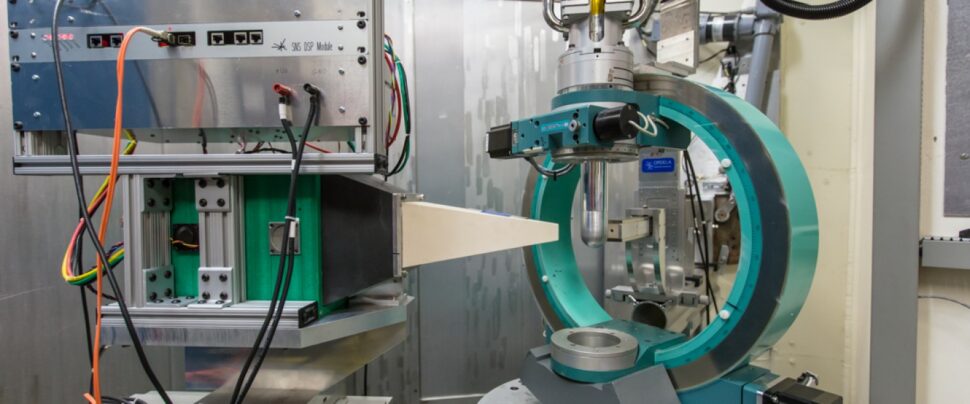
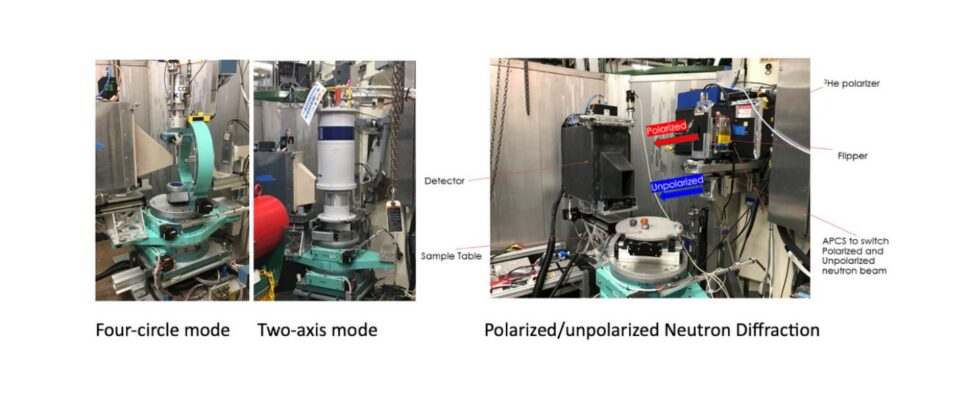
The Dimensional Extreme Magnetic Neutron Diffractometer (DEMAND) has two modes of operation. Four-circle mode with the χ circle goniometer can operate with a closed-cycle-refrigerator (4–800 K) that allows a pressure cell (0-10 GPa), or a permanent magnet (0-0.9 T), and electric field. Two-axis mode allows extreme sample equipment cryomagnet (0-6 T), 3He insert and dilution refrigerators (0.05-300 K). Both modes can have an unpolarized and polarized neutron beam that can be switched by automated elevator device. The current detector has three Anger camera modules stacked vertically to cover 16° (horizontally) x 48° (vertically). The detector sits on the 2Θ rotation arm to cover the scattering angle range of 3° < 2Θ < 155°. A multilayer-[110]-wafer silicon monochromator with the reflection from HHL planes ensures sharp diffraction peaks in specified ranges of detector angles by control of the horizontal radius of curvature. Any HHL planes can be set in Bragg position, but only the (331), (220) with (440), and (111) with (333) reflections are of practical interest. For the fixed monochromator angle of 47.5°, these reflections provide principal incident wavelengths of 1.005 Å, 1.546 Å, and 2.541 Å, respectively. A PC-based LabView system provides user-friendly diffractometer control and data acquisition. The beam size is 6.3 mm in diameter, and the minimum measured crystal size is 0.02 mm3. The maximum crystal dimension is usually limited to 5 mm. The flux on the sample can be up to 2.2 × 10⁷ n/cm2/s. The horizontal bending of the monochromator can be changed to optimize the Q-resolution or flux depending upon the needs of the measurement. The longer wavelength of 2.541 Å has ~5% λ/3 contamination and is mainly used for polarized neutron diffraction (S-bender will filter out the high-order contamination). The 1.546 Å-wavelength has the highest flux but with ~1.4% λ/2 contamination (PG filter is available to reduce the contamination below 10^-3), is mainly used for determining magnetic structures. The 1.005 Å wavelength is monochromatic and is good for precisely determining both nuclear and magnetic structures although the flux is 8 times lower than the highest flux at 1.546 Å.
Applications
The HB-3A DEMAND has the mission to explore nuclear and magnetic structures as a function of temperature, pressure, magnetic field, and electric field. The instrument is particularly suitable for studying phase transitions and accompanying structure changes, as well as measuring order parameters and exploring the phase diagram. It is also suitable for a wide range of small-unit-cell crystallography studies, including superlattice structures and atomic anharmonicity. Users have researched problems in physics, materials science, chemistry, and mineralogy. Recent specific areas of study include magnetic structure and nuclear superstructure in iron pnictide superconductors, magnetic and nuclear structures of possible quantum magnets, Weyl semimetals, topological insulators, multiferroic oxide phase transitions and diagrams, magnetic/orbital frustration in spinels, new permanent magnets, temperature dependence of atomic displacement parameters in battery and thermoelectric materials, structural phase transitions of photo-voltaic hybrid perovskites, hydrogen bonding in rock-forming minerals, crystallography of novel scintillators, and diffuse scattering.
These materials have a wide range of contemporary and prospective applications, such as terahertz equipment, sensors, high temperature power harvesting, high-efficient power transmission, green refrigeration, wireless communication, bolometers in space investigation, data storage and “qubit” in quantum computation.
Specifications
| Beam Spectrum | Thermal |
| Monochromators | Double focusing silicon |
| Monochromator angle | 47.5° |
| Incident Wavelengths | 1.005 Å (331), 1.546 Å (220), 2.541 Å (111) |
| Four-circle mode | Huber, half full χ circle, with 4 – 800 K CCR, 2Θ<95° |
| Two-axis mode | -181°< omega <181°, out-of-scattering plane coverage -8°< γ < 40°, 2Θ < 95° |
| Detector | 2D Anger camera |
| Crystal size requirement | > 0.1 mm3, maximum crystal dimension 5mm |
| Flux at sample | 2.2 × 10⁷ n/cm2/s |
| Polarized neutron diffraction | Polarizer: In situ pumped 3He filter S-bender supermirror |
DEMAND Instrument Team
Please select link below to email the instrument team. Be sure to include your name and email address.
Information for DEMAND Users
DEMAND runs with a large high-pixelated detector, that enables the efficient reciprocal space mapping, allowing the studying the novel structure and magnetic phases, and short-range order, even diffuse scattering. The instrument can run in the “Four-Circle mode” and “Two-axis mode” with easily switchable polarized and unpolarized neutron beam. The “Four-Circle mode” allows the full reciprocal space access, multiple scattering studies, high-resolution mapping the peak shape in 3D that can be used for detailed crystal screening, high pressure sciences, polarized neutron diffraction, electric field and stimulation, and other user-designed sample environment within the temperature range of 4 K-700 K. The “Two-Axis mode” is mostly for the experiments require the ultra-low temperature sample environment (0.04 K to 4 K) or/and cryomagnetic field (-6 to 6 T), in which, the large vertical detector coverage (-8o to 40o) ensures enough reciprocal space coverage out-of-scattering-plane. The polarized beam is available for both thermal neutrons of 1.5424 Å and cold neutrons of 1.541 Å with He-3 filter polarizer and S-bender supermirror polarizer, respectively. Two ways of data reduction are available, MantidWorkbench through https://analysis.sns.gov/ and ReTIA (Real-Time Image Analyzer).
Published articles present details the instrument’s capability and specification:
- B. C. Chakoumakos, et al., “Four-circle single-crystal neutron diffractometer at the High Flux Isotope Reactor“, Journal of Applied Crystallography 44, 655-658 (2011).
- H.B. Cao, et al., “DEMAND, a Dimensional Extreme Magnetic Neutron Diffractometer at the High Flux Isotope Reactor“, Crystals, 9, 1, 5 (2019).
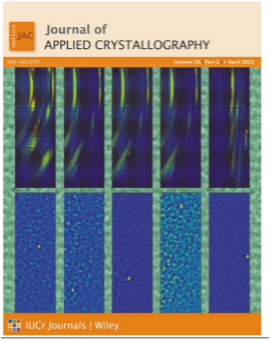
- Y. Hao, et al., “Machine-learning-assisted automation of single-crystal neutron diffraction”, Journal of Applied Crystallography 56, 519-525 (2023).
For remote user experiments, please visit the User Guide to Remote Experiments webpage.
Shipping Addresses for Samples
For details information, please visit the ORNL User Facilities Sample Handling and Shipping page.
Non-activated samples coming to HFIR:
Recipient: IPTS XXXXX, HFIR user sample
Oak Ridge National Laboratory / HFIR Site
1 Bethel Valley Road
Bldg 7972 Room 100 [Special requirements (example: freezer or intert gas)]
Oak Ridge, TN 37830
HFIR Sample Management Desk phone number: 865-576-9030
Activated samples coming to HFIR:
Recipient: IPTS XXXXX, HFIR user sample [Replace the XXXX with your IPTS number]
Oak Ridge National Laboratory / HFIR Site
1 Bethel Valley Road
Bldg 7001 [Special requirements (example: freezer or intert gas)]
Oak Ridge, TN 37830
HFIR Sample Management Desk phone number: 865-576-9030
Users are encouraged to use a shipping provider who delivers directly to ORNL (ex: FedEx, UPS, DHL). These shipments are considered priorities and are processed through ORNL shipping facilities within 8-24 hours of delivery. Please be aware that the use of USPS may delay the processing of your shipment. due to a longer lead time for sorting.
NOTE: Replace the XXXX with your Integrated Proposal Tracking System (IPTS) number.
Software Downloads
Data is accessed and reduced remotely on the SNS analysis cluster using Mantidworkbench. A good tool to obtain an overview of your measured files is through ONCat.
The data reduction process has changed in 2021. Please refer to the following manuals for data reduction:
- MantidWorkbench – Data plotting and reduction software at analysis server. The manual explains how to login to the SNS analysis cluster, access data at Oncat and start data processing and visualizing data with MantidWorkbench (Example of Mantid scripts could be found at analysis cluster in /HFIR/HB3A/shared/Scripts/ : HB3A_visualization.py and HB3A_peakintegration.py).
- FullProf, Jana, and Shelx are the major refinement packages for determination of nuclear and magnetic structures.
- Bilbao Crystallographic Server and SaraH – contains the user friendly structural and magnetic symmetry analysis tools.
- ReTIA – Automated data reduction build in the instrument (in development). The manual is a quick guide for getting started on this software. .
- Graffiti – This program is an old version of data reduction software that allows the user to browse through the scans (.dat files) in the experiment. Data transfer with Graffiti is discontinued. But if the data has been downloaded to local PC and data path set as ***\HB3A\exp**\Datafiles, it could be used for quick checks on the data status.
Lecture Notes and Example Data
Please refer to the Lecture Notes page from the Magnetic Structure Determination from Neutron Diffraction Data Workshop 2016 for example data and relevant articles.
Capabilities of the DEMAND Instrument
The scientific communities that use the HB-3A instrument include condensed matter physics, chemistry, mineralogy, and materials science. Crystal and magnetic structure studies on single crystals are the instrument’s focused mission. DEMAND can efficiently map the full reciprocal space, is optimized for studying novel materials and complex magnetism, but is also capable of studying short range order and defect correlation. The sample environment covers 4-700 K with the closed-cycle refrigerator (CCR) at its Four-Circle mode, ultra-low temperature (0.04-4 K), and temperature beyond 700 K in its Two-Axis mode. Polarized beam can be switched on easily to measure weak ferromagnetism, magnetization density map, local site magnetic susceptivity.
Four-Circle mode: structure, site-disorder, magnetic orders, ordering parameters, determining propagation vectors, fitting magnetic scattering data to determine spin arrangement and moments. With a dedicated closed-cycle refrigerator mounted on the diffractometer, magnetic structural studies can be undertaken over the temperature range of 4 to 700 K.
Two-axis mode: magnetic orders, ordering parameters, determining propagation vectors, fitting magnetic scattering data to determine spin arrangement and moments, magnetic field dependence. With the cryomagnet (Mag-I) up to 6 T from 1.5 K to 10 K.