Pressure drives Ce through different microstructural pathways: ambient compression produces textured α′-Ce, while cold compression produces randomly oriented α″-Ce. Retained γ-Ce persists metastably and imprints the transformation history.
Scientific Achievement
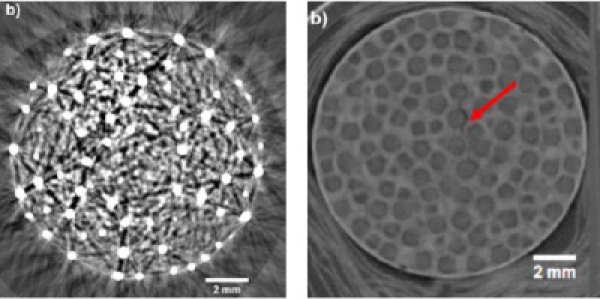
A natural uranium-based, unirradiated TRISO fuel compact was nondestructively imaged using both X-ray (XCT) and neutron computed tomography (nCT). Complementary structural details were revealed.eparated yet strongly correlated, allowing stable and tunable topological transport properties.
Significance and Impact
While XCT maps uranium-bearing fuel kernels, imaging artifacts preclude examination of the graphite matrix. In this work, nCT was used for the first time on a TRISO compact and successfully revealed a crack
Research Details
- XCT were conducted at Idaho National Laboratory’s (INL) using a ZEISS Xradia 620 Versa X-ray microscope (XRM).
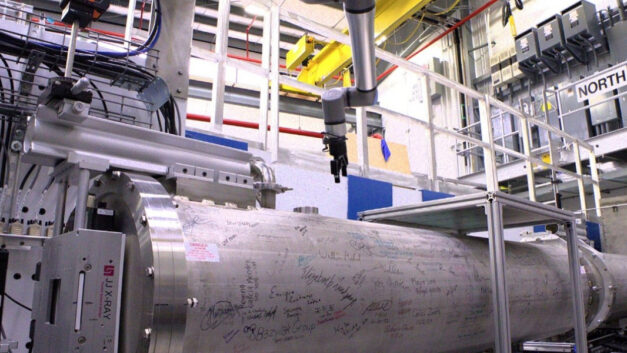
- nCT was performed at the Oak Ridge MARS beamline.
- XCT and nCT datasets are co-registered and fused.
“Neutron and x-ray computed tomography of a natural uranium tristructural isotropic (TRISO) fuel compact,” Journal of Radioanalytical and Nuclear Chemistry, 335, 2229-2238 (2025)
https://doi.org/10.1007/s10967-025-10629-725-02414-4
NScD Key Contributors
Yuxuan Zhang