Ultra Small-Angle Neutron Scattering Instrument
Mission Statement
Analyzing the structure of inhomogeneities, from minerals to biological tissues.
Instrument Description
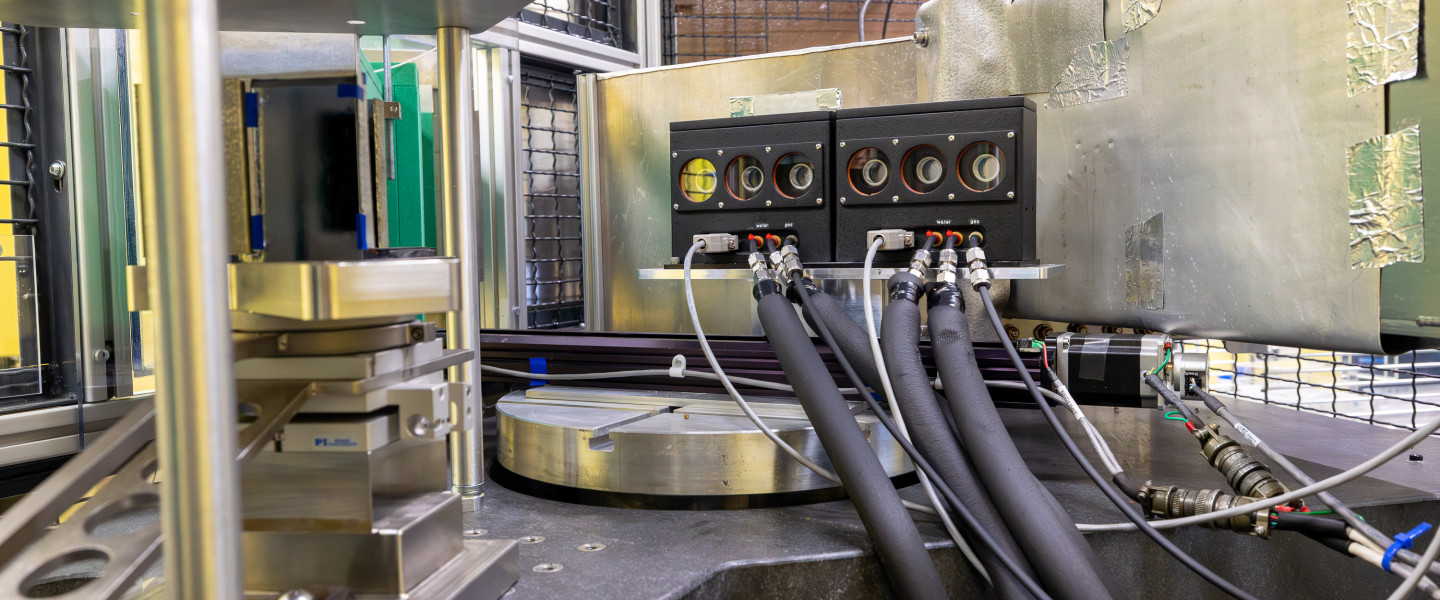
USANS is designed for the study of hierarchical structures in natural and artificial materials. It can be considered an advanced version of the classical Bonse-Hart double-crystal diffractometer (DCD), which in contrast with its single-wavelength reactor-based analog, will operate with the discrete multiwavelength spectrum of Bragg reflections.
The optical scheme of the USANS instrument is similar to that of the conventional Bonse-Hart DCD; however, the pulsed nature of SNS offers an opportunity to separate the orders of Bragg reflection in time space using the time-of-flight technique. Thus, the application of time-of-flight to the USANS technique allows the separation of data optimized for neutron flux and the Q resolution or minimum accessible Q while simultaneously removing contamination by higher harmonic reflections, one of the most significant contributions to the intrinsic instrument background on this class of instruments.
Applications
Ultra-small-angle neutron scattering provides a new way to solve a broad range of scientific problems such as:
- Structure of soft matter systems including polymer solutions and melts, colloidal suspension and micellar solutions
- Structure of precipitate strengthened alloys
- Phase transitions and critical phenomena
Requesting Complementary SANS beam time on a USANS proposal
Beginning with the Spring 2020 call for proposals, users submitting USANS General User proposals may request SANS beam time in order to obtain complementary information on the same sample(s) as for the USANS experiment, with the following conditions:
- SANS beam time that has been requested with a USANS general user Proposal that has been awarded time through the general user program review process may only be used to measure the samples that were characterized by USANS.
- Only experiments that use the standard sample environment (10-70°C, titanium or copper demountable cells, or solid thin films) are eligible for measurement through this program. In the event that a specialized sample environment is required, SANS beam time must be obtained through the general user (GU) program.
- The SANS experiment will be performed on the requested SANS instrument if schedule permits during the awarded cycle, but staff reserves the right to perform the experiment on any one of the GP-SANS, Bio-SANS or EQ-SANS instruments depending on capabilities and availability.
- The SANS beam time at SNS or HFIR will be scheduled by the members of the team of the SANS instrument to be used.
- Users are encouraged to perform the SANS experiment, if possible.
- If users are not able to attend the SANS experiment due to scheduling, a staff member will perform the experiment on their behalf.
- Staff members are not responsible for any sample degradation or problems that result from sample handling that occur between the USANS experiment and the SANS experiment.
Specifications
| Moderator | Decoupled poisoned hydrogen |
| Source detector distance | 30 m |
| Focusing | Copper mosaic Cu (111) crystals |
| Monochromator and analyzer | Si (220) channel-cut, triple-bounce crystals |
| Bragg angle | 70° |
| Wavelength spectrum | 4 Bragg reflections at 3.6, 1.8, 1.2, 0.9 Å |
| Q range | 1×10⁻⁵ Å-1 < Q < 3×10⁻³ Å-1 |
USANS Instrument Team
Please select link below to email the instrument team. Be sure to include your name and email address.
Contact the USANS Instrument Team
Wei-Ren Chen – Instrument Scientist
Gernot Rother – Instrument Scientist
Yingrui Shang – Computational Instrument Scientist
Carrie Gao – Scientific Associate
Zhang T.; Chen W.R.; Ghanbarian B.; Li S.; Clarkson C.R.; Hu Q.Y. “Bayesian-MaxEnt inversion of pore-size distributions in hydrocarbon-bearing shales with explicit structure-factor inference from neutron scattering”, Fuel, 427, 139944, 2026
Tung C.; Huang G.R.; Wang Y.; Carrillo J.Y.; Zhang T.; Shinohara Y.; Rother G.; Shang Y.; Neal C.; Heroux L.; Do C.; Chen W.R. “A unified resolution and multiple-scattering correction framework for Spallation Neutron Source ultra-small-angle neutron scattering and complementary small-angle neutron scattering”, Journal of Applied Crystallography, 59, 1454-1466, 2026
Tarnsangpradit J.; Bagheri M.; Chen O.; Wu H.; Yin R.; Xu Y.; Karim A.; Matyjaszewski K.; Bockstaller M.R. “Molecular Parameters Favoring Disordered Hyperuniformity in Brush Particle Materials”, Macromolecules, 59, 10748–10759, 2026
Tung C.; Do C.; Ding L.; Wang Y.; Carrillo J.Y.; Shinohara Y.; Porcar L.; Zhang D.H.; Huang G.R.; Yip S.; Chen W.R. “Optimal Binning of Correlated Measurements”, Journal of Chemical Physics, 165, 104115, 2026
Tung C.; Do C.; Shang Y.; Ding L.; Carrillo J.Y.; Huang G.R.; Chen W.R. “Constrained Variational Optimization of Counting-Time Allocation in Sequential Scattering Measurements: Application to Bonse–Hart USANS”, Journal of Chemical Physics, 165, 104114, 2026
Keller A.L.; Singh K.A.; Biswas S.; Kadu K.; Miller S.E.; Hua W.; Conjeevaram S.; Ramanuja V.; Roy S.; Foster S.; Do C.; Chen W.R.; Jin Y.; Gaharwar A.K. “Tunable Fabrication of 2D-Layered Magnesium Nanosilicates With Hemostatic Properties”, Small, 6, e70374, 2026
Huang G.R.; Tung C.; Chen P.; Rother G.; Shang Y.; Gao C.Y.; Everett M.; Berry K.D.; Mellard S.; Wang Y.; Shinohara Y.; Do C.; Chen W.R. “Analytical desmearing of Bonse–Hart ultra-small-angle neutron scattering data via truncated Abel inversion”, Journal of Applied Crystallography, 59, 1083-1093, 2026
Tung C.; Huang G.R.; Wang Y.; Carrillo J.Y.; Semnani S.J.; Zhang T.; Shinohara Y.; Shang Y.; Rother G.; Do C.; Chen W.R. “Feasibility of correlation-aware inference and universal precision scaling in Bonse–Hart ultra-small-angle neutron scattering”, Journal of Applied Crystallography, 59, 1219-1223, 2026
Tung C.; Huang G.R.; Shang Y.; Rother G.; Do C.; Wang Y.; Carrillo J.Y.; Semnani S.J.; Zhang T.; Shinohara Y.; Chen W.R. “Desmearing Bonse–Hart USANS data using Bayesian Gaussian process regression”, Journal of Chemical Physics, 164, 204102, 2026
Related Research Highlights

December 27, 2023
Controlled Large-Scale Growth of Nanosheets
October 11, 2021
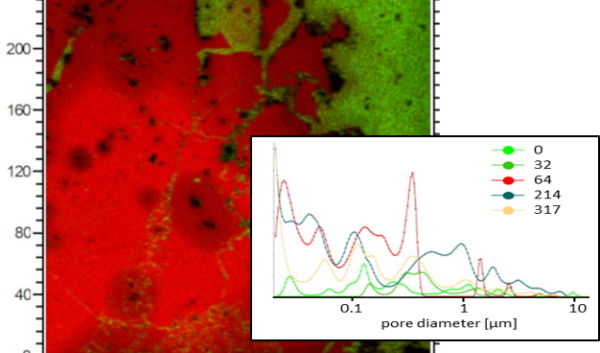
Pore Structure Determines Pathways of Rock Alteration