Versatile Intense Triple-Axis Spectrometer
Mission Statement
Diffraction studies of structural and magnetic phase transitions or parametric studies of low-lying magnetic excitations in novel materials.
Instrument Description
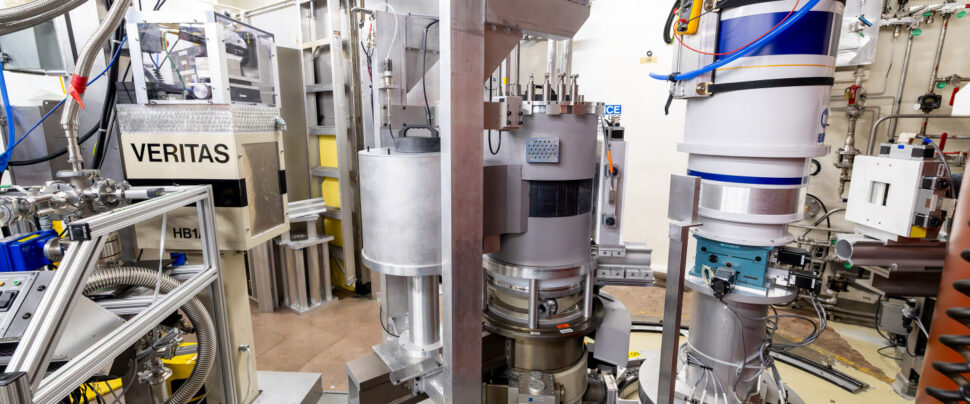
The VERITAS triple-axis spectrometer (HB-1A) at the High Flux Isotope Reactor operates at a fixed incident energy of Ei = 14.5 meV (wavelength λ = 2.37 Å) by employing a double-bounce pyrolytic graphite monochromator system. The first monochromator is flat, while the second monochromator is fixed vertically focused. A highly-oriented pyrolytic graphite filter is placed after each monochromator to reduce λ/2 contamination (~0.01%). This configuration gives VERITAS an intense, clean monochromatic beam nearly free of higher-order contamination neutrons. The double-bounce monochromator system, combined with an analyzer for energy discrimination, ensures that the instrument has a low background and an excellent signal-to-noise ratio. The instrument also utilities a four-circle goniometer option which allows data collection in extended reciprocal space for investigating magnetic orders and determining magnetic structures. The instrument is well-suited for investigating the magntic properties of quantum materials, and particularly useful in probing weak scattering signals from single crystals, powders and thin films, covering a wide variety of sample environments, including high-temperature furnaces (≤ 1500°C), ultra-low temperature cryostats (≥ 0.03K), vertical field cryomagnets (≤ 6T), pressure cells (≤ 2GPa), electric field sticks (≤ 10kV), and uniaxial pressure stick (force up to 300 lbs).
Applications
VERITAS serves the condensed matter and materials science communities. The instrument is primarily used for diffraction study of the magnetic properties of bulk/thin film materials, including the following:
- Quantum materials
- High-Tc superconducting materials
- Frustrated magnets
- Multifunctional materials
- Topological materials
VERITAS is also optimized for parametric study of low-lying magnetic excitations (up to ~ 9 meV).
Specifications
| Beam Spectrum | Thermal |
| Monochromator | PG(002), double-bounce monochromator system |
| M1 is flat, M2 is fixed vertically focused | |
| Monochromator angle | 2Θ M = 41.3° Ei ≈ 14.5 meV |
| Analyzers | PG(002), fixed vertically focused |
| Sample angles | ±180° |
| Scattering angle | -5 to 130° |
| Analyzer angles | -60° < 2ΘA < 120° |
| Detector | Single 3He gas counter |
| Collimations | Premonochromator: 40′ Monochromator-sample: 20′, 40′ Sample-analyzer: 20′, 40′ Analyzer-detector: 20′, 80′ |
| Filters | Sapphire pre-monochromator 2 pyrolytic graphite filters each mounted after M1 and M2, respectively (λ/2 ≈ 10-4 λ) |
| Flux at sample | ~4.2 × 10⁷ n/cm2/s |
| Momentum range | 0.2 to 4.8 Å-1 (elastic configuration) |
VERITAS Instrument Team
Please select link below to email the instrument team. Be sure to include your name and email address.
Information for VERITAS Users
Shipping your samples:
Please visit the ORNL User Facilities Sample Handling and Shipping page for the correct shipping addresses.
Access to VERITAS data:
All data can be accessed through ONCat or the analysis cluster.
Sample Environments:
A list of equipment available at VERITAS can be found in the Sample Environment Equipment Database. The database contains detailed equipment specifications and images, drawings and other related documents.
Planning for your experiment:
Scheduling your experiment:
Once you are notified of an approved proposal, please update your impossible dates in IPTS as soon as possible to ensure that they are accommodated in our instrument schedule.
Note that there may be limited scheduling flexibility for your VERITAS experiments requesting the use of extreme sample environment (e.g. cryostats, cryomagnets, ultra-low temperature inserts) due to our sample environment block scheduling system.
Sample preparation: single crystal pre-alignment
If you need to pre-align your single crystal samples using the neutron alignment station (CG-1B) or the Laue machine at SNS before your VERITAS experiment begins, please email the VERITAS instrument team well in advance so alignment time can be reserved for you on the appropriate instrument. Note that we have a first come, first served scheduling system for CG-1B. Also, please let the VERITAS instrument team know if you are experienced with sample alignments or if you will require significant assistance.
Acknowledgement Statement for User Publications:
Intent to publish: As a condition for performing nonproprietary research, the US Department of Energy requires users to publish results from their research. Authorship of publications based on research from these facilities should reflect the normal considerations of recognizing collaborations. It is also important to take into account the considerable efforts of the instrument scientists in their role of designing, constructing, and/or operating the instrument and related facilities. Results are typically published in peer-reviewed journals, proceedings, or presentations at technical conferences. Proprietary users are not required to publish.
Credit line: Research should be published acknowledging ORNL and the facility, or facilities, with this required statement:
This research [or, A portion of this research] used resources at the High Flux Isotope Reactor [and/or Spallation Neutron Source, as appropriate], a DOE Office of Science User Facility operated by the Oak Ridge National Laboratory. [If applicable: The beam time was allocated to [Instrument] on proposal number IPTS-XXXXX.X.]
In addition, users are asked to credit the instrument(s) used in the body of the paper.
Contribute to Our Publication Records: Please submit publications, theses, patents, etc., via the Publications Portal to help us track instrument publications. Both the credit statement and PuSH link are on the Neutron Sciences Publications website.
Links Related to Neutron Scattering and Crystallography:
Neutron scattering lengths and cross sections: https://www.ncnr.nist.gov/resources/n-lengths/
Calculate absorption, basic activation calculation: http://www.ncnr.nist.gov/resources/activation/
Inorganic Crystallographic Structure Database (ICSD): https://icsd.fiz-karlsruhe.de/search/basic.xhtml
Capabilities of the VERITAS Instrument
VERITAS is primarily used for performing parametric studies of magnetic order, exploring critical behavior, determining magnetic structures, and mapping out phase diagrams in single crystals and antiferromagnetic thin films. Unlike conventional diffractometers, the use of a double-bounce monochromator system and an analyzer with energy discrimination supress the background and provide an excellent signal-to-noise ratio for VERITAS. This instrument also features a high flux, clean beam free of higher-order wavelength contamination, and wide array of available sample environments. It is optimized for investigating the magnetic properties of quantum materials and it is a particularly good instrument for studying weak scattering signals in small single crystals and antiferromagnetic thin films. Recently, a four-circle goniometer option was added to the instrument program and it can be used for both parametric studies and magnetic structure determination of single crystals.
The following examples highlight the capabilities of VERITAS:
- Investigating magnetic order in topological materials• “Large Topological Hall Effect and Spiral Magnetic Order in the Weyl Semimetal SmAlSi“, Physical Review X 13, 011035 (2023).• “Thermal cycling induced alteration of the stacking order and spin-flip in the room temperature van der Waals magnet Fe5GeTe2“, Physical Review Materials 7, 044411 (2023).
- Parametric studies of antiferromagnetic thin films• “Direct neutron-diffraction-based measurement of magnetic order in brownmillerite SrCoO2.5 and La0.5 Sr0.5CoO2.5 thin films”, APL Materials 12, 4, 041123 (2024).• “Electronic and magnetic properties of hole-doped topological kagome Fe1-xMnxSn thin films”, Physical Review Materials 9, 074201 (2025).
- Probing complex magnetic order and spin textures in quantum materials• New insight into tuning magnetic phases of RMn, npj Quantum Materials 9, 42 (2024).• “EuAuSb: An odd-parity helical variation of altermagnetism“, Physical Review B 112, 094455 (2025).
- Combined elastic and inelastic study on a high-temperature superconductor • “Tilted stripes origin in La1.88Sr0.12CuO4 revealed by anisotropic next-nearest neighbor hopping”, Communications Physics, 7, 257 (2024).
VERITAS Sample Environments
VERITAS can accommodate a wide variety of sample environments. For more information, please visit the Sample Environment Equipment Database. The database contains detailed equipment specifications, images, drawings and other related documents
Temperature Control Devices
- Closed Cycle Refrigerator – Bottom Loading (4 – 300K)
- Closed Cycle Refrigerator – Top Loading (4 – 750K)
- Liquid Helium Cryostat (1.5 – 300K)
- 3He-insert (0.3 – 300K)
- Dilution Fridge (0.03 – 300K)
- Furnace (Room temperature – 1500 °C, 303 – 1773 K)
Temperature Control Device for four-circle:
- Closed Cycle Refrigerator: 4 – 450 K
Magnet System
- 6T vertical field cryomagnet (0 – 6 T, with temperature ranges 1.5 – 300 K, 0.3 – 300 K with 3He-insert, or 0.03 – 300 K with dilution fridge insert)
High Pressure
For detailed information, please visit the high-pressure sample environment page https://dev-neutrons.pantheonsite.io/high-pressure-and-gas-handling/home.
Hydrostatic pressure:
-
- Clamp & gas pressure cells (£ 2 GPa)
In-situ uniaxial pressure:
-
- Compressive force up to 300 lbs (1.5 – 300 K, 0 – 6 T)
Custom Sample Environments
Additional custom sample environments (e.g. current, elelctric field, uniaxial strain cell, etc.) can be accommodated on VERITAS. Users are strongly encouraged to discuss experiment needs with the VERITAS instrument team before requesting custom sample environments for their proposals.