Fine-Resolution Fermi Chopper Spectrometer
Mission Statement
Studying dynamic processes in novel systems
Instrument Description
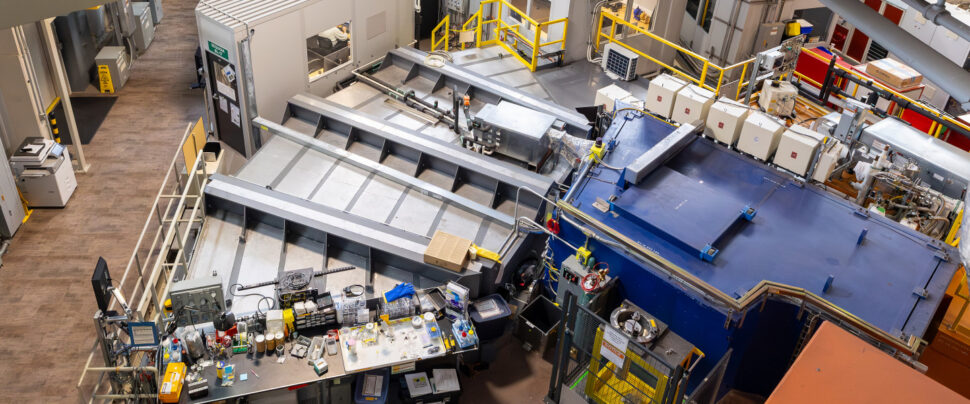
SEQUOIA is a direct geometry time-of-flight chopper spectrometer with fine energy transfer (ω) and wave-vector (Q) resolution capabilities used for forefront research on dynamical processes in materials. In particular, SEQUOIA allows for unprecedented high-resolution inelastic neutron scattering studies of magnetic excitations and lattice vibrations.
Applications
Condensed matter and materials science experiments cover a wide cross-section of important research areas such as the following:
- strongly correlated electrons systems
- high-temperature superconductors
- colossal magnetoresistive materials
- quantum and molecular magnetism
- itinerant magnets and multilayers
- ferroelectric, piezoelectric, and thermoelectric materials
- soft condensed matter
- alloys
SEQUOIA’s flexibility has been advantageous when measuring systems that have never been examined with inelastic neutron scattering techniques. SEQUOIA complements the other main thermal to epithermal SNS chopper spectrometer, ARCS. In general, SEQUOIA is the instrument of choice for experiments that require high Q and ω resolution and large solid angle coverage at low-to-intermediate scattering angles.
To meet the technical requirements of fine resolution in both ω and Q, SEQUOIA has a 5.5 m flight path from the sample to detector bank. This detector bank currently covers scattering angles from -30 to 60° in the horizontal and from -18 to 18° in the vertical in increments of ≈0.3°. Therefore the total solid angle coverage is .863 steradians. To optimize the flux on sample in this high-resolution configuration, the moderator-to-sample distance is as short as possible (i.e., 20 m). SEQUOIA uses the full source spectrum provided by the decoupled water moderator and can therefore be used to study excitations on energy scales ranging from a few millielectron volts up to several electron volts.
A supermirror neutron guide is included on the instrument to further enhance the flux of thermal neutrons on the sample.
Specifications
| Source-sample distance | 20.0 m |
| Mean sample-detector distance | 5.53 m |
| Angular coverage | Horizontally -30 to 60 deg. Vertically: +/- 18 |
| Range of energy resolution | 1–5% Ei |
| Typical incident energy range | 8-2000 meV |
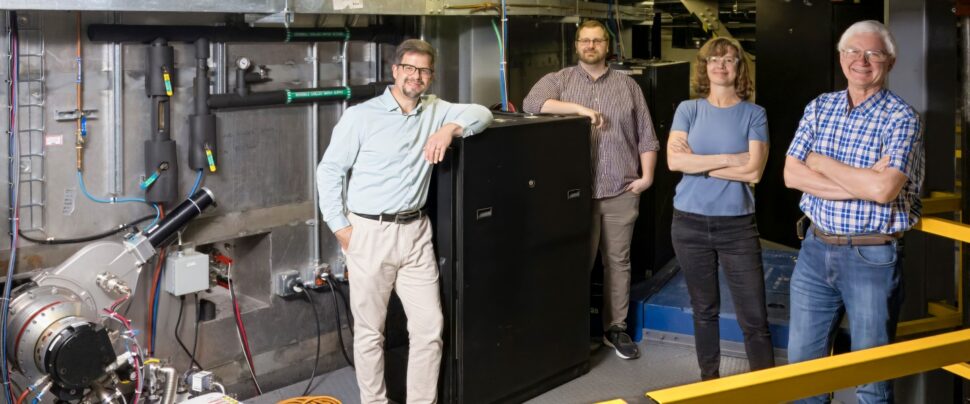
SEQUOIA Instrument Team
Please select link below to email the instrument team. Be sure to include your name and email address.
User Guidance
Announcements
Please feel free to contact instrument scientists regarding your proposal.
Become a SEQUOIA User
Please examine Become a User for information on how to become a SEQUOIA user.
Shipping Addresses for Samples
Please visit the ORNL User Facilities Sample Handling and Shipping page.
Quick Start Guides for Sample Changes and PPS
We do not often allow users to change their own samples.
Data Reduction and Analysis
SEQUOIA uses an autoreduction procedure. If your data needs to be manually reduced, please consult with your local contact.
How to access SEQUOIA data
Help information is available for those with internal access
- Create an ORNL Resource account (if you don’t already have one) at the ORNL Guest Portal.
- You can then login to our analysis cluster by clicking on Launch Session in https://analysis.sns.gov. Login credentials will be the same as XCAMS. You can also install ThinLinc client on your local machine. Step by step instructions are provide in the document POWGEN Experiment Guide: A-Z.
- Once you login under your home directory you will see the following folder structure/data/SNS/SEQ/IPTS-#/. All the run numbers will appear for your data. Data is automatically reduced .nxs and .nxspe files using the default parameters. Those data can be found in the/shared/autoreduce folder and subdirectories therof. If you fail to see the IPTS-# folder then try /SNS/SEQ/IPTS-#/shared/autoreduce. This is the real location of the file whereas the first one is a symlink.
- You can of course re reduce data with other binning values using mantidplot. Please consult with your local contact if you need further information
- Secure ftp or secure shell will allow you to get the data onto your local drive. Select one of the programs below to download: http://winscp.net/eng/download.php or http://cyberduck.io/
- Enter the following information to connect to the analysis computers:
Host: analysis.sns.gov
Username and password
Port: 22
A summary file called with the file extension of .csv can be found in the /SNS/SEQ/IPTS-xxxxx/shared/autoreduce folder which is also where the data is stored (where xxxxx need to be replace by your IPTS #).
Publishing Your Experiment Results
Users must credit ORNL in all publications resulting from experiments performed at these facilities. In addition, publications, papers, patents, honors and awards, and their citations must be reported to the User Office to assist the facilities in recording the contributions of its users. Each facility (HFIR or SNS or both) must be acknowledged with this statement:
“[A portion of] This research at Oak Ridge National Laboratory’s High Flux Isotope Reactor [and/or Spallation Neutron Source, as appropriate] was sponsored by the U.S. Department of Energy, Office of Basic Energy Sciences.”
Additionally, we request the citation of a SEQUOIA instrument paper in any peer-reviewed journal publication:
Granroth G.E., Kolesnikov A.I., Sherline T.E., Clancy J.P., Ross K.A., Ruff J.P., Gaulin B.D., Nagler S.E., “SEQUOIA: a newly operating chopper spectrometer at the SNS”, Journal of Physics: Conference Series, 251, 12058 (2010).
OR
Stone M.B., Niedziela J., Abernathy D.L., Debeer-Schmitt L.M., Ehlers G., Garlea V.O., Granroth G.E., Graves-Brook M., Kolesnikov A.I., Podlesnyak A.A., Winn B., “A comparison of four direct geometry time-of-flight spectrometers at the Spallation Neutron Source”, Review of Scientific Instruments, 85, 4, 045113 (2014).
Please enter publications including dissertations and theses in the Neutron Science Publications Systems. This ensures that the publication will appear on the SEQUOIA publications page.

Capabilities of the SEQUOIA Instrument
SEQUOIA is a direct geometry time-of-flight chopper spectrometer with fine energy transfer (ω) and wave-vector (Q) resolution. The instrument is used to conduct forefront research on dynamical processes in materials. In particular, SEQUOIA is enabling unprecedented high-resolution inelastic neutron scattering studies of magnetic excitations and fluctuations and lattice vibrations. The impact on condensed matter, materials science, and geology spans a cross-section of important research areas. These include unconventional superconductors, quantum magnetism, itinerant magnets, ferroelectrics, thermoelectrics, multiferroics, metal hydrides, and hydrogen dynamics in various materials.
SEQUOIA is also an outstanding tool for the investigation of novel systems and materials that are currently unknown. In general, SEQUOIA is the instrument of choice for experiments that require fine Q and ω resolution and large solid angle at low-to-intermediate scattering angles. References [1-2] provide further information regarding the design and operation of the SEQUOIA spectrometer.
[1] G. E. Granroth, A. I. Kolesnikov, T. E. Sherline, J. P. Clancy, K. A. Ross, J. P. C. Ruff, B. D. Gaulin, S. E. Nagler, “SEQUOIA: a newly operating chopper spectrometer at the SNS”, Journal of Physics: Conference Series 251, 12058 (2010).
[2] M. B. Stone, J. L. Niedziela, D. L. Abernathy, L. DeBeer-Schmitt, G. Ehlers, O. Garlea, G. E. Granroth, M. Graves-Brook, A. I. Kolesnikov, A. Podlesnyak, and B. Winn, “A comparison of four direct geometry time-of-flight spectrometers at the Spallation Neutron Source”, Rev. Sci. Instrum. 85, 045113 (2014).
Operating Parameters
| Recommended Incident Energy Ranges | 5 meV-11 meV, 18 meV-4000 meV |
| Routine Energy Resolution | For Ei < 200 meV ~2%, 5% or 10% For Ei > 200 meV ~5-10% For Ei ~ 1000 meV ~3% with 1eV fine chopper |
Several measurements illustrate some of the capabilities of SEQUOIA
- Spectroscopy on magnetic powders can be used to identify gaps and modes in the magnetic excitation spectrum. Fermi chopper 2 was used with an Ei = 60 meV in a 2% resolution condition to measure the Unconventional Spin-Peierls system TiOBr. This measurement not only determined the singlet-triplet Energy gap but also identified two triplet excitations. Further details are provided in J. P. Clancy, B. D. Gaulin, C. P. Adams, G. E. Granroth, A. I. Kolesnikov, T. E. Sherline, and F. C. Chou, “Singlet-Triplet Excitations in the Unconventional Spin-Peierls TiOBr Compound”, Phys. Rev. Lett. 106, 117401 (2011).
- Spectroscopy can be used to refine Hydrogen positions and their environments in many materials. Specifically SEQUOIA was used to identify the H environment in Mica from a pegmatite. These studies help to understand the diversity in natural mica that arises from varied H content. L’ubomír Smrčok, Milan Rieder, Alexander I. Kolesnikov, and Garrett E. Granroth, “Combined inelastic neutron scattering and solid-state density functional theory study of dynamics of hydrogen atoms in muscovite 2M1”, American Mineralogist, 96, 301 (2011).
- There is a diversity Hydrogen containing systems that can be studied on SEQUOIA. Metal Hydrides is another class of materials that is of interest. The phonon density of states of MgH2 has been measured. The single phonon features were identified and compared to Density Functional Theory calculations to determine the environment around the H. A.I. Kolesnikov, V.E. Antonov, V.S. Efimchenko, G. Granroth, S.N. Klyamkin, A.V. Levchenko, M.K. Sakharov, Y. Ren, J. All. Com., 10 156 (2010).
- On Low dimensional systems, a single crystal can be oriented with the irrelevant Q direction along the beam and magnetic excitations measured quite effectively. On SEQUOIA, Mn Doped BaFe2As2 was measured with the two dimensional planes perpendicular to the incident beam. This configuration reveals that spin fluctuations are induced at the (1/2,1/2) position in that plane. G. S. Tucker, D. K. Pratt, M. G. Kim, S. Ran, A. Thaler, G. E. Granroth, K. Marty, W. Tian, J. L. Zarestky, M. D. Lumsden, S. L. Bud’ko, P. C. Canfield, A. Kreyssig, A. I. Goldman, and R. J. McQueeney “Competition between stripe and checkerboard magnetic instabilities in Mn-doped BaFe2As2” arXiv:1206.3486v1 (2012).
- Rotation of a single crystal through a large angle allows a complete mapping of the Q-ω space. A single crystal of 160Gd has been measured in this manner. Specifically, the structure factor of the magnetic excitations has been measured in great detail and analysis is underway to determine what role the itinerant moment affects the excitations. Scheie A., et al., “Dirac Magnons, Nodal Lines, and Nodal Plane in Elemental Gadolinium”, Physical Review Letters, 128, 097201 (2022). Scheie A., et al., “Spin-exchange Hamiltonian and topological degeneracies in elemental gadolinium”, Physical Review B, 105, 104402 (2022)
- With careful thought more than a single incident energy can be used on SEQUOIA to measure multiple resolution conditions simultaneously. A Single Crystal of KCuF3 was measured with several incident energies allowing the full bandwidth and the absence of a spin gap to be observed. G. E. Granroth, “Advances in Neutron Spectroscopy and High Magnetic Field Instrumentation for Studies of Correlated Electron Systems”, J. Phys. Soc. Jpn. 80, SB016 (2011).
- On SEQUOIA neutrons are available from 5 meV up to 4 eV. The upper end of this energy range is illustrated by recoil measurements on water. Many of the interesting behaviors of water, (super cooled, super critical, in or on nano particles, etc.) are measured on SEQUOIA and the resultant data is under analysis. However a measurement of the recoil that shows the upper energy range of SEQUOIA is shown in C. Andreani, “Supercooled water researcher finds Sequoia’s power ‘amazing’”, Notiziario Neutroni e Luce di Sincrotrone 16, 2 (2011).
SEQUOIA Mail-in Program
Mail-In Program Overview
- Mail-in proposals for SEQUOIA may be submitted at any time and are reviewed as they are received.
- Measurements will be allocated time on a first-come/first-served basis up to the maximum amount of mail-in time available for a given cycle.
- Mail-in proposals will be evaluated for conflicts with other active proposals at the ORNL neutron scattering facilities.
- An experimental status report or a publication reference regarding prior mail-in measurements at SEQUOIA is required before a 2nd mail-in proposal will be approved from the same research group.
- The requested beamtime per proposal can be in 8 hour increments up to 24 hours total.
- A proposal may request up to 3 samples be measured. Empty sample can measurements count toward the three samples.
- Users may specify temperatures between 5 K and 320 K, measurement times per sample, and standard configurations of the instrument (i.e. high flux or high resolution mode for a given incident energy) for each measurement.
- Sample cooling and warming times are included in the allotted beamtime.
- Monochromatic vanadium measurements for absolute unit normalization are not routinely performed as part of the mail-in program.
- Sample cans may be requested to be sent to the users for filling and sealing, or sample cans can be filled by NSD staff at ORNL. Users will be given the choice of several standard sample can sizes and geometries for their measurement.
- Mail-in experiments will not be scheduled until sample shipment is arranged with the SEQUOIA team.
- All shipment requirements of the general user program also apply to the SEQUOIA mail-in program.
- Mail-in proposals must include a single page written proposal. The SEQUOIA mail-in proposal template is available at the bottom of the SEQUOIA mail-in webpage. Proposals are submitted via IPTS. A measurement planning spreadsheet is also available at the bottom of the SEQUOIA mail-in webpage. The measurement plan spreadsheet is submitted to the instrument team upon request after the mail-in proposal is approved.
- Users will be told of the approximate date for the measurement. Due to the mail-in nature of the experiment, users will not be guaranteed the ability to modify the experiment plan during the measurement. Mail-in Users will not be given the ability to control the instrument remotely.
- Data will be reduced following standard data reduction protocol. Data files to be made available are nxs files and nxspe files (powder averaged, 0.5 degree binning with 0.5% of Ei energy bins). Auto-reduced data will be available during or immediately after the measurement is completed via standard user data access routes.
- Submit your proposal using the IPTS system and choosing the “Mail-in” proposal type.
Click on the link below for further information regarding the user program at the ORNL neutron scattering facilties