Powder Diffractometer

Mission Statement
POWGEN is a high-resolution neutron powder diffractometer that enables characterization of the crystal, magnetic and local structure of novel polycrystalline materials.
Instrument Description
POWGEN is a general-purpose powder diffractometer useful for a wide range of structural studies. It can cover d-spacings from ~0.1 Å to 8 Å in a single measurement, ideal for both traditional Rietveld data and PDF measurements with longer collection times. It can also cover long d-spacings up to ~ 38 Å, powerful for studying magnetic order. Rietveld measurements for standard neutron-size samples (0.3-3cc) can be completed in ~ 1 or 2 hours with <0.1% resolution at short d-spacings and <2.5% resolution for nearly all d-spacings of interest. Alternatively, much of this resolution can be traded for intensity, making it possible to take shorter measurements while still maintaining good resolution. It is also possible to collect data from much smaller samples with longer collection time. The adjustable bandwidth-limiting choppers allow for large variations in the incident wavelengths and pulse repetition rate. Interchangeable guide sections and the ability to trade resolution for intensity at the analysis stage allow users great latitude to optimize the data range, resolution, and statistical precision for each experiment.
Applications
Scientific studies at this instrument encompass a wide range of novel materials. These include, but are not limited to, structural studies of energy storage materials such as battery materials, ceramic membranes for solid oxide fuel cells and oxygen sensors, hydrogen storage materials, high-entropy alloys and thermoelectric materials. Fast data collection allows looking at in situ processes (e.g. solid-state synthesis, redox reactions and gas-solid interactions). Long d-spacing coverage enables the study of magnetic materials such as magnetic semimetals, multiferroics, high-Tc superconductors, charge and orbital ordering transitions, magnetocaloric materials, and molecular magnets. The availability of magnetic field capabilities allows the study of field-induced structural and magnetic transitions. POWGEN capabilities can contribute to understanding materials such as zeolite and aluminophosphate frameworks; metals and semiconductors; dielectrics, ferroelectrics; metal-organic frameworks (MOFs), and ab initio structure solutions of complex polycrystalline materials.
Specifications
| Moderator | Decoupled poison supercritical H2 |
| Source-to-sample distance | 60 m |
| Sample-to-detector distance | 2.5-4.7 m |
| Flight Path | 44m straight guide followed by 6m interchangeable High Resolution or High Intensity sections. |
| Detector angular coverage | 10° < 2Θ < 170° |
| Solid angle detector coverage | 1.2 steradians (12 m2) |
| Bandwidth | 1Å (tunable incident wavelength from 0.533 Å -4.797 Å) |
| Frame 1 | (CWL: 0.8 Å) d coverage of 0.1 – 8 Å |
| Frame 2 | (CWL: 1.5 Å) d coverage of 0.5 – 12.5 Å |
| Frame 3 | (CWL: 2.665 Å) d coverage of 1 – 20.5 Å |
| Frame 4 (non-standard) | (CWL: 4.797 Å) d coverage of 2.2 – 38 Å |
| Resolution | 0.0008 < ∆d/d < 0.025 (in a single measurement) |
| Sample environment | Sample Changer: 10K-300K, 24 slots Orange Cryostat: 2K-300K Cryofurnace: 5K-500K or 30K-700K Gas Dosing: 5K-300K, 0-50bar Vacuum Furnace: RT-1200°C Gas-Flow AGES: RT-850°C (pO2 sensor + RGA) Slim SAM Magnet: 2K-300K and 0-5 T |
POWGEN Instrument Team
Please select link below to email the instrument team. Be sure to include your name and email address.
Contact the POWGEN Instrument Team


Useful Links for POWGEN Users
- Experiment Guide: A–Z
- Hutch Poster
- ADDIE (ADvanced DIffraction Environment) general and Powgen-specific tools for neutron scattering, including simulating Powgen diffraction patterns
- Monitor Webpage
- Rebuild paper Journal of Applied Crystallography, 52, 1189-1201 (2019)
- Original paper Zeitschrift fur Kristallographie, 1, 127-135 (2011)
- User Manual for Data Acquisition
- User Manual for Data Access
- User Manual for Mantid Workbench
Shipping Addresses for Samples
Please visit the ORNL User Facilities Sample Handling and Shipping page.
Quick Start Guides for Sample Changes and Shutter Operation
- Gas-flow furnace sample change
- Vacuum furnace sample change
- Janis cryofurnace with high temperature stick (30-750 K) sample change
- Janis cryofurnace with low temperature stick (5-500 K) sample change
- Orange cryostat sample change
- PAC sample changer loading
- Removing Samples from Beamline 11a
- Shutter operation
Data Reduction and Analysis by Run Cycle
Parameter files for GSAS-II, FullProf, Jana and TOPAS can be downloaded from the table below. Be sure to pick the correct cycle. These files are also stored in the /SNS/PG3/run_cycle_11A_CAL folder in the analysis computer where cycle is year_1 or year_2 based on cycle A or B.
Data Analysis Tutorials
- Mantid Tutorial – Finding Structural Change from Event Data
- FullProf Crystal Structure and Commensurate Magnetic Order
- GSAS-II joint X-ray/neutron refinement using 11BM and POWGEN data
- GSAS-II Crystal Structure and Commensurate Magnetic Order
- TOPAS refinement example
- Mag2Pol tutorial
Synchrotron Partnership
POWGEN has a partnership with beam line 11BM at the Advanced Photon Source where users can get x-ray data if they have an approved proposal at POWGEN. This option is not available for mail in proposals.

Sample Environment of the POWGEN Instrument
Sample Holders
Various sample holders are used for the sample environment equipment mentioned below. For photos and detailed information about materials and dimensions, please refer to the document Powgen sample cans.
Powgen Automatic Changer
The Powgen Automatic Changer (PAC) is the second generation sample changer that was developed for Powgen. The changer has a carousel that holds a maximum of 24 sample-filled vanadium cans, and data may be collected in a temperature range of 10 to 300 K. The cool down time from room temperature to 10 K is 30 minutes. The sample may be changed at 10 K, which takes about 1 hour.
Vacuum Furnace / Gas Insert
A traditional vacuum furnace built with vanadium heating elements is available for high-temperature measurements from room temperature to 1200°C. Cooling to 100°C takes approximately 4 hours. The vacuum level of the furnace is ~2 x 10⁻⁵ torr. The aluminum tail of the furnace has been modified with vanadium windows for the primary beam. Installing a niobium heating element increases the maximum temperature to 1600ºC; however, Q coverage is limited due to the Nb peaks observed in the back- and forward-scattering detectors.
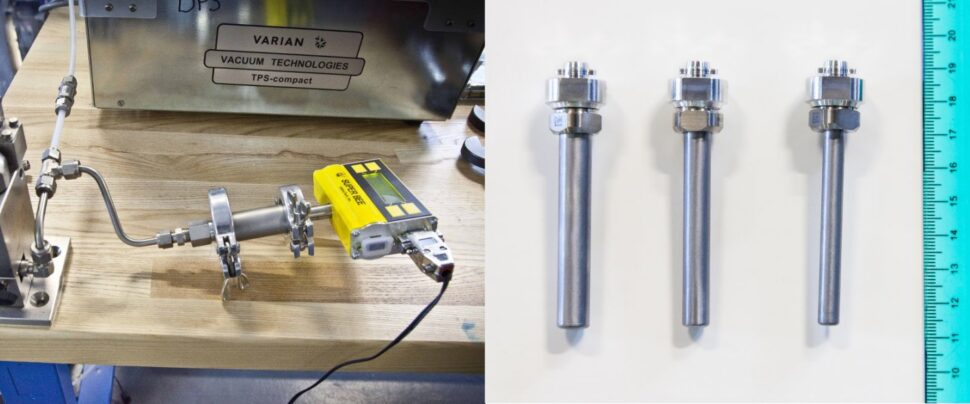
This furnace can also be configured to have a quartz insert that allows flow of various gas mixtures through the sample using the gas handling system. Approved gases include H2, CH4, CO, CO2, N2, Ar, He and O2. The sample is loaded in a quartz basket with frit at the bottom and quartz wool on top to allow flow of gas through the sample. The furnace is capable of heating up to 850°C with this insert.
Orange Cryostat
The orange cryostat is a standard 50 mm bore cryostat with modified tails similar to the vacuum furnace to eliminate aluminum in the path of the primary neutron beam. The temperature range is 2 to 300 K.
Cryofurnace
The Janis cryofurnace is a top loading CCR with three different stick setups. The cold stick has a temperature range of 5 to 500 K, while the hot stick can go from 30 to 750 K. The gas loading stick and panel allow controlled dosing of different gases into the sample.
MAG-08 (7T Magnet)
MAG-08 is a 7T vertical magnet with a cryo-stick with a temperature range of 2 to 300K. This magnet has a vanadium tail for clean neutron diffraction patterns without contamination from aluminum peaks.
POWGEN Mail-in Program
Mail-In Program Overview
- Proposals are accepted at any time.
- A number of days are reserved from the general user program each cycle.
- It is expected that samples are ready before the mail-in proposal is submitted.
- A maximum of 8 hours can be requested in each cycle.
- Temperatures between 10K and 300K can be requested but the total time cannot exceed 8 hours.
- Once approved, vanadium sample cans are sent to the users to be filled and returned to the SNS.
- Samples should be returned to SNS within two weeks of receiving the empty cans.
- Experiments are measured on a first-come, first-served basis.
Mail-In Proposal Process
- Make sure your samples are ready.
- Prepare your proposal, using the template provided below. You are limited to a total collection time of 8 hours and a temperature range of 10-300 K. Consider simulating Powgen data with ADDIE to plan your measurements. Please contact instrument staff if you have any questions.
- Submit your proposal through IPTS. Be sure to select Mail-In as the proposal type. Mail-in proposals are accepted at any time, independent of the semi-annual general user proposal call.
- If your proposal is accepted, you will receive an email with additional information, and empty sample cans will be sent to the address you specified in the proposal.
- Load your sample cans, according to the instructions linked below, and fill out the sample loading spreadsheet in IPTS.
- Ship the loaded samples back to the address listed on the Shipping Guidance page.
- Your samples will be measured at the first available opportunity, on a first-come, first-served basis.
- You will receive an email when data collection is complete. Follow the directions and linked guides on the Powgen User Guidance page to download and analyze your data.
- All publications resulting from your Powgen data must include the SNS acknowledgement and should be submitted to the PuSH publication tracking system.
- After 30 days, your samples will either be wasted or shipped back to you, based on what you requested in the proposal.