Neutron Powder Diffractometer
Mission Statement
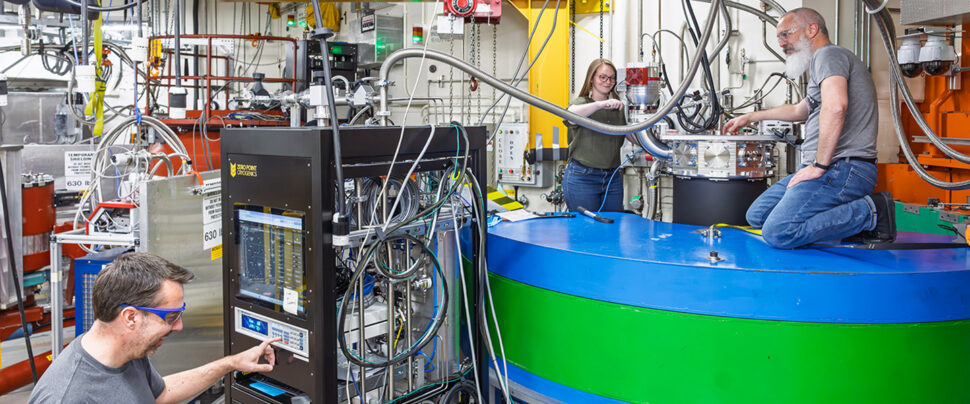
The Neutron Powder Diffractometer (HB-2A) a versatile instrument, able to examine a variety of materials. With low angular coverage and a clean background, HB-2A is particularly well-suited to studying new, complex, magnetically ordered systems. The use and development of extreme sample environments of temperature, magnetic field, and pressure allows the necessary wide area of phase space to be accessed to investigate novel phenomena in new materials.
Instrument Description
HB-2A conducts magnetic and crystal structural studies of powder samples as a function of intensive conditions from 0.03 – 1800 K, up to 6 T, and up to 2 GPa.
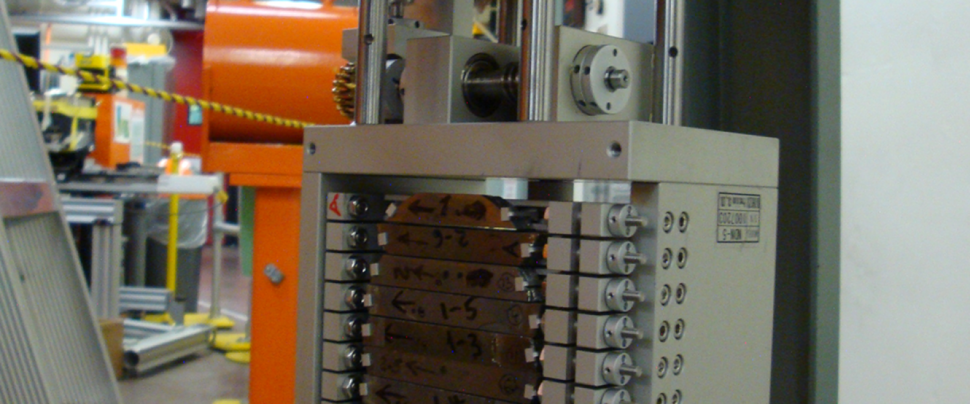
HB-2A has a Debye-Scherrer geometry. The moveable detector bank has 44 3He tubes with 12′ Soller collimators, spaced by ~2.5° in 2Θ. A germanium wafer-stack monochromator is vertically focusing and provides one of three principal wavelengths, depending on which reflection is in the diffracting condition: Ge(113) 2.41 Å, Ge(115) 1.54 Å, or Ge(117) 1.12 Å. The take-off angle from the monochromator is fixed at 90°, and the minimum peak full width at half maximum (FWHM) is 0.2°. There are two choices of premonochromator collimation (α1), which is open, 60; effective, and via three choices of presample collimation (α2 = 16′, 21′, or 31′).
The instrument can operate in polarized mode with the use of a polarizing supermirror V-cavity optimized for the 2.41 Å wavelength.
In addition to traditional crystal structural refinements, studies of phase transitions, thermal expansion, quantitative analysis, residual stress, and ab initio structure solution can be undertaken from the powder data.
Specifications
| Beam Spectrum | Thermal |
| Monochromator | Vertically focusing Germanium |
| Monochromator angle | 2Θm = 90° |
| Wavelengths | λ=1.54 Å, 2.41 Å, 1.12 Å |
| Scattering angles | 2° < 2Θ < 155° |
| Collimations (FWHM) | Premonochromator (α1): open (60′ effective) Monochromator – Sample (α2): 16′, 21′, or 31′ Sample – Detector (α3): 12′ |
| Detector Bank | 44 3He detectors |
| Beam Size | 50 × 25 mm2 at sample position |
| Resolution | 2 × 10⁻³ Δd/d |
HB-2A POWDER Instrument Team
Please select link below to email the instrument team. Be sure to include your name and email address.
Contact the POWDER Instrument Team
Clarina dela Cruz – POWDER Diffraction Group Lader
Stuart Calder – Instrument Scientist
Danielle Yahne – Instrument Scientist
Joe Paddison – Computational Instrument Scientist
Malcolm Cochran – Scientific Associate
Baral R.; Zhou H.D.; Zhang Q.; Frandsen B.A.; Calder S. “Local magnetic order in the vacancy-disrupted spin ice Ho2TiO5”, Physical Review B, 114, 204417, 2026
Xu M.; Boswell M.; Ding Q.; Peng C.; Sapkota A.; Zhang Q.; Yahne D.R.; Bud'ko S.L.; Furukawa Y.; Canfield P.C.; Ribeiro R.A.; Xie W. “Pressure-Stabilized MnSb2 with Complex Incommensurate Magnetic Order”, Journal of Physical Chemistry C, 130, 13036-13045, 2026
Yadav L.; Cheng Y.Q.; Doucet M. “Automated multiphase identification and refinement in powder diffraction using mismatch-tolerant machine learning”, APL Machine Learning, 4, 036114, 2026
Narayanan N.; Garlea V.O.; Mole R.A.; Winn B.L.; Sun D.; Ma X.; Hester J.R.; Liu Y.; McIntyre G.J.; Robinson R.A.; Cao S.; Yu D.H. “Cooperative spin coupling in PrFeO3”, Physical Review B, 114, 074426, 2026
O’Donnell S.; Regier C.E.; Mahatara S.; Mandujano H.C.; Rodriguez E.E.; Yahne D.R.; Lany S.; Bauers S.R.; Smaha R.W.; Neilson J.R. “Ferrimagnetic order in tetragonal antiperovskite Mn3GeN”, Physical Review Materials, 10, 074410, 2026
Aczel A.A.; Ortiz B.R.; Luo Y.; Pokharel G.; Sarte P.M.; Cruz C.D.; Liu J.; Sala G.; Wilson S.D.; Frandsen B.A.; Paddison J.A. “Influence of controlled disorder on the dipolar spin-ice state of Ho-based pyrochlores”, Physical Review B, 113, 214415, 2026
Xia H.; Liu Z.; Wu Y.; Sun Q.; Hayashi N.; Shen X.; Cao H.B.; dela Cruz C.; Yu R.; Yang Y.f.; Takano M.; Long Y.W. “Small Co-doping induced magnetic and electrical transitions in single crystal CaFe0.95Co0.05O3”, Physical Review B, 113, 214443, 2026
Gao F.; Dhale N.; Lin L.; Taddei K.M.; Zhang Y.; Cruz C.D.; Dagotto E.; Lv B. “Block-Type Antiferromagnetism in Single Chain Quasi-One-Dimensional K3Fe2Se4”, Physical Review Letters, 136, 256706, 2026

Information for HB-2A users
Instrument Overview: The papers “The high-resolution powder diffractometer at the high flux isotope reactor” and “Powder Suite” have the HB-2A (POWDER) instrument capabilities and specifications.
Preparing for your experiment: use the experiment simulator to see what your data will look like for different masses, counting times and sample holders.
Choose your sample holder:
| Al and Cu standard cans | Al and Cu Tip-Top cans | Vanadium standard cans |
|---|---|---|
| 4.8mm x 60mm | 4.8mm x 33mm | 6.0mm x 56mm |
| 6.3mm x 60mm | 6.3mm x 33mm | 7.6mm x 56mm |
| 8.8mm x 60mm | 8.8mm x 33mm | 9.2mm x 56mm |
| 15mm x 60mm | 15mm x 33mm |
For drawings of sample cans see: Standard and Tip-Top.
Other non-standard can options are available, such as annular cans and flat plates to mitigate absorption in highly neutron absorbing samples.
Check the sample absorption to choose the most suitable powder can dimensions: NCNR Neutron Attenuation and Activation Calculator
Samples can be easily loaded onsite. See Using the on-site sample can sealer
Running the experiment:
Reference guide for doing measurements at HB-2a
Live instrument display shows a current view of the instrument.
HB2A monintor shows all completed runs
Looking at the data:
All data is autoreduced and can be accessed through ONCat or the analysis cluster
Further details can be found in this guide: Accessing autoreduced data and combining data
Analyzing the data:
Basic analysis: Rietveld Refinement of HB-2A Data Using FullProf Software
Detailed Lecture Notes and Step-By-Step examples with data for Magnetic Strucutre Refinements can be found on the following workshop websites:
Magnetic structure determination examples (2022)
Lecture notes and examples from 2019 workshop
Lecture Notes (2016 workshop)
Shipping Samples: Full instructions can be found on ORNL User Facilities Sample Handling and Shipping.
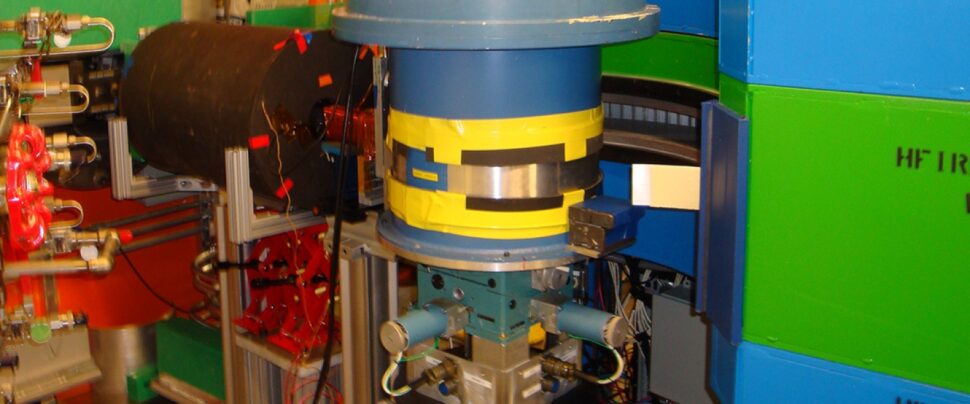
Sample Environment Capabilities: A list of equipment available at HB-2A can be found in the Sample Environment Equipment Database, this includes specifications and drawings. Ranges of current sample environment conditions are 30mK–1700 K, 0-6 Tesla, 0-2GPa (BeCu clamp cell) and 0-3kbar (Al-helium gas pressure cell). NOTE: All conditions are not attainable simultaneously, contact the instrument team for details.
SAMPLE CHANGERS:
| Condition | Number of samples |
| 0.05 – 300 K | 3 (will increase to 14) |
| 0.3 – 300 K | 14 |
| 1.5 – 300 K | 6 |
| 0-6 Tesla, 1.5-300 K | 3 |
Software Downloads for data analysis
- FullProf and GSAS-II are Rietveld refinement packages for determination of nuclear and magnetic structures.
- SaraH or newer website version – contains the user friendly magnetic structure analysis programs SARAh-Representational Analysis and SARAh-Refine. SARAh uses representational analysis to calculate ‘symmetry allowed magnetic structures’ that can then be directly utilized in Fullprof or GSAS.
- Bilbao Crystallographic Server – contains magnetic symmetry information, tutorials and examples.
- ISOTROPY – contains magnetic symmetry information, tutorials and examples.
Calibration Standards
Calibration for all wavelengths (Ge113 [2.41 A], Ge115 [1.54 A], and Ge117 [1.12 A]) and pre-sample collimator settings (IN = op_21_12, OUT = op_op_12):
| Cycle | Run dates | Calibration | Fullprof IRF | GSAS-II INSTPRM |
|---|---|---|---|---|
| 513 | 11/11/25 – 12/5/25 | Si | cycle513_FP.zip | cycle513_GSASII.zip |
| 512 | 09/16/25 – 10/31/25 | |||
| 511 | 02/18/25 – 03/14/25 | Si | cycle511_FP.zip | cycle511_GSASII.zip |
| 510 | 10/15/24 – 11/09/24 | Si + LaB6 | cycle510_FP.zip | cycle510_GSASII.zip |
| 509 | 09/03/24 – 09/28/24 | Si + LaB6 | cycle509_FP.zip | cycle509_GSASII.zip |
| 508 | 07/23/24 – 08/16/24 | Si + LaB6 | cycle508_FP.zip | cycle508_GSASII.zip |
| 507 | 06/11/24 – 07/05/24 | Si | cycle507_FP.zip | cycle507_GSASII.zip |
| 506 | 04/09/24 – 05/03/24 | Si + LaB6 | cycle506_FP.zip | cycle506_GSASII.zip |
| 505 | 02/27/24 – 03/22/24 | Si + LaB6 | cycle505_FP.zip | cycle505_GSASII.zip |
| 504 | 01/18/24 – 02/12/24 | Si + LaB6 | cycle504_FP.zip | cycle504_GSASII.zip |
| 503 | 08/29/23 – 08/11/23 | Si | cycle503_FP.zip | cycle503_GSASII.zip |
| 502 | 07/18/23 – 08/11/23 | Si | cycle502_FP.zip | cycle502_GSASII.zip |
| 501 | 05/23/23 – 06/16/23 | Si | cycle501_FP.zip | cycle501_GSASII.zip |
Example PCR file for Fullprof – Si Standard, cycle 507
Flourinert and Methanol-Ethanol
Calculation of Sample Absorption Correction: (mu) * (R)
Obtain mu [cm-1] using NCNR Neutron Attenuation and Activation Calculator
R is radius of powder can used for measurement, see List of available powder sample holders for sample can dimensions.
Acknowledgement Statement for User Publications
Intent to Publish: As a condition for performing nonproprietary research, the US Department of Energy requires users to publish results from their research. Authorship of publications based on research from these facilities should reflect the normal considerations of recognizing collaborations. It is also important to take into account the considerable efforts of the instrument scientists in their role of designing, constructing, and/or operating the instrument and related facilities. Results are typically published in peer-reviewed journals, proceedings, or presentations at technical conferences. Proprietary users are not required to publish.
Credit Line: All publications based on work done in whole, or in part, at the Spallation Neutron Source or the High Flux Isotope Reactor at Oak Ridge National Laboratory should acknowledge the facility (or facilities) with this required statement:
This research [or, A portion of this research] used resources at the High Flux Isotope Reactor [and/or Spallation Neutron Source, as appropriate], a DOE Office of Science User Facility operated by the Oak Ridge National Laboratory. [If applicable: The beam time was allocated to [Instrument] on proposal number IPTS-XXXXX.X.]
In addition, users are asked to credit the instrument(s) used in the body of the paper.
Contribute to Our Publication Records: After your results have been published submit the papers citation information via the Publications Portal.
Old and miscellaneous information not typically used anymore:
Old style powder cans: Sample preparation using powder cans
Graffiti – Old unsupported program that allowed the user to download HFIR data to their own computer and browse through the scans in the experiment.
Capabilities
The following techiques are available:
- Rietveld Refinement of magnetic and crystal structure
- Polarization measurements to determine local anisotropy (susceptiblity tensor) and weak net-magnetism
- Diffuse scattering analysis in real space (mPDF) and reciprocal space (spinvert)
Sample changer options:
| Condition | Number of samples |
| 0.05 – 300 K | 3 (will increase to 14) |
| 0.3 – 300 K | 14 |
| 1.5 – 300 K | 6 |
| 0-6 Tesla, 1.5-300 K | 3 |
Highlights from Research Conducted at POWDER (HB-2A)
Candidate Elastic Quantum Critical Point in LaCu6-xAux
A combination of neutron diffraction, x-ray diffraction, and heat capacity measurements in conjunction with first principles calculations were used to show that the LaCu6-xAux system hosts the first known example of an elastic quantum critical point. Neutron and x-ray diffraction measurements were performed to study the structural properties as a function of temperature and Au-composition. First principle calculations confirm that the phase transition is driven by an elastic instability and is independent of electronic properties. Heat capacity measurements indicate the presence of quantum fluctuations at the critical composition.
View the full presentation.
Slater Insulator discovered in a new Iridate Perovskite
The magnetism, structural behavior and resistivity change in SrIr1−xSnxO3 indicated this material was a Slater insulator. This is a rare insulator where the magnetism controls the conduction of electrons. The behavior can be controlled by altering the Sn content.
View the full presentation.
Melting of unexpected charge glassy state leads to a pressure induced metal-insulator transition
PbCrO3 shown to have Pb4+ and Pb2+ ions that form an unexpected charge glassy state, explaining a large volume collapse and metal-insulator transition.
View the full presentation.
Rare magnetic order and insulating behavior in a 4d oxide
A rare case of magnetic insulating behavior driven by spin-orbit coupling is revealed in the 4d oxide Sr4RhO6.
View the full presentation.
Melting of unexpected charge glassy state leads to a pressure induced metal-insulator transition
Applying pressure causes a dramatic volume collapse accompanied by a insulator to metal transition. This is revealed as being due to a melting of a charge glassy state that results in an intermetallic charge transfer. This change was found to alter the valence in the material from Pb2+0.5Pb4+Cr3+O3 to Pb2+Cr4+O3. This valence change occurs since Pb is a so-called valence skipper, i.e. it goes directly from 2+ to 4+ and cannot form a 3+ state. This characteristic is utilized in lead batteries.
View the full presentation.
New multiferroic material with a surprisingly highly symmetric crystal structure
Neutron diffraction reveals cubic nuclear structure of LaMn3Cr4O12 hosting the G-type AFM structure of the Cr and Mn sublattice with spin orientation along the [111] direction that lacks an inversion center. The magnetism occurs concurrently with the onset of ferroelectric polarization and is enhanced by the application of a magnetic field.
View the full presentation.
Correlation of anisotropy and directional conduction in β-Li3PS4 fast Li+ conductor
Neutron and X-ray diffrac3ons determine the stability of β-Li3PS4 and the anisotropic thermal expansion with its structural origin from Li+ channels.
View the full presentation.
Neutrons Provide Insight into a New Approach to Tune Magnetic and Electronic Properties with Chemical Doping
Neutron studies were used to reveal a complex magnetic phase diagram of Cr2(Te1−xWx)O6 systems. While compounds with different x values possess the same crystal structure, they display different magnetic structures below and above xc = 0.7, where both the transition temperature TN and sublattice magnetization (Ms) reach a minimum.
View the full presentation.
Neutrons Provide Insights into Magnetic Structures of New Frustrated Compounds
Neutron diffraction studies under applied fields were used to reveal the complex magnetic phase diagram of two new members of the frustrated triangular lattice type with XY-anisotropy.
View the full presentation.
Biennial Magnetic Structure Determination from Neutron Diffraction Data Workshop
The workshop’s aim was to enhance the community studying magnetism in materials by learning from experts, the essential theoretical foundations to magnetic representation analysis and work through real examples to gain experience in solving and refining magnetic structures from neutron powder and single crystal diffraction measured from both reactor and spallation sources.
View the full presentation.
Instrumentation Upgrades
The HFIR HB-2A powder diffractometer has undergone two important upgrades that enhance its efficiency, boost its performance, and further improve the ALARA practice.
View the full presentation.
New collimators and improved efficiency of HB-2A Powder Diffractometer
During the HFIR outage engineers, technicians and instrument staff worked to replace the 44 pre-detector collimators on HB-2A. Commissioning measurements have confirmed an intensity increase of 2.6 with a signal to noise efficiency increase of 1.5.
View the full presentation.
Synthesis and Structure of Novel Battery Materials
Lithium transition metal fluorophosphates with a tavorite structure have been recognized as promising electrode materials for lithium-ion batteries because of their good energy storage capacity combined with electrochemical and thermal stability.
View the full presentation.
Magnetically driven metal to insulator transition
Experimental demonstration of a novel pathway to transform a materials conducting properties first predicted 60 years ago, with the unique insulting state existing at room temperature.
View the full presentation.
Neutron Powder Diffraction of Piezoelectric Ceramics at HB2A
Piezoelectrics are a huge industry and their uses will expand if solutions can be found for a few limiting issues. Jennifer Forrester, a researcher at the University of Florida, and Krishna Nittala, a Ph.D. candidate at the university, used the Neutron Powder Diffractometer (NPD, at HB-2A) at HFIR to explore the structure and characteristics of piezoelectric ceramics that might lead to improved applications. Forrester used the NPD to examine crystal structures of lead-free piezoelectric ceramics with the aim of creating materials that can take more deformation and demonstrate improved properties. A limitation of currently used piezoelectrics is that at high temperatures they shift to a cubic structure, losing their piezoelectric properties. Nittala examined samples of piezoelectric materials at gradually increasing temperatures as part of an effort to develop materials with higher transition temperatures. The current temperature limit for piezoelectrics is around 400°C. He examined samples at temperatures ranging from room temperature to 600°C using the ILL vacuum furnace on HB2a. Their results have been published in APL and JACS.
View the full presentation.
Tuning thermoelectric materials at the atomic level, guest-host interactions are important
The clathrate-type semiconductor, Ba8AlxSi46-x, provides a controlled system to explore the role of the interactions between the guest atoms, barium in this case, and the host atoms, Al and Si, because the Al-content can be varied over a large range. We have used neutron diffraction to explore the detailed structural changes of the crystal structure of Ba8AlxSi46-x as a function of Al content using the HB-2A Neutron Powder Diffractometer at the High Flux Isotope Reactor, Oak Ridge National Laboratory.
View the full presentation.
Neutron Study Reveals New Magnetic Structure in NaMnGe2O6 Pyroxene
This work completes the study of the evolutionof magnetic properties of the alkali-metal pyroxenes as a function of the d-orbital occupancy from d1 to d5 and reveals a new magnetic structure in NaMnGe2O6.
View the full presentation.
Polarized neutron diffraction experiments now possible at the HB2A Powder diffractometer
Polarized neutrons were further used to precisely measure the magnitude of the ordered magnetic moment in an itinerant ferromagnet. The difference scattering from neutron beam polarized parallel and antiparallel to the applied magnetic field gives an improvement of nearly one order of magnitude in detection sensitivity.
View the full presentation.
Magnetic order and ice rules in the multiferroic spinel FeV2O4
Neutron diffraction study done at HB2A of FeV2O4, which is rare in exhibiting spin and orbital degrees of freedom on both cation sublattices of the spinel structure. Showing that the direction of ordered vanadium spins at low temperature obey “ice rules” more commonly associated with the frustrated rare-earth pyrochlore systems.
View the full presentation.
Phase stability of Li(Fe1-xMnx)BO3 battery materials
In situ determination of temperatures of melting and phase change in the Li(Mn/Fe)BO3 class of emerging high-capacity (220 mAh/g) Li-ion battery cathode materials.
View the full presentation.
Successive Magnetic Phase Transitions and Multiferroicity in S = 1Triangular-Lattice Antiferromagnet Ba3NiNb2O9
The studies on Ba3NiNb2O9 reveal that (i) it is a new S = 1TLAF system showing two magnetic phase transitions bracketing an intermediate up-up-down phase; (ii) it is a multiferroic system with ferroelectric ground states stabilized at all three magnetic phases.
View the full presentation.
Related Research Highlights

December 14, 2024
ZnH-MOF Enables Hot CO2 Capture Relevant to Industrial Processes

October 21, 2024
Spin Dynamics of the Skyrmion Magnet GdRu2Si2

November 22, 2022
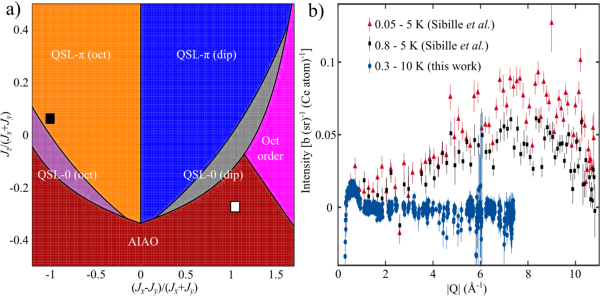
The Fourth Ferroic Order: Hunting Ferrotoroidicity in Energy Materials
February 23, 2020
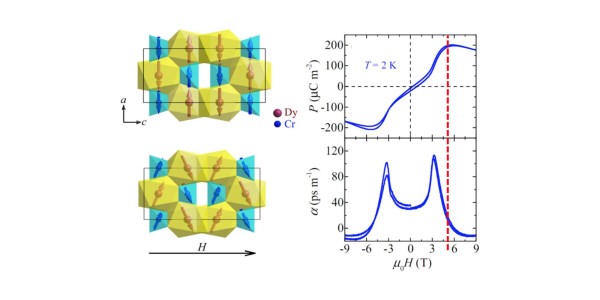
Large Linear Magnetoelectric Effect in DyCrO4