Nanoscale-Ordered Materials Diffractometer

Mission Statement
Study of a large variety of samples ranging from liquids, solutions, glasses, polymers, and nanocrystalline materials to long-range-ordered crystals.
Instrument Description
NOMAD is a high-flux, medium-resolution diffractometer that uses a large bandwidth of neutron energies and extensive detector coverage to carry out structural determinations of local order in crystalline and amorphous materials. It enables studies of a large variety of samples ranging from liquids, solutions, glasses, polymers, and nanocrystalline materials to long-range-ordered crystals. The enhanced neutron flux at SNS, coupled with the advanced neutron optics and detector features of NOMAD, allows for unprecedented access to high-resolution pair distribution functions, small-contrast isotope substitution experiments, small sample sizes, and parametric studies.
Applications
- Environmental (e.g., solvent) effects on and direction of nanoscale structure formation
- In situ structural changes in nanoscale oxide catalysts used in automobile catalytic converters
- Structure of hydrogen storage materials under in situ conditions
- Transient structures of materials under extreme conditions (e.g., at high temperature or high pressure under the influence of transient fields or in metastable states)
Specifications
| Beam line | 1B |
| Moderator | decoupled poisoned supercritical hydrogen |
| Moderator-to-sample distance | 19.5 m |
| Sample-to-detector distance | 0.5 – 3 m |
| Wavelength range | 0.1 – 3 Å |
| Momentum transfer range | 0.04 – 100 Å-1 |
| Detector angular range | 3 – 175° scattering angle |
| Initial coverage | 4.0 steradian |
| Full detector complement | 8.2 steradian |
| Flux on sample | ~1 × 10⁸ neutrons cm-2 sec-1 |
Sample Environment
| Automated Sample Changer with Cobra Cryostream | 90-500K, vanadium sample cans, quartz capillaries, NMR & kapton tubes |
| Orange Cryostat | 2-310K, vanadium sample cans |
| ILL furnace | Room temperature -1200C, vanadium sample cans (Compatibility of sample with vanadium at high temperatures required) |
| Aerodynamic levitator | 800-3000K, container-less solid samples |
| High Voltage Stick | +-10kV at room temperature, no temperature control, ceramic solids |
| Gas Handling Panel | 2-310K in Cryostat + gas handling, vanadium sample cans |
More information can be found in this NOMAD overview presentation or “The Nanoscale Ordered Materials Diffractometer NOMAD at the Spallation Neutron Source SNS,” published in Nucl. Inst. and Meth. B.
NOMAD Instrument Team
Please select link below to email the instrument team. Be sure to include your name and email address.

Information for NOMAD Users
Shipping address for samples
Click here for shipping information.
Running your NOMAD Experiment
Accessing Your Experiment Data
The Neutron Science Portal has information about how experiment data can be accessed and other services that are provided by Neutron Sciences.
Nomad Data
- Request a Neutron Sciences account and select the NOMAD instrument.
- Go to analysis.sns.gov to install the application appropriate for your operating system.
- How to Access the Analysis Cluster
Data Reduction
- How to Post Process Data with Addie
- How to View Bragg Patterns with Addie
- How to View and Analyze Total Scattering Patterns with ADDIE
Rietveld Data Analysis by Run Cycle
| Cycle | Topas | GSAS | GSAS-II | Fullprof | Jana |
|---|---|---|---|---|---|
| 2023-A | TOPAS.zip | GSAS_II.zip | Fullprof.zip | JANA.zip | |
| 2021-A | TOPAS.zip | GSAS.zip | GSAS_II.zip | Fullprof.zip | JANA.zip |
| 2020-A (May-August) | TOPAS.zip | GSAS.zip | GSAS_II.zip | Fullprof.zip | JANA.zip |
| 2020-A (Jan-March) | same as 2019B | same as 2019B | same as 2019B | same as 2019B | same as 2019B |
| 2019-B | TOPAS.zip | GSAS.zip | GSAS_II.zip | Fullprof.zip | JANA.zip |
| 2019-A | TOPAS.zip | GSAS.zip | GSAS_II.zip | Fullprof.zip | JANA.zip |
| 2018-B | TOPAS_Bragg.zip TOPAS_PDF.zip | GSAS_Bragg.zip | GSAS_II_Bragg.zip | Fullprof.zip | JANA_Bragg.zip |
| Video | Fitting-Data-in-TOPAS | Fitting-Data-in-GSAS | Fitting-Data-GSAS-II | Fitting-Data-in-Fullprof | Fitting-Data-in-JANA2006-Bank4 Fitting Data-in-Jana2006-Fourbanks |
PDF Data Analysis
| Cycle | PDFgui | DiffPy-CMI | RMCprofile | Fourier Information | Data Reduction Manuals |
|---|---|---|---|---|---|
| 2023-A | PDFgui-zip | ——————- | ——————- | See previous cycle | See previous cycle |
| 2021-A | PDFgui-zip | ——————- | ——————- | See previous cycle | See previous cycle |
| 2020-A (May-August) | PDFgui.zip | ——————- | ——————- | See previous cycle | See previous cycle |
| 2020-A (Jan-March) | same as 2019B | ——————- | ——————- | See previous cycle | See previous cycle |
| 2019-B | PDFgui.zip | ——————- | ——————- | See previous cycle | See previous cycle |
| 2019-A | PDFgui.zip | ——————- | ——————- | See previous cycle | See previous cycle |
| 2018-B | PDFgui.zip | DiffPy-CMI.zip | ——————- | Fourier Information | Data Reduction Manuals |
| Video | Fitting-Data-in-PDFgui | Fitting-Data-in-DiffPy-CMI | ——————- | ——————- | ——————- |
Katharine Page’s Atomic Pair Distribution Function (PDF) Analysis Lecture
The Science at Work at NOMAD
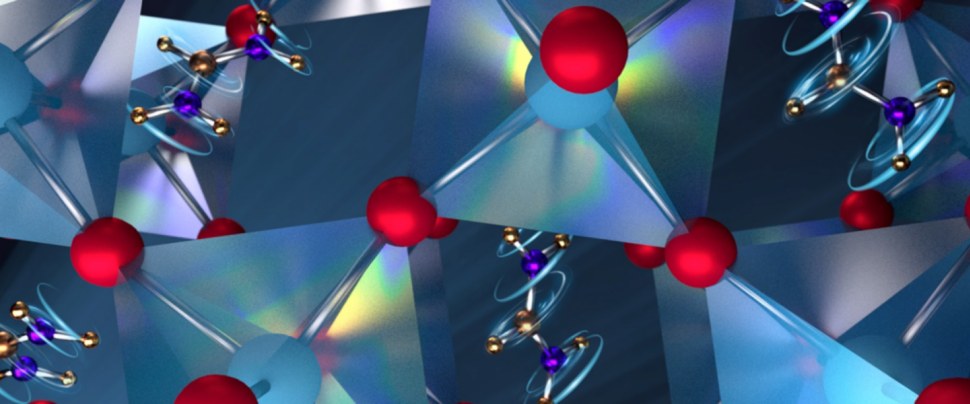
NOMAD is designed for investigations of materials through the total scattering technique with no regard for periodicity. As such, is applicable to materials ranging from liquids, glasses, to highly ordered crystalline materials. As a practical matter; however, with a resolution in backscattering of the order of 0.3%, it can also be used as a fast medium resolution neutron powder diffractometer.
The ability to understand and tailor the structure on the nano and atomic scale can be enhanced through accurate determination of structural features. The structural characterization of new materials provides critical feedback for further improvements in synthesis and in tuning of desired properties.
This diffractometer is particularly designed to effectively and efficiently use the high flux at SNS for studies of atomic-level and nanoscale structural features. This characteristic enables the study of new materials that are only available in small quantities and previously thought of as unsuitable for neutron diffraction. this opens up the possibility to follow processes and reactions in situ and allows isotope contrasting measurements to obtain element specific local structure.
Some selected science work from NOMAD:
Liquids, glasses and nanomaterials

NOMAD is designed for the investigation of materials with or without limited long-range periodicity, such as liquids, glasses, and nanomaterials. It has since been broadly used for the structure study of these types of materials across a wide spectrum of science and industrial areas, including but not limited to solvent chemistry, geology, alloys (especially metallic glasses), conventional glass industry, catalysis, and energy conversion and storage materials, etc.
A few successful examples can be found in the following publications:
Liquids and Glasses
- Low Cation Coordination in Oxide Melts. Phys. Rev. Lett.112, 157801, 2014
Link: https://journals.aps.org/prl/abstract/10.1103/PhysRevLett.112.157801 - Pressure-induced structural changes in titanophosphate glasses studied by neutron and X-ray total scattering analyses. Journal of Non-Crystalline Solids, 483, 50-59, 2018.
Link: https://www.sciencedirect.com/science/article/pii/S0022309317307184 - In-situstudy of crystallization kinetics in ternary bulk metallic glass alloys with different glass forming abilities. Appl. Phys. Lett. 201906, 105, 2014
Link: https://aip.scitation.org/doi/10.1063/1.4901905 - Structure origin of a transition of classic-to-avalanche nucleation in Zr-Cu-Al bulk metallic glasses. Acta Mater. 108-118, 149, 2018.
Link: https://www.sciencedirect.com/science/article/abs/pii/S1359645418301289?via%3Dihub
Nanomaterials
- Structure and stability of SnO2nanocrystals and surface-bound water species. J. Am. Chem. Soc., 6885–6895, 135, 2013
Link: https://pubs.acs.org/doi/10.1021/ja312030e - Resolving the Structure of Ti3C2TxMXenes through Multi-Level Structural Modeling of the Atomic Pair Distribution Function, Chem. Mater., 349–359, 28, 2016
Link: https://pubs.acs.org/doi/10.1021/acs.chemmater.5b04250 - Quantitative Analysis of the Morphology of {101} and {001} Faceted Anatase TiO2Nanocrystals and Its Implication on Photocatalytic Activity. Chem. Mater., 29, 5591–5604, 2017
Link: https://pubs.acs.org/doi/abs/10.1021/acs.chemmater.7b01172
Disordered crystalline materials
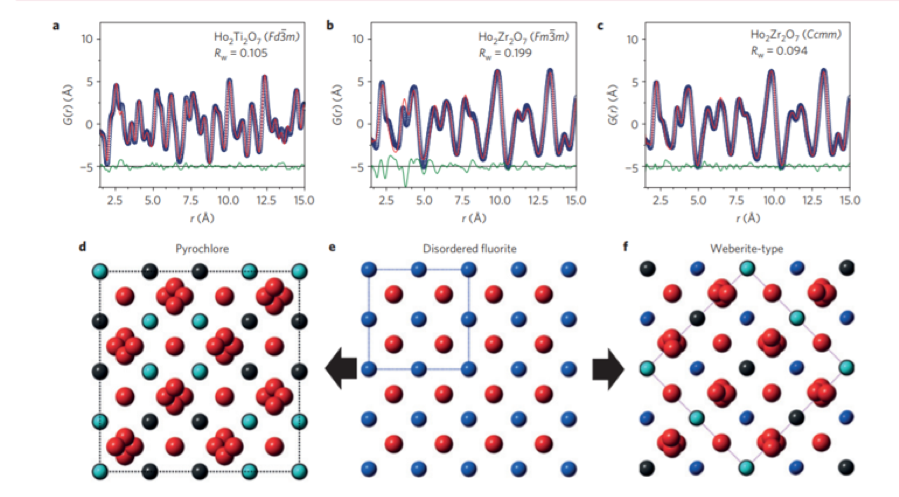
NOMAD has also been frequently used to study disordered crystalline materials where appreciable amounts of disorder are present in a relatively rigid and periodic lattice. These disordering components could be local distortions, chemical short-range order, anti-site defects, antiphase boundaries, liquid-like behavior for specific atoms/ions/spins, and stacking faults or dislocations.
A few successful examples can be found in the following publications:
- Probing disorder in isometric pyrochlore and related complex oxides. Nat. Mat.15, 507–511, 2016 (Local distortion in solid state oxides)
Link: https://www.nature.com/articles/nmat4581 - Real-space investigation of short-range magnetic correlations in fluoride pyrochlores NaCaCo2F7
- NaSrCo2F7with magnetic pair distribution function analysis. Phys. Rev. Materials1, 074412, 2017 (Magnetic diffuse scattering)
link: https://journals.aps.org/prmaterials/abstract/10.1103/PhysRevMaterials.1.074412 - Structure-Induced Reversible Anionic Redox Activity in Na Layered Oxide Cathode. Joule, 2, 125-140, 2018 (Chemical short-range order and stacking disorder in layered oxides)
Link: https://www.sciencedirect.com/science/article/pii/S2542435117301320 - Extending the limits of powder diffraction analysis: Diffraction parameter space, occupancy defects, and atomic form factors. Review of Scientific Instruments, 89, 9, 093002, 2018. (Anti-site defects in layered battery cathodes)
Link: https://aip.scitation.org/doi/10.1063/1.5044555
In situchemical reactions, catalysis and batteries

One of the greatest advantages of NOMAD is its world-leading flux compared to other neutron time-of-flight diffractometers. This opens up the possibilities to study the structure evolution of small amounts of samples in operando. Specifically, it allows the operation of an in situgas flow cell on the beamline, which can be used to follow chemical decomposition and heterogenous catalytic reactions. Recent efforts have also been devoted to developing in situelectrochemical cells that can be used to study the charge/discharge process of batteries or super-capacitors.
A few successful examples can be found in the following publications:
- A high precision gas flow cell for performing in situ neutron studies of local atomic structure in catalytic materials. Review of Scientific Instruments, 88, 034101, 2017
Link: https://aip.scitation.org/doi/abs/10.1063/1.4978287 - A high temperature gas flow environment for neutron total scattering studies of complex materials. Review of Scientific Instruments,89, 092906, 2018
Link: https://aip.scitation.org/doi/abs/10.1063/1.5033464 - Capturing the Details of N2Adsorption in Zeolite X Using Stroboscopic Isotope Contrasted Neutron Total Scattering. Chem. Mater., 30, 296–302, 2018
link: https://pubs.acs.org/doi/abs/10.1021/acs.chemmater.7b04594
Structure determination and refinement of crystalline materials
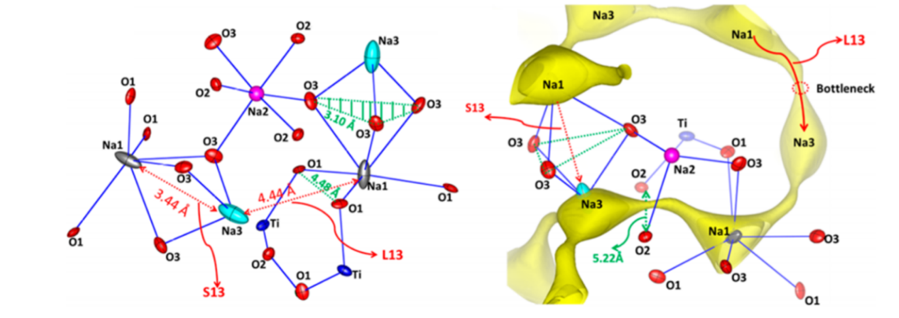
In addition to the above achievements, NOMAD can be used as a medium resolution powder diffractometer for structure determination and refinement. This enables abinitiostructure determination and structure refinement of new or modified functional crystalline materials. Moreover, due to the unprecedented high flux, it makes possible the accurate structure study of novel or metastable materials that can only be synthesized in small quantities (tens to hundreds of mg). A few successful examples can be found in the following publications:
- Mixed close-packed cobalt molybdenum nitrides as non-noble metal electrocatalysts for the hydrogen evolution reaction. J. Am. Chem. Soc., 135, 51, 19186-19192, 2013.
Link: https://pubs.acs.org/doi/10.1021/ja4081056 - Removal of Interstitial H2O in Hexacyanometallates for a Superior Cathode of a Sodium-Ion Battery. J. Am. Chem. Soc., 137, 2658–2664, 2015
Link: https://pubs.acs.org/doi/abs/10.1021/ja512383b - In Situ Neutron Diffraction Studies of the Ion Exchange Synthesis Mechanism of Li2Mg2P3O9N: Evidence for a Hidden Phase Transition. J. Am. Chem. Soc., 139, 9192–9202, 2017
Link: https://pubs.acs.org/doi/abs/10.1021/jacs.7b02323
New science areas/ideas you want bring to NOMAD?
New science areas and ideas are always welcomed, please contact the beamline team if you are interested in using NOMAD for your science.

NOMAD Mail-In Program
- Mail-in proposals are reviewed continuously, allowing for very short turn-around time.
- The Mail-in program runs on accelerator physics/ maintenance days (Tuesdays) after resumption of neutron production until the next morning (Wednesdays), unless operational considerations dictate otherwise.
- One proposal can ask for up to 5 measurements (5 samples, 5 temperatures between 100 K and 500 K, or any combination, up to 5 total). There is no restrictions on the number of proposals per user and per run cycle, however an experimental report for previous mail-in proposals is required before submission of a new proposal. If the number of samples exceeds the number of available slots on a given day, priority is given to new users.
- Samples cannot run in the mail-in program if they compete with an approved General User Program proposal. The mail-in program can, however, be used to support a general user proposal from the same group.
- 3 mm diameter quartz capillaries made specifically for the NOMAD sample shifter will be mailed to you after your proposal is approved. Samples must arrive loaded and sealed with rubber stopper or parafilm, not flame sealed. Epoxy can be used for sealing air sensitive samples. Samples that have been epoxied will not be heated above room temp.
- The data will be processed with the NOMAD auto reduction software, currently producing input files for GSAS, FULLPROF, RMCProfile, PDFgui, and TOPAS.
- If the project does not fit the narrow description of the mail-in program or requires more instrument scientist support, users are encouraged to submit a General User Program proposal.
- Mail-in proposals must be short. Limit yourself to one page.
- You can apply for mail-in proposal any time using the Integrated Proposal Tracking System. Chose ‘Mail-in’ as a proposal type.