Liquids Reflectometer
Mission Statement
To enable world-leading neutron reflectometry on complex interfaces by probing surface and interfacial structures on length scales from 0.5 nm to 350 nm, delivering transformative insights into the dynamics, function, and evolution of surfaces and thin films across the physical, chemical, biological, and materials sciences.
Instrument Description
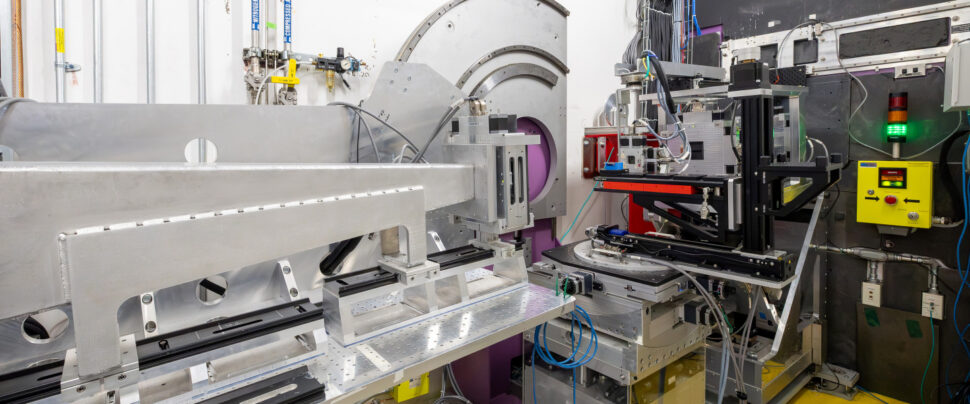
The Liquids Reflectometer measures specular and off specular neutron reflectivity in a horizontal sample geometry from solid surfaces, solid/liquid interfaces, and free liquid surfaces. Probe wavelength and flux constrain size and flatness to samples no smaller than about 1×1 cm2 deposited on atomically smooth and cm-scale flat substrates such as silicon, quartz, sapphire, or water. The most commonly used substrate is a 50-mm-diameter, 5-mm-thick silicon wafer. A variety of sample environments are supported, including an automated sample changer, temperature-controlled liquid/solid cells with liquid handling, potentiostatically controlled electrochemical cells, vacuum and gas-handling chambers, a rheometer, and a Langmuir trough. For specialized sample environments, the user should contact a beamline staff member. We are always open to new ideas and interested in developing new capabilities.
Applications
Researchers are using the LR to study a broad range of problems, including those in the following scientific fields
- Interfacial reactions in energy storage materials
- Phase separation in polymer films
- Inorganic templating at air/water interfaces
- Complex fluids under shear and flow
- Vesicles and gels
- Reaction kinetics
- Surfactants at interfaces
- Interfacial structure in drug delivery systems
- Membranes and their intermolecular interaction
- Protein adsorption
- Critical phenomena in fluid systems
- Biocompatibility and sensors
- Corrosion reactions
Specifications
| Moderator | Coupled supercritical H2 |
| Bandwidth | 3.4 Å @ 60 Hz, 6.8 Å @ 30 Hz |
| Wavelength Range | 2.5 Å < λ < 17.0 Å |
| Resolution | 0.02 < δQ/Q < 0.10 |
| Sample Environment | Examples include: Automated sample changer 2” diameter liquid/solid cells Multi-Channel Potentiostat Vacuum and multi-environment Chamber High Voltage Vacuum Chamber Rheometer |
LR Instrument Team
Please select link below to email the instrument team. Be sure to include your name and email address.
Information for LR Users
Measurement Types
Standard measurements are carried out in at 30Hz (frame skipping mode) to provide an extended wavelength band and the sample is tilted to reach varying incident angles (θ-2θ geometry). The position-sensitive detector is used to maximize use of guide divergence whilst recovering qz resolution. These can be carried out in either a reflection up or a reflection down geometry.
For free-liquids and other systems that cannot be tilted, the sample angle is kept horizontal and the incident angle is varied via the guide divergence (θ – θ geometry). These measurements are carried out at 60Hz.
Data are collected in event mode which enables retrospective slicing of the data in time to provide variable temporal resolution for kinetic measurements or time-dependent systems.
Measurement times will depend on the samples, conditions and hypothesis being tested so should be discussed with a member of the beamline team.
Preparation for Beam-time
How to design an experiment?
It is always best to discuss your experiment ideas with a member of the beamline team who can help in preparing your proposal and optimizing experiment scope, sample setup and measurement plans.
Reflectivity simulation tools are very useful for testing technique sensitivity and choosing contrasts. See below for example links and resources.
Important aspects to consider: what is the hypothesis to be tested and what similar structures need to be differentiated? What sample conditions (sample environment) are required? What scattering contrast is best to use? How long will the experiment require? Are changes needed to the sample to make it suitable for the neutron reflectometry measurement?
What makes a “good” sample?
Neutron reflectometry experiments typically require a surface with very low roughness, waviness and uniformity across the surface. For a solid-liquid interfacial measurement, it also requires high neutron transmission through the solid phase (e.g. silicon, quartz, alumina).
Complementary measurements
It is good practice to carry out pre-testing of the system and samples with complementary techniques to optimize use of the beam-time and strengthen proposal submissions. Depending on the system, these can include x-ray reflectivity, ellipsometry, QCM-d, Langmuir trough, XPS, or FTIR. If you do not have access to these techniques at your home institution, there are some user facilities at the Center for Nanophase Materials Science (CNMS) (https://www.ornl.gov/facility/cnms) and in the SNS User labs.
On award of neutron beam-time, users are expected to attend the experiment in person with appropriate staffing to cover the full length of the experiment, which runs 24-hours per day. Typically this is a minimum of 2-3 people.
There is detailed information on the User area of the website covering all aspects of beam-time experiments. Of particular note:
- The User charter (.pdf) outlines details of what to expect and your responsibilities as an ORNL Neutron Sciences User
- There is a detailed guide to shipping samples to the facility
- Publishing expectations?
Further Resources
- Lecture introduction to the instrument and example capabilities
- Introduction lecture on planning a neutron scattering experiment
- Introduction lecture to small angle scattering and reflectometry – Part One and Part Two
- Open Reflectometry Standards Organisation (ORSO) collates a number of useful resources for understanding the technique and available instruments
- This includes an SLD database, calculator and tool for simulating data
- NIST reflectivity calculator for simulations
- Neutron Scattering Lengths and Cross Sections
Beam Line Equipment
The Liquids Reflectometer (BL-4B) supports a range of in-situ and ex-situ sample environments for studying solid, liquid, and solid/liquid interfaces. Beamline staff can help configure or adapt these systems for a specific experiment; contact the instrument team to discuss requirements before you submit a proposal.
Liquid/Solid Cells
Temperature-controlled cells accommodate 2″ and 3″ diameter substrates for measurements at the solid/liquid interface, including tilted-cell geometries for free liquid surfaces, with sample heating up to 180 °C. Solvent exchange is performed in situ via syringe pumps and/or an HPLC pump.
Electrochemical Cell
A 2-channel Biologic VMP-300 potentiostat/galvanostat, provides electrochemical control for in-situ NR measurements during cycling — for example, tracking interfacial structure evolution in battery electrodes or corrosion layers under applied potential.
Langmuir Trough
A Biolin Langmuir trough, with interchangeable X-small, small, and medium trough sizes (36–163 mL volume), supports studies of monolayers and thin films at the air/water interface with barrier-controlled surface pressure.
Rheometer
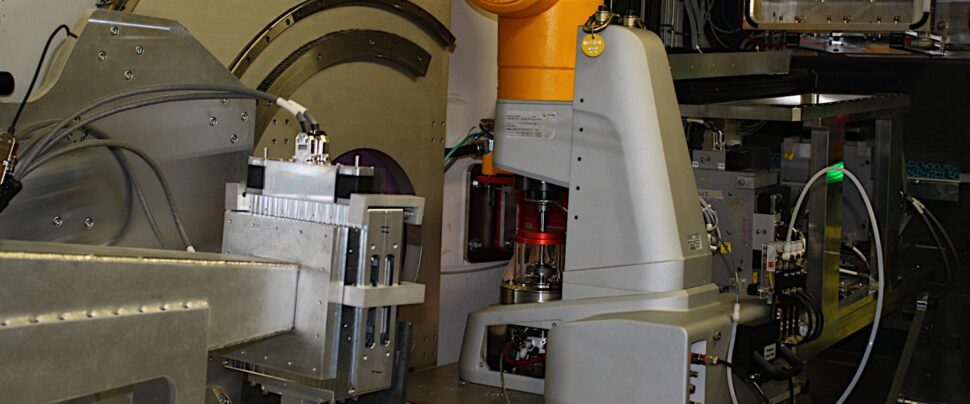
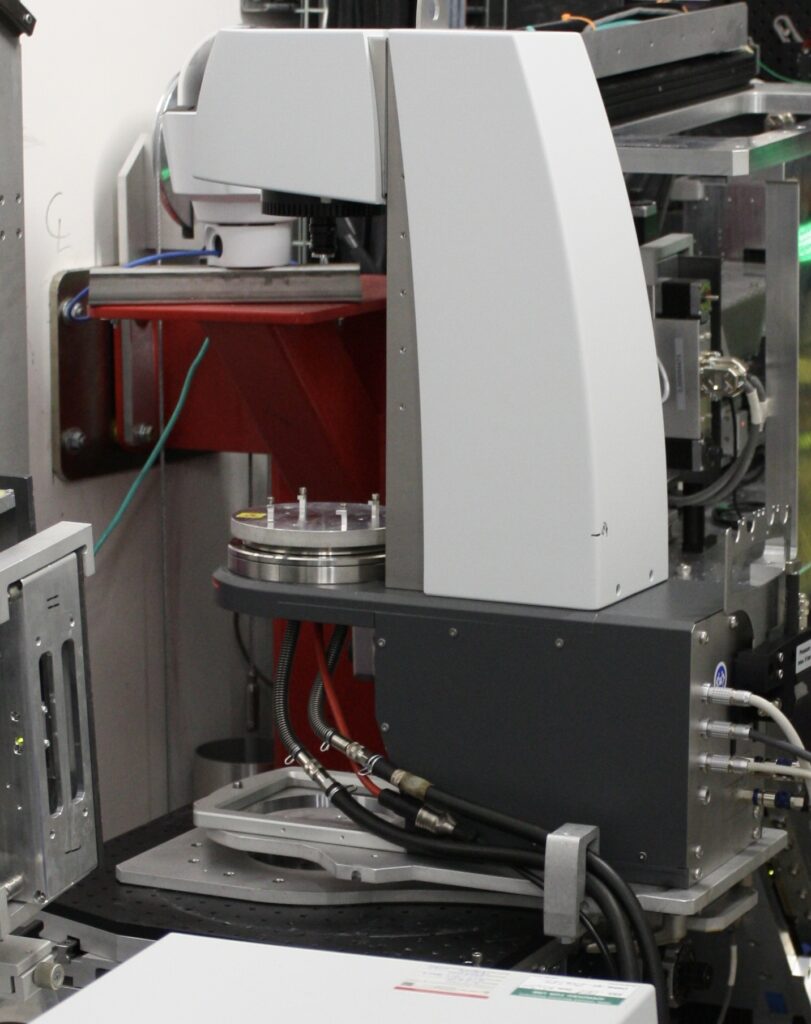
An Anton Paar MCR 703 space saver rheometer allows simultaneous shear rheology and neutron reflectivity measurements, in plate/plate and cone/plate configurations for shear studies of complex fluids under flow.
High Voltage Chamber
Enables in-situ NR measurements of thin films under applied electric field, with voltages ranging from −10 kV to +10 kV and temperatures up to 140 °C, used for example to study field-induced reorientation of block copolymer microdomains.

Multi-Environment Chamber
Supports measurements under high vacuum (down to 10⁻⁸ torr) and inert atmosphere (up to 760 torr), with sample temperatures reaching 600 °C — suited to studies of thin film structure under controlled gas exposure or thermal treatment.
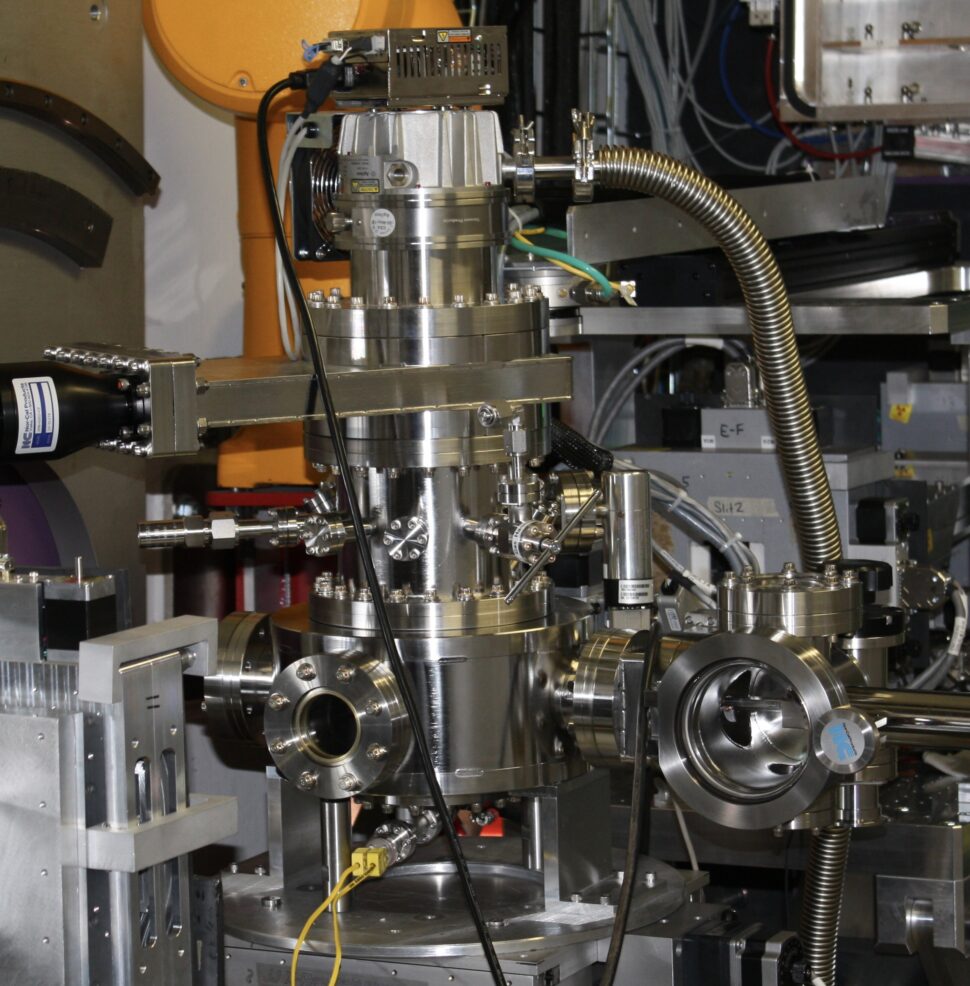
High Pressure Sample Cell
Reaches pressures from 0 to 50 MPa and temperatures from 25 to 200 °C, for NR studies of interfacial structure under elevated pressure conditions.
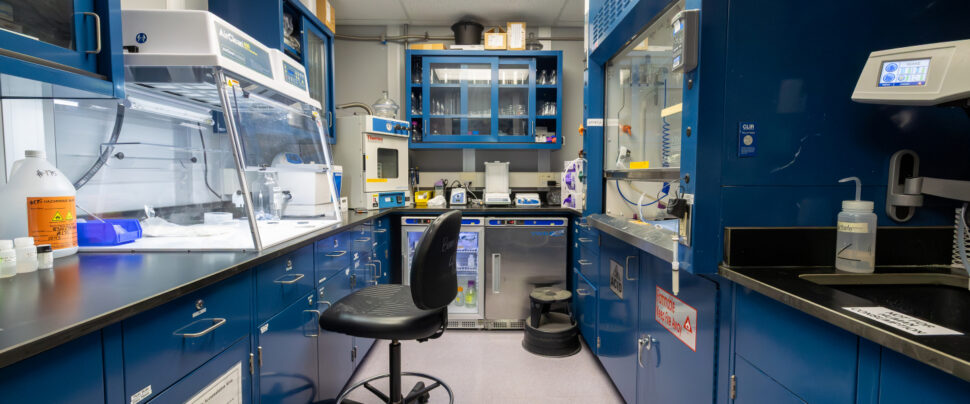
Sample Preparation Laboratory
The LR has a small dedicated 100 ft2 wet laboratory for sample preparation. Users are asked to perform the following:
- Take the laboratory safety training. The training is a short lesson of the general rules and information related to our laboratory. It is completed during instrument specific training conducted at the beam line at the start of your experiment.
- Plan what type of equipment and supplies you will need. Talk to your local contact and/or Candice Halbert ([email protected]) to help prepare the laboratory for your experiment.
Available Equipment
- Fume Hood
- Cabinets for flammable materials and acids (below fume hood)
- Refrigerator and freezer (4 °C and -22 °C)
- Deionized high-purity (18 mega-ohm) water systems
- 5.7 L ultrasonic cleaner
- Mettler Toledo balance (0.0001 g to 1000 g)
- Single-wafer spin coat processor
- Vortex mixers and hotplate/stirrer
- Vacuum oven (30 torr base pressure; RT to 200 °C)
- Laminar flow hood
- Microscope (3x viewing scope)
- pH meter
Safety Rules
All of the usual precautions for work with chemicals apply in the sample preparation laboratory. Some additional rules are necessary because it is a multi-user laboratory. Keep in mind that although your own work might not require certain precautions, other users could be working with hazards not obvious to you. Follow the guidelines listed in the Sample Preparation Laboratory at the Liquids Reflectometer Training Document (.pdf).
Support Labs
SNS Soft Matter Lab
SNS Thin Films Lab
CNMS Support Labs