Cold Neutron Chopper Spectrometer
Mission Statement
Inelastic or quasielastic neutron scattering experiments using cold or thermal neutrons with good to medium energy resolution.
Instrument Description
CNCS is a high-resolution, direct-geometry, multi-chopper inelastic spectrometer designed to provide flexibility in the choice of energy resolution and to perform best at low incident energies (2 to 50 meV). Although the detector coverage around the sample is 1.7 sr, a later upgrade to 3 sr is possible. Experiments at CNCS typically use energy resolutions between 10 and 500 µeV. A broad variety of scientific problems, ranging from complex and quantum fluids to magnetism and chemical spectroscopy, are being addressed through experiments at CNCS.
Applications
- Magnetism: collective magnetic excitations in multiferroics; low-dimensional systems; non-Fermi liquids; frustrated, disordered, or molecular magnets
- Structural excitations: collective excitations (phonons) in thermoelectric materials, superconductors, soft matter, bio-materials, or other materials of interest
- Dynamics in confined geometries: quantum fluids in confined geometries, tunneling, molecules on surfaces
Funding and development of this instrument was overseen by a university-national laboratory collaboration.
Specifications
| Source-sample distance | 36.2 m |
| Sample-detector distance | 3.5 m |
| Angular coverage | Horizontally:−50° – +140° Vertically:±16° |
| Energy resolution | 10 – 500 µeV |
| Incident energy range | 0.5 – 80 meV |
| Momentum transfer range | 0.05 – 10 Â−1 |

CNCS beam intensity in a neutron monitor for a few popular choices of the instrument setup. The sample is an annular vanadium foil: diameter of 10 mm, height of 63 mm, thickness of 1 mm. Here, dd-opening is the double-disk opening mode, and dd-freq is the frequency of the double-disk rotation. The gray regions are non-standard incident energies that are non-optimal for the CNCS. Measured in cycle 2018B.
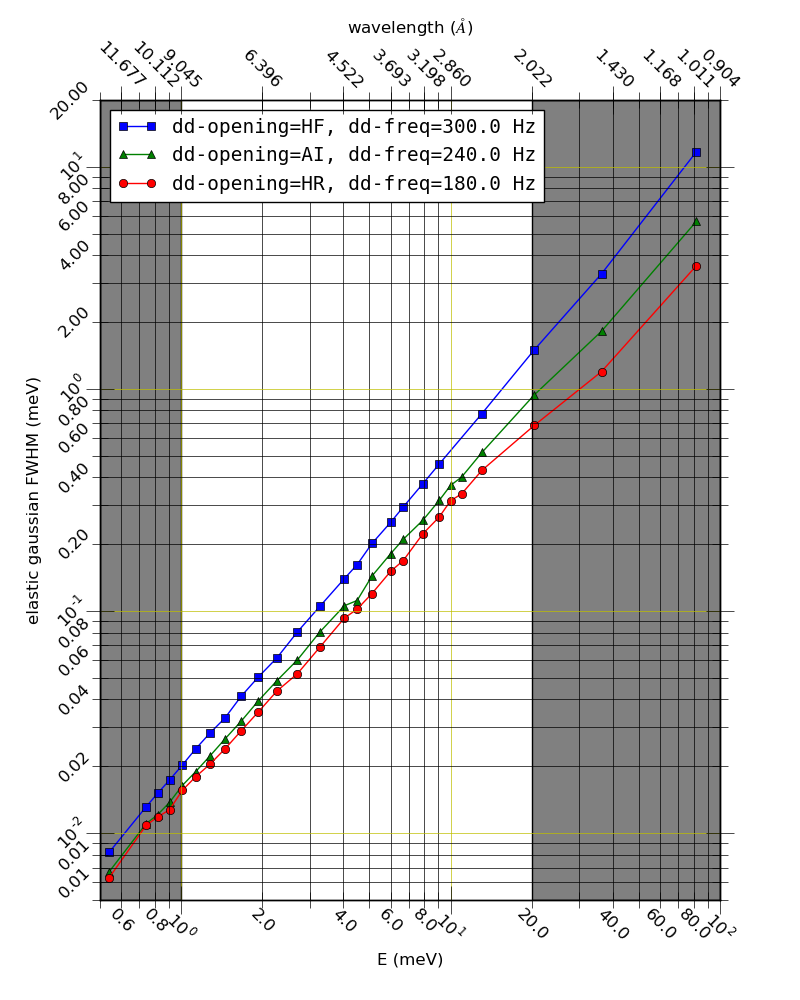
CNCS energy resolution for a few popular choices of the instrument setup. The sample is an annular vanadium foil: diameter of 10 mm, height of 63 mm, thickness of 1 mm. Here, dd-opening is the double-disk opening mode, and dd-freq is the frequency of the double-disk rotation. The gray regions are non-standard incident energies that are non-optimal for the CNCS. Measured in cycle 2018B.
CNCS Instrument Team
Please select link below to email the instrument team. Be sure to include your name and email address.
Capabilities of the CNCS Instrument
The scientific communities using the Cold Neutron Chopper Spectrometer (CNCS) at the Spallation Neutron Source span condensed matter physics, materials science and chemistry, physical chemistry, and soft and biological matter. CNCS is a high-resolution, direct-geometry time-of-flight spectrometer optimized for low-energy inelastic and quasielastic neutron scattering. Flexible choices of incident energy and energy resolution, broad reciprocal-space coverage, and integrated sample environments enable measurements as functions of temperature, magnetic field, pressure, and sample orientation.
A core capability of CNCS is rotation-based single-crystal spectroscopy. Measurements acquired at many crystal orientations are combined to reconstruct the four-dimensional dynamical scattering function, (S(Q,E)), as a function of momentum and energy transfer. Modern data-analysis workflows support automated slicing, symmetrization, Brillouin-zone folding, visualization, and quantitative comparison with theoretical models and simulations. See A. Sable, A. T. Savici, B. Linjawi, and O. Delaire, “pathSQE: an automated workflow for single-crystal inelastic neutron scattering data processing and analysis,” Journal of Applied Crystallography 59, 248–262 (2026).
Representative experiments and recent scientific highlights include:
- Magnetic excitations and quantum magnetism. CNCS maps low-energy magnetic excitations throughout reciprocal space, including conventional magnons, multiparticle continua, bound states, and fractionalized quasiparticles. Measurements under magnetic field and across temperature-dependent phase transitions can determine microscopic spin Hamiltonians and distinguish competing quantum states. Recent examples include the field-tuned spectroscopic separation of emergent photon and spinon excitations in a dipolar-octupolar quantum spin liquid—B. Gao et al., “Spectroscopic Demarcation of Emergent Photons and Spinons in a Dipolar-Octupolar Quantum Spin Liquid,” Physical Review Letters 136, 256703 (2026)—and the identification of Bose–Einstein condensation of a two-magnon bound state in a spin-1 triangular-lattice magnet—J. M. Sheng et al., Nature Materials 24, 544–551 (2025).
- Phonons and structural dynamics. Rotation measurements on single crystals can map phonon dispersions, linewidths, and diffuse structural fluctuations throughout reciprocal space. Temperature-dependent measurements provide direct information about anharmonicity, phase transitions, electron–phonon coupling, and mechanisms controlling thermal and optoelectronic properties. A recent study of halide perovskites revealed correlated octahedral-tilt fluctuations, quasielastic diffuse rods, and acoustic phonon softening: C. Mao et al., “Correlated dynamic disorder, octahedral tilts, and acoustic phonon softening in CsSnBr₃ and CsPbBr₃,” Physical Review Materials 9, 065401 (2025).
- Quasielastic neutron scattering and diffusion. The combination of high neutron flux, flexible energy resolution, broad dynamic range, and multidimensional detector coverage makes CNCS well suited to studies of diffusion, molecular reorientation, and correlated ionic motion. Measurements may be performed on powders or single crystals to determine both characteristic timescales and the momentum-space geometry of dynamical processes. A recent demonstration used four-dimensional QENS to investigate correlated ionic-conduction pathways in a fast-ion conductor: J. Coles et al., “Four-Dimensional Quasielastic Neutron Scattering (4D-QENS) Analysis of Correlated Ionic Conduction in SrCl₂,” PRX Energy 5, 023002 (2026).
- Elastic and diffuse scattering. Although optimized for spectroscopy, CNCS can also efficiently map elastic and near-elastic scattering over large regions of reciprocal space. Such measurements are useful for locating magnetic ordering wave vectors, characterizing short-range correlations and diffuse manifolds, and following field- or temperature-induced phase transitions. A recent example identified nodal-line spin-liquid correlations and fluctuation-stabilized magnetic order in K₂IrCl₆: Q. Wang et al., “Pulling Order Back from the Brink of Disorder: Observation of a Nodal-Line Spin Liquid and Fluctuation Stabilized Order in K₂IrCl₆,” Physical Review X 15, 021021 (2025).
Additional examples spanning quantum magnetism, lattice dynamics, energy materials, molecular motion, and neutron instrumentation are available on the CNCS publications page.
CNCS Equipment Gallery
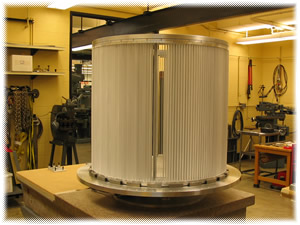
Radial collimator

Frame overlap chopper
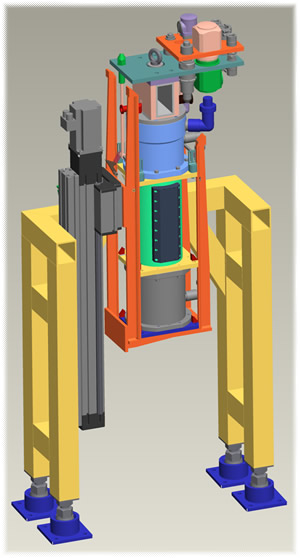
Fermi chopper

Detector tube testing module
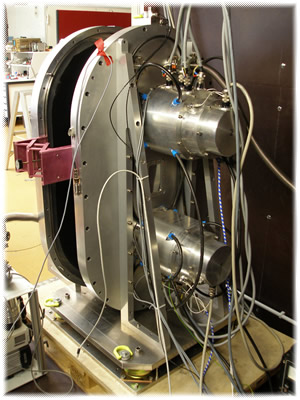
High-speed double disk chopper