Wide Angular-Range Chopper Spectrometer
Mission Statement
Illuminating excitations in condensed matter systems to enhance the fundamental understanding of dynamic processes in materials.
Instrument Description
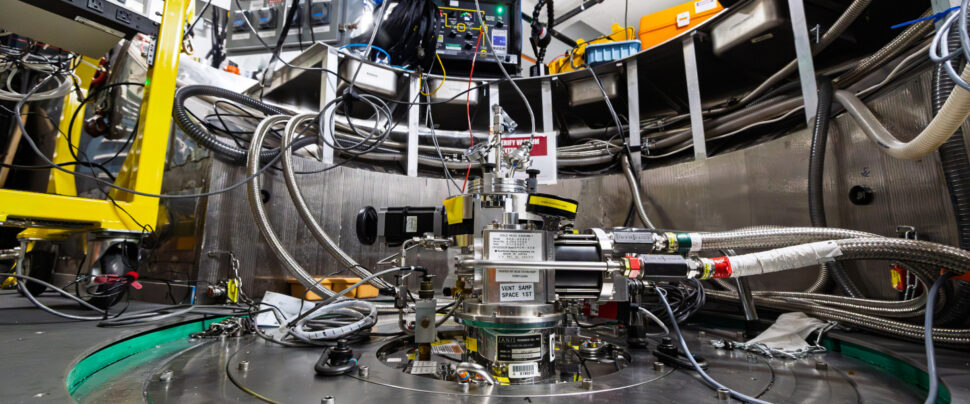
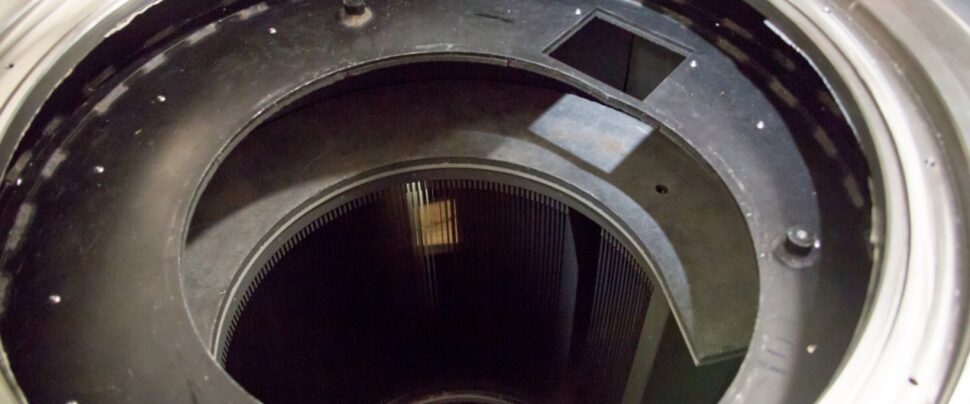
ARCS is optimized to provide a high neutron flux at the sample and a large solid angle of detector coverage. The spectrometer is capable of selecting incident energies from a wide range, making it useful for studies of excitations from a few to several hundred milli-electron volts. An elliptically shaped supermirror guide in the incident flight path boosts the performance at the lower end of this range. The sample and detector vacuum chambers provide a window-free final flight path and incorporate a large gate valve to allow rapid sample changeout. A T0 neutron chopper not only blocks the prompt radiation from the source but also eliminates unwanted neutrons from the incident beam line. An oscillating radial collimator can reduce the background from complex sample environment equipment.
Applications
The increased sensitivity of ARCS offers new opportunities for scientific studies in:
Lattice Dynamics
- Entropy and the effects of vibrational modes on stability and phase transitions of solids
- Excitations in disordered materials; effects of nanoscale features on vibrational entropy and thermodynamic stability
- Equations-of-state from the measured phonon density-of-states versus temperature and pressure
- Phonons in correlated-electron materials; coupling of lattice and electronic degrees of freedom in high Tc, heavy-fermion and mixed valence materials
Magnetic Dynamics
- High-temperature superconductivity-spin dynamics in superconductors and precursor compounds and crystal field spectroscopy
- Low-dimensional systems; one-dimensional quantum magnets and low-dimensional conductors
- Magnetism in actinide materials; heavy fermion magnetism and superconductivity
Chemical Physics
- Deep inelastic neutron scattering studies of hydrogen and helium
Inelastic neutron scattering studies such as those conducted at ARCS can impact the development of important practical materials, such as ferroelectrics used in ultrasounds and thermoelectrics used to harvest energy from waste heat.
Specifications
| Moderator | decoupled ambient water |
| Source – Fermi chopper distance | 11.6 m |
| Chopper – sample distance | 2.0 m |
| Sample – detector distance | 3.0 m – 3.4 m cylindrical geometry |
| Incident energy range | 10 – 1500 meV |
| Resolution (elastic) | 3 – 5% Ei |
| Detector coverage horizontal | -28° – 135° |
| Detector coverage vertical | -27° – 26° |
| Minimum detector angle | 3° |
| Beam Size | 5 cm x 5 cm, with fully adjustable motorized slits in the horizontal and vertical directions |
Commonly used and well–characterized sample environment equipment List
ARCS Instrument Team
Please select link below to email the instrument team. Be sure to include your name and email address.
Information for ARCS Users
- ARCS Instrument Orientation Guide
- ARCS User Operation Manual
- Alarm Response
- Procedure for User Operation of IPPS System
- Sample Preparation Area
- Procedure for Sample Removal
- User Training Checklist
- Data access and analysis:
Publishing Your Experiment Results
Users must credit ORNL in all publications resulting from experiments performed at these facilities. In addition, publications, papers, patents, honors and awards, and their citations must be reported to the User Office to assist the facilities in recording the contributions of its users. Each facility (HFIR or SNS or both) must be acknowledged with this statement:
“[A portion of] This research at Oak Ridge National Laboratory’s High Flux Isotope Reactor [and/or Spallation Neutron Source, as appropriate] was sponsored by the U.S. Department of Energy, Office of Basic Energy Sciences.”
Additionally, we request the citation of the ARCS instrument paper in any peer-reviewed journal publication:
Abernathy, D. L., Stone, M. B., Loguillo, M. J., Lucas, M. S., Delaire, O., Tang, X., Lin, J. Y.Y., and Fultz, B., Design and operation of the wide angular-range chopper spectrometer ARCS at the Spallation Neutron Source,” Review of Scientific Instruments 83, 15114 (2012).
Please enter publications in the Neutron Science Publications Systems. This ensures that the publication will appear on the ARCS publications page.
ARCS Overview
The wide angular-range chopper spectrometer ARCS at the Spallation Neutron Source (SNS) is optimized to provide a high neutron flux at the sample position with a large solid angle of detector coverage. The instrument incorporates modern neutron instrumentation, such as an elliptically focused neutron guide, high speed magnetic bearing choppers, and a massive array of 3He linear position sensitive detectors. Novel features of the spectrometer include the use of a large gate valve between the sample and detector vacuum chambers and the placement of the detectors within the vacuum, both of which provide a window-free final flight path to minimize background scattering while allowing rapid changing of the sample and sample environment equipment. ARCS views the SNS decoupled ambient temperature water moderator, using neutrons with incident energy typically in the range from 15 to 1500 meV. This range, coupled with the large detector coverage, allows a wide variety of studies of excitations in condensed matter, such as lattice dynamics and magnetism, in both powder and single-crystal samples.
Typical sample environment equipment used at ARCS includes closed-cycle refrigerators (bottom and top loading, 5K – 300K), cryostats (liquid He 1.8K – 300K) and furnaces (resistive heater 300K – 900K, radiative heater (ILL style) 300K – 1500K). Other types of equipment that may be accommodated, including a large capacity dilution refrigerator (40 mK base temperature). Reference: D. L. Abernathy, M. B. Stone, M. J. Loguillo, M. S. Lucas, O. Delaire, X. Tang, J. Y. Y. Lin, and B. Fultz, “Design and operation of the wide angular-range chopper spectrometer ARCS at the Spallation Neutron Source,” Review of Scientific Instruments 83, 15114 (2012)
Measurements of single crystal phonons in large volumes of reciprocal space
Phonon excitations in single crystals provide a detailed look at the atomic interactions in a material. By measuring large volumes of reciprocal space, one may find unusual features that might be overlooked by more focused triple-axis measurements. Examples include the effects of electron-phonon interactions and anharmonicity. Due to its large detector coverage ARCS can acquire such data quickly, allowing for more detailed studies as a function of temperature or other parameters. The sample environments used provide a vertical axis of rotatation of the sample and are optimized for the very low background required for single crystal studies.
| Examples of Relevant Research | |
| O. Delaire, K. Marty, M. B. Stone, P. R. C. Kent, M. S. Lucas, D. L. Abernathy, D. Mandrus, and B. C. Sales, “Phonon softening and metallization of a narrow-gap semiconductor by thermal disorder.”Proceedings of the National Academy of Science (PNAS), 108, 4725 (2011).Sample size: ~30 g (single crystal FeSi)Typical measurement time: ~15 minutes per temperature, angleTotal experiment time: 4 daysSingle-crystal phonon dispersions of FeSi, measured by time-of-flight inelastic neutron scattering (ARCS), illustrating the change in phonon frequencies between 10 K (A–C) and 300 K (D–F). | M. E. Manley, D. L. Abernathy, N. I. Agladze, and A. J. Sievers, “Symmetry-breaking dynamical pattern and localization observed in the high-temperature vibrational spectrum of NaI.”Scientific Reports 1, 4 (2011).Sample size: ~35 g (single crystal NaI)Typical measurement time: ~20 minutes per temperature, angleTotal experiment time: 5 days |
Parameteric studies of phonon density-of-states
Measurements of the phonon density-of-states in powder samples can be used to study how atomic vibrations contribute to the thermodynamics and bulk properties of materials. By doing parametric studies with variations of temperature and composition, the nature of the interactions in the sample can be related to lattice expansion, thermal conductivity and stability of alloys, for example. ARCS allows such studies to be performed quickly due to its large flux and wide incident energy and angular ranges. These measurements combined with computational studies and bulk characterization can lead to better understanding of the thermodynamics of alloys, negative thermal expansion materials, and thermoelectric properties.
| Examples of Relevant Research | |
| C.W. Li, X. Tang, J.A. Muñoz, J.B. Keith, S.J. Tracy, D.L. Abernathy and B. Fultz, “The structural relationship between negative thermal expansion and anharmonicity of cubic ScF3,” Physical Review Letters 107, 195504 (2011).Sample size: ~15 g (powder ScF3)Typical measurement time: ~45 minutes per temperature, energyTotal experiment time: 3 daysA. Möchel, I. Sergueev, H.-C. Wille, J. Voigt, M. Prager, M. B. Stone, B. C. Sales, Z. Guguchia, A. Shengelaya, V. Keppens, and R. P. Hermann, “Lattice dynamics and anomalous softening in the YbFe4Sb12 skutterudite.”,Physical Review B 84 194306 (2011).Sample size: ~11 g (powder YbFe4Sb12Typical measurement time: ~2 hours per temperature, energyTotal experiment time: 4 days | Neutron-weighted ScF3 phonon DOS.Shifts of phonon peak centers relative to 7 K data |
Studies of quantum liquids and solids
ARCS is well-suited to the study of the momentum distributions in quantum liquids and solids. The high flux of the SNS source combined with the large detector coverage allow for detailed measurements of 4He in confined geometries or under pressure, for example. Bose-Einstein condensation in such systems or the excitations in 3He-4He mixtures may be studied. A special high-resolution Fermi chopper is available for incident energies near 700meV with a momentum transfer range up to Q ~ 30 Å-1.
| Examples of Relevant Research | |
| S.O. Diallo, R.T. Azuah, D.L. Abernathy, R. Rota, J. Boronat, and H.R. Glyde, “Bose-Einstein Condensation in liquid 4He near the liquid-solid transition line,” Physical Review B 85, 140505(R) (2012)Sample size: ~100ccTypical measurement time: ~8 hours per temperature, pressureTotal experiment time: 7 daysObserved scattering intensity S(Q,ω) as a function of energy transfer E = ħω and momentum transfer ħQ from liquid 4He at p = 24 bars and T = 40 mK. The signal from the empty Al container has been subtracted. The black dashed line is the calculated 4He recoil line Er = ħ2Q2/2m, shown as a guide to the eye. | |
Magnetic excitations
The high neutron flux at thermal and epithermal wavelengths makes ARCS appropriate for single crystal and powder measurements of magnetic materials with strong magnetic interactions. Single crystal measurements of magnetic systems often make use of the ability to measure large volumes of reciprocal space. The higher energies available at ARCS makes the instrument complimentary to lower energy measurements performed using thermal triple axis spectrometers. The large detector coverage of the instrument allows one to systematically measure the temperature dependence in powder samples as a function of composition.
| Examples of Relevant Research | |
| M. B. Stone, M. D. Lumsden, S. E. Nagler, D. J. Singh, J. He, B. C. Sales, and D. Mandrus, “Quasi-one-dimensional magnons in an intermetallic marcasite,” Physical Review Letters 108, 167202 (2012).Sample size: 3.2 g single crystal CrSb2 (~14 mmol of S=1)Typical measurement time: ~45 min per angleTotal experiment time: 4 daysObserved scattering intensity S(Q,ω) as a function of energy transfer E = ħω and momentum transfer from S=1 spins in CrSb2. Solid line is the determined spin-wave dispersion based upon a Heisenberg model.O. J. Lipscombe, G. F. Chen, C. Fang, T. G. Perring, D. L. Abernathy, A. D. Christianson, T. Egami, N. Wang, J. Hu, and P. Dai, “Spin waves in the (p,0) magnetically ordered iron chalcogenide Fe1.05Te”Physical Review Letters 106, 57004 (2011).Sample size: 6 g single crystal Fe1.05Te (~32 mmol of Fe)Typical measurement time: ~16 hours per temperature and energy.Total experiment time: 5 daysObserved scattering intensity S(Q,ω) as a function of momentum transfer for four different ranges of energy transfer for the magnetic scattering in Fe1.05Te. | |
ARCS Mail-in Program
- Mail-in proposals for ARCS may be submitted at any time and are reviewed as they are received.
- Measurements will be allocated time on a first-come/first-served basis up to the maximum amount of mail-in time available for a given cycle.
- Mail-in proposals will be evaluated for conflicts with other active proposals at the ORNL neutron scattering facilities.
- An experimental status report or a publication reference is required before a 2nd mail-in proposal will be approved from the same research group.
- The requested beamtime per proposal can be in 8 hour increments up to 24 hours total.
- A proposal may request up to 3 samples be measured. Empty sample can measurements count toward the three samples.
- Users may specify temperatures between 10 K and 600 K, measurement times per sample, and standard configurations of the instrument (i.e. automatic flux or resolution mode for a given incident energy) for each measurement.
- Sample cooling and warming times are included in the allotted beamtime.
- Sample cans may be requested to be sent to the users for filling and sealing, or sample cans can be filled by NSD staff at ORNL. Users will be given the choice of several standard sample can sizes for their measurement.
- For high temperature experiments, agreement with the instrument and facility staff will be needed concerning sample sealing and containment. An approved high temperature checklist in IPTS will be required.
- Mail-in experiments will not be scheduled until sample shipment is arranged with the ARCS team.
- All shipment requirements of the general user program also apply to the ARCS mail-in program.
- Mail-in proposals must include a single page written proposal (template is available at the bottom of the ARCS mail-in webpage) and a measurement plan (spreadsheet template is available at the bottom of the ARCS mail-in webpage).
- Users will be told of the approximate date for the measurement. Due to the mail-in nature of the experiment, users will not be guaranteed the ability to modify the experiment plan during the measurement. Mail-in users will not be given the ability to control the instrument remotely.
- Data will be reduced following standard data reduction protocol. Data files to be made available are nxs files and nxspe files (1.0% of Ei energy bins). Autoreduced data will be available during or immediately after the measurement via standard user data access routes.
- Submit your proposal using the IPTS system and choosing the “Mail-in” proposal type.
Click here for further information regarding the user program at the ORNL neutron scattering facilties