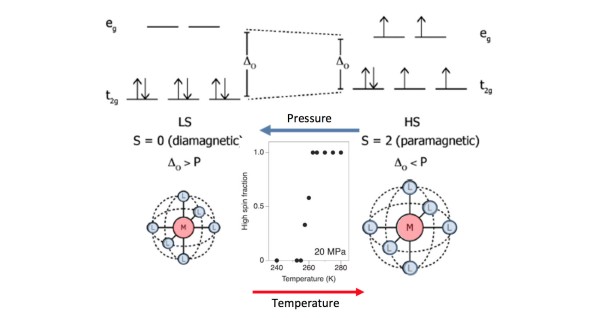
(Top): Schematic energy level diagram for an octahedrally coordinated Fe(II) ion showing the effect of a ligand field in generating a low spin (LS) or high spin (HS) state. ∆0 is the ligand field splitting energy and P is the spin-pairing energy. (Bottom)
Scientific Achievement
The pressure and temperature dependence of structure and calorimetry in the compound [FeL2][BF4]2, where L is a partially deuterated ligand (2,6-di(pyradzol-1-yl)pyridine), established the existence of a large spin-crossover driven barocaloric effect.
Significance and Impact
This is the first experimental evidence for a spin cross-over driven barocaloric effect, relating hydrostatic pressure and temperature change, relevant for solid state refrigeration.
Research Details
- [FeL2][BF4]2 magnetization measurements were made at the Center for Nanoscale Materials Sciences.
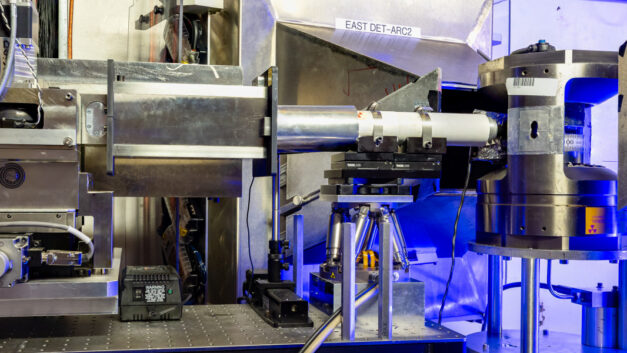
- In situ high pressure neutron diffraction measurements determined the temperature and pressure dependence of the spin crossover (SC) transition.
- Calorimetric measurements were made to determine the entropy change across the SC transition.
“Giant Barocaloric Effect at the Spin Crossover Transition of a Molecular Crystal,”
S.P. Vallone, A.N. Tantillo, A.M. dos Santos, J. Molaison, R. Kulmaczewski, A. Chapoy, P. Ahmadi, M.A. Halcrow, K.G. Sandeman,
Advanced Materials, 31, 1807334 (2019). DOI: 10.1002/adma.201807334
Key NScD Contributors
Jamie Molaison
António M. dos Santos