Spallation Neutrons and Pressure Diffractometer

Mission Statement
A micro-diffraction beamline for extreme-conditions research, spanning high-pressure science and other challenging samples available only in small quantities.
Instrument Description
SNAP is a high-flux neutron diffractometer with tuneable resolution for studying materials under extremes. It combines large-area spatially resolved detectors, beam-focusing optics, and a versatile suite of pressure devices to enable diffraction measurements on very small samples from within complex sample-environments. Core sample-environment capabilities include the Paris–Edinburgh press, SNAP’s unique large-volume diamond anvil cells (DACs), and the SNS’s broader gas-pressure and clamp-cell infrastructure. SNAP is used to investigate both average and local structure in crystalline and amorphous materials and is suitable for powder, single-crystal, and liquid samples. Designed as a true micro-diffraction instrument, SNAP can measure extremely small crystalline samples, including powders of less than 0.2 mg. This capability is especially valuable for studies of samples recovered from a wide range of extreme environments (recovered from high pressure, high radiation environments, etc), highly absorbing materials that are traditionally difficult to measure with larger sample volumes, and other specimens that cannot be produced in large quantities.
Applications
SNAP is dedicated to studying the effects of extreme environments, in- and ex-situ, from a wide range of sceince areas:
- Geosciences, study of hydrogen-rich minerals
- Planetary physics, structure, mechanical properties and phase evolution of ices
- Evolution of local structure in crystalline materials under pressure.
- Molecular crystallography, quantifying hydrogen bonding in organic and inorganic systems.
- Altermagnetism and other exotic magnetic states in rare-earth metals, high entropy alloys, and other quantum materials.
- Structure/property correlation in functional materials such as ferroelectric and thermoelectrics, including magneto-structural properties.
- Basic research; fundamental crystallography, technique development.
- In-situ crystallization from a liquid/melt.
- Metastability time dependent
- Alloy and element research, e.g. Invar behaviour and metastability.
- Recovered samples, pharmceuticals.
Specifications
| Moderator | Decoupled poisoned supercritical hydrogen |
| Source to sample distance | 15 m |
| Sample to detector distance | 0.5 m |
| Angular coverage | Two detector banks, in-plane and out-of-plane coverage +/- 22.5° Each bank is independently repositionable at a central 2Θ of 50, 65, 75, 90, 105, 115o |
Wavelength Range (bandwidth)
| Frame 1 | 0.5 – 3.65 Å |
| Frame 2 | 3.7 – 6.5 Å |
| Pressure range | Paris-Edinburgh Press: 20 GPa, DAC: 40 GPa |
| Beam dimensions | Variable, 0.25 to 100 mm2 |
SNAP Instrument Team
Please select link below to email the instrument team. Be sure to include your name and email address.
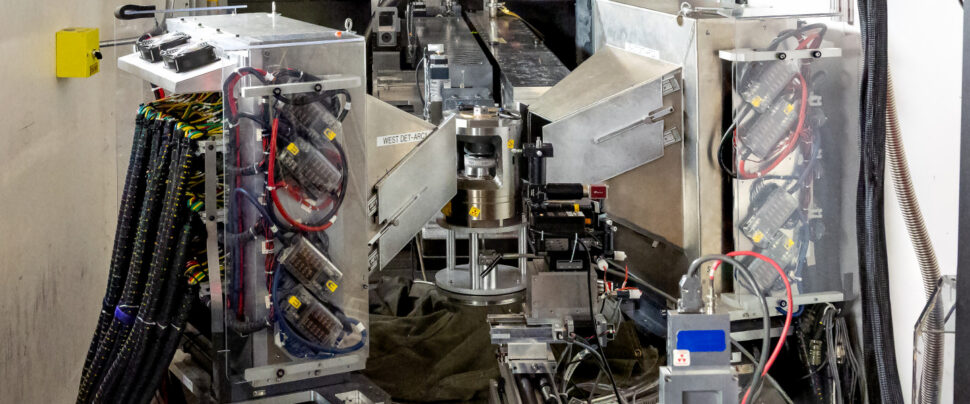
Capabilities of the SNAP Instrument
Powder crystallography: tunable resolution, dependent on required d-spacing range. Each detector can be positioned independently, and refined jointly to combine the benefits of d-spacing range and resolution. Multiple chopper settings can be used to extend the d-spacing range up to 15 Å with limited resolution and low flux (suitable for a strong signature). The instrument is compatible with a 50 mm orange cryostat (1.8 K), and a 70 mm closed-cycle refrigerator (10 K).
Single-crystal diffraction. SNAP can measure very small single-crystal samples, detecting remarkably weak signatures. However, with a limited detector coverage, you must have a well aligned, and well thought-through experiment. In the Paris-Edinburgh press, or the DAC, we are limited in access to reciprocal space, and so the science must be well targeted, and the crystals must be well aligned in advance.
Disordered materials studies (glasses/liquids/sloppy crystals at HP): low-resolution wide Q-range mode, 0.6 < Q < 20 Å-1, at temperatures between 90–300 K and pressures up to 10 GPa in the Paris-Edinburgh press. Currently this is achievable without a pressure medium.
Software: SNAP uses MANTID for all data reduction, using SNAP Reduce (SNAPRed) for all powder reduction and data exporting.
SNAP Mail-In Program
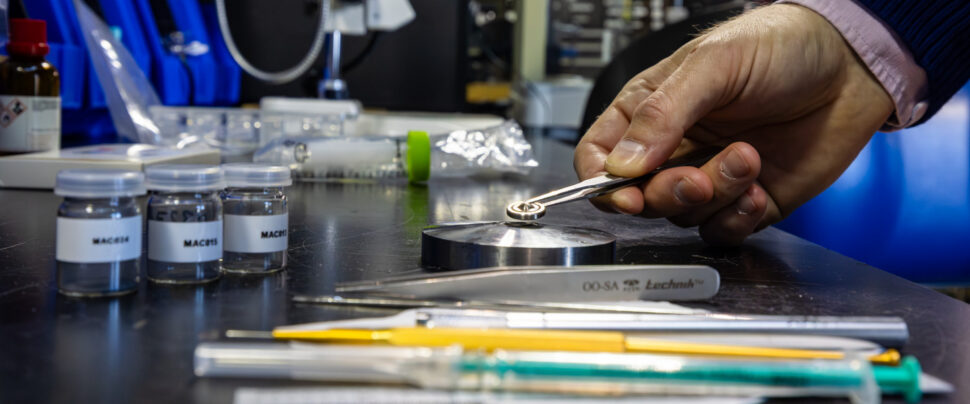
SNAP operates a mail-in program for room temperature high-pressure measurements using the Paris-Edinburgh (PE) press. This uses a limited subset of the instrument’s capabilities to provide timely access to high-pressure neutron powder diffraction data, up to ~8 GPa at room temperature.
Availability
Mail-in slots available for August-December 2026.
Mail-In Program Overview
- Proposals are accepted at any time.
- Several days are reserved from the General User Program each cycle.
- Experiments are measured on a first-come, first-served basis.
- Mail-in proposals will not be accepted if they directly compete with an approved General User Program proposal.
- Samples should be fully prepared before the mail-in proposal is submitted. Evidence of this is advantageous to the proposal.
- Each mail-in proposal is allocated 12 hrs of beamtime, following one of two preset experiment plans (see below).
- One sample is allowed per proposal.
- The measurements are limited to room temperature only, using the Paris-Edinburgh press.
Loading considerations
- Sample Loading: Beamline staff will load your sample.
- Sample Volume: A minimum of 50 mm³ is required—typically 0.2 to 0.5 g depending on your sample’s density.
- Pressure Marker: A foil of polycrystalline Pb will be added to your sample. This contributes to the diffraction signal and is essential for pressure determination.
- Sample Types: Liquid or polycrystalline solid samples can be accommodated. For solids, powdered form is preferred.
- Pressure Medium for Solids: A liquid pressure-transmitting medium will be added. By default, a methanol:ethanol mixture is used. If your sample reacts with or dissolves in methanol, a fluorinated oil can be used as an alternative.
- Liquid Samples: For liquid samples, silica glass wool will be added to promote better powder-averaging upon crystallization.
- Sample Sensitivity: In some instances air- or moisture-sensitive samples can be accommodated for mail-in submissions, depending on the pressure medium requirements.
Measurement plan options
Pressures achievable: Exact pressures cannot be guaranteed. We offer two approximate pressure-loading protocols:
1) ~0.5 GPa steps up to 5 GPa
2) ~1 GPa steps up to 8 GPa
Instrument Configuration: The instrument will be operated in one fixed configuration. You may choose one of the following measurement options:
A) Full run over the 0.4 – 5.1 Å d-spacing range
B) Split run: Half the time on 0.4 – 5.1 Å, half on 2.8 – 10.5 Å
Mail-In Proposal Process
- Prepare Your Samples: Ensure your sample meets the criteria described above, including volume and compatibility with pressure media.
- Prepare Your Proposal: Use the SNAP Mail-In Proposal Template (1 page maximum, excluding references). In your proposal, specify the pressure medium compatible with your sample, the desired loading route (Option 1 or 2), and the preferred measurement configuration (Option A or B).
- Submit Your Proposal: Upload your completed proposal through the IPTS system. Be sure to select “Mail-In” as the proposal type. Mail-in proposals are reviewed continuously and independently from the semi-annual proposal cycle.
- Proposal Review: If your proposal is accepted, you will receive an email with additional instructions.
- Ship Your Samples: Follow the instructions and use the address listed on the Shipping Guidance page. Samples will be measured in the order they are received.
- Measurement and Data Access: You will receive an email notification once data collection is complete. Instructions for accessing your data will be included (see below).
- Sample Disposal or Return: After 30 days, samples will either be discarded or returned to you, depending on the preference indicated in your proposal.
Data access
- Your data will be automatically reduced. You can access this through the Remote Analysis Service (https://neutrons.ornl.gov/users/remote-analysis).
- Your data will be saved in “/SNS/SNAP/IPTS-XXXXX/shared/SNAPRed/export/” for your relevant IPTS number.
- Data formats include XYE and GSAS files.
Facility acknowledgment
This statement must be included in the acknowledgment section of any publications resulting from, or contributed to by, the mail-in program:
This research [or, A portion of this research] used resources at the Spallation Neutron Source, a DOE Office of Science User Facility operated by the Oak Ridge National Laboratory. The beam time was allocated to SNAP on proposal number IPTS-XXXXX.X.
Notes
Mail-in proposals do not carry-over between cycles. The mail-in proposal will expire given any of the following:
- Samples are not received in a timely manner.
- Samples are not in an appropriate format to load into the press.
- The PE press experiences a ‘blow-out’ – no further loading attempts will be made.
- If the PE press is no longer in commission e.g. due to unplanned maintenance.
- Beam production is reduced or cancelled, undermining the delivery of full experiments.
- We reach the upper cap of mail-in beam days for the current cycle.
Users will be notified of cancellation/expiration and are encouraged to resubmit the proposal.
Help
If you are unsure of any of the details specified above, please contact Chris Ridley ([email protected]) for further information

Sample Environment of the SNAP Instrument
SNAP Pressure Equipment
Pressure media and markers: for the Paris-Edinburgh press we routinely use liquid pressure media, deuterated methanol:ethanol (4:1 by volume), deuterated pentanes, fluorinated liquids or deuterated glycerol. For sample pressure determination, Pb is routinely used as a pressure marker (internal calibrant) with a variable PT equation-of-state available. Other internal standards such as NaBr/NaCl/NaF and MgO among others are available. For clamp cells, fluroinated oils are preferred. In the DAC we typically gas load using Ar gas as a medium, and use ruby fluoresence for pressure determination.
Diamond Anvil Cells: the DAC system routinely operates to 30 GPa with a sample volume of 0.2 mm3, measurable from 7 to 300 K, suitable for powders and single-crystals. Given this very small sample volume, these measurements still require higher symmetry systems, consisting of strong scattering elements or well aligned crystals. In some cases, from very simple, strong scattering systems, we have reached 94 GPa on a sample volume 0.04 mm3. Pressure control and measurement via ruby spectroscopy is all done in-situ. If you have an idea for a DAC experiment, we strongly encourage you to discuss it with an instrument team member in advance.
The table below can be used to provide approximate measurement ranges for the SNAP equipment. The instrument staff welcomes any technical questions about the feasibility of your experimental ideas.
| Equipment | Max. Pressure (GPa) | Temperature range (K) | Approx. Sample size (mm³) | d-spacing range (Å) | Scattering angles (°) | Notes |
| Diamond anvil cell | 40 | 10-350 | 0.05 | 0.7-5 Å | 80-100° 2Θ, +/- 22° vertical | Contact the instrument team. Powder or single crystal. |
| Paris-Edinburgh press, single-toroidal anvils | 10 | 85-350 | 70 | 0.8-16 Å | 26-142° 2Θ, +/- 7° vertical | cBN anvils, clean signal. Powder or single crystal. |
| Paris-Edinburgh press, double-toroidal anvils | 20 | 85-350 | 35 | 0.7-16 Å | 26-142° 2Θ, +/- 7° vertical | Bragg peaks from polycrystalline diamond anvils above 6 GPa. Powder or single crystal. |
| Versimax anvil cell | 8 | 2-350 | 0.7-16 Å | 26-142° 2Θ, +/- 22° vertical | Single crystal samples only. | |
| Clamp Cell | 2 | 2-350 | 150 | 0.7-16 Å | 26-142° 2Θ, +/- 22° vertical | Parasitic scatter from cell (NiCrAl/Al or BeCu). Powder or single crystal. |
| Gas cell (Al) | 0.6 | 2-350 | 700 | 0.7-16 Å | 26-142° 2Θ, +/- 22° vertical | Parasitic scatter from cell (Al). Powder or single crystal. |
| Gas cell (TiZr null-scattering alloy) | 0.2 | 2-350 | 340 | 0.7-16 Å | 26-142° 2Θ, +/- 22° vertical | No Bragg peaks, incoherent background (TiZr). Powder or single crystal. |
Sample Mass Calculator
| Bulk Modulus (GPa) | Density (g/cm3) | Volume (mm3) | Sample Mass Needed (mg) | |
|---|---|---|---|---|
| Custom Values | ||||
| NaCl | 24.4 | 2.17 | 87.1 | 171.888 |
| MnO | 148.0 | 5.37 | 87.1 | 354.256 |
| V | 160.0 | 6.00 | 87.1 | 388.104 |
| CoO | 180.0 | 6.44 | 87.1 | 402.766 |
| Bi | 31.0 | 9.78 | 87.1 | 767.770 |
Sample Geometry
| Click below for illustration of sample shapes for use in the Paris-Edinburgh press | Volume (mm3) |
| Double-toroid, encapsulated | 30 |
| Double-toroid, non-encapsulated | 40 |
| Single-toroid, encapsulated | 60 |
| Single-toroid, non-encapsulated | 88 |
If you see NaN in the “Sample Mass Needed (mg)” field, then one of your entries probably contains non-numeric data or is not a valid number, for example, entering 3.9.0 (double decimal points).