General-Purpose Small-Angle Neutron Scattering Diffractometer
Mission Statement
It’s the little things that matter.
Instrument Description
The properties and performance of hard and soft matter systems is often intimately linked to the internal microstructure. Small-angle neutron scattering (SANS) is a uniquely powerful tool for probing structural information on length scales ranging from 0.5-200nm. Among the features that make it so useful are the facts that neutrons are highly penetrating, low-energy, magnetic, and sensitive to the nuclei of atoms. These properties make it a complementary probe to x-ray scattering and microscopy techniques and make location of light elements, distinguishing between atoms nearby on the periodic table, isotopic labeling, and the separation of magnetic and nuclear scattering contributions possible.
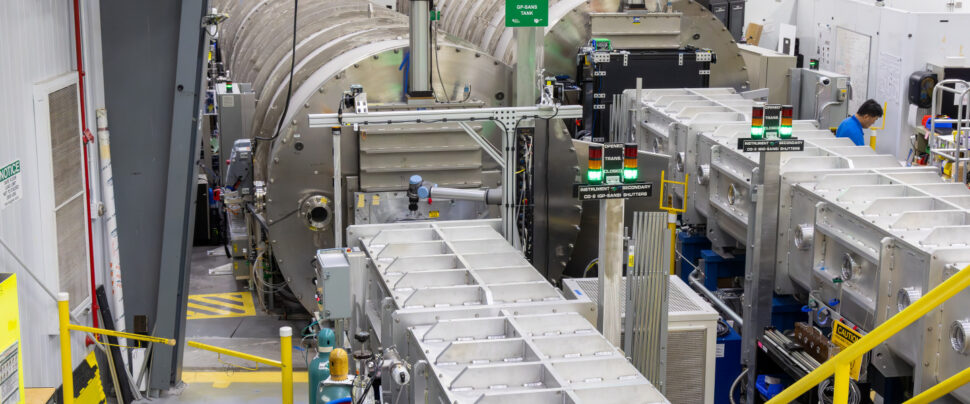
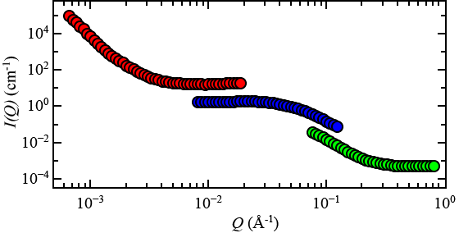
The General-Purpose Small-Angle Neutron Scattering Diffractometer (GP-SANS) CG-2 instrument is optimized for providing information about structure and interactions in materials in the range of 0.5–200 nm. It has a cold neutron flux on sample and capabilities comparable to those of the best SANS instruments worldwide, including a wide range of neutron wavelengths (4–20 Å), a resolution Δλ ⁄ λ 9-25%, and a 1 m2 area detector with 8 × 4 mm2 pixel resolution with a maximum counting capability of up to 2 mHz. The sample-to-detector distance can be varied from 1–19 m, and the detector can be offset horizontally by up to 40 cm, allowing a total accessible Q range from <0.001 to 1.3 Å-1. The 2 m sample environment area will accommodate large, special-purpose sample environments such as cryomagnets, furnaces, mechanical load frames, and shear cells.
Applications
- Soft matter and Polymers:
Polymer solutions, blends, membranes, and nanocomposites; molecular self-assembly in complex fluids (colloids, micelles, vesicles, emulsions); hydrogels; responsive materials; and nanoscale heterogeneity in glassy or amorphous systems. - Structural and Energy Materials:
Phase separation and grain growth in metallurgical, high-entropy, and reactor-based alloys; structural analysis of energy storage materials (batteries, MXenes), metal-organic frameworks (MOFs), advanced ceramics, and porous catalytic or adsorbent materials. - Quantum and Magnetic Materials:
3D SANS tomography of magnetic spin textures and skyrmion systems; incommensurate magnetism; flux lattices in superconductors; ferrofluids; and the relationship between structural and magnetic domains.
Specifications
| Beam Spectrum | Cold |
| Monochromators | Velocity selector |
| Incident wavelength | 4 < λ < 20 Å |
| Resolution Range | Δλ ⁄ λ= 9 – 25% |
| Collimation | Eight removable guide sections, each 4 x 4 cm2 and 2 m long; 2 m open area at sample stage to mount automatic changers, furnaces, magnets, cryostats, pressure cells, etc. |
| Q range (Å-1) Collimation 6 m, SDD 1 m Collimation 6 m, SDD 6 m Collimation 17 m, SDD 19 m | 4.75 Å 0.05-1 Å-1 4.75 Å 0.008-0.202 Å-1 12 Å 0.001-0.025 Å-1 |
| Sample detector distances | 1 – 19 m |
| Detector | 1m wide array of 192 1m long He3 LPSDs |
| Max counting rate | 2 kHz/pixel, 2 Mhz over the detector |
GP-SANS Instrument Team
Please select link below to email the instrument team. Be sure to include your name and email address.
Contact the GP-SANS Instrument Team
Lisa DeBeer-Schmitt – Instrument Scientist
Lilin He – Instrument Scientist
Karin Jakobi – Instrument Scientist
Yingrui Shang – Computational Instrument Scientist
Arina Rostopchina – Scientific Associate
Liu J.; He L.; Osti N.C.; Zhang Y. “Neutron Scattering in Sodium-Ion Battery Research: Progress and Prospects”, Advanced Energy Materials, 16, e06774, 2026
Jorgensen C.S.; Unocic R.R.; Fan X.; Santodonato L.; Liaw P.K.; Gilbert D.; Debeer-Schmitt L.M. “Insights into the magneto-structural phase transitions in Al𝑥CoCrFeNi”, Physical Review Materials, 10, 094412, 2026
Lailey O.; Sarenac D.; Clark C.W.; Cory D.G.; Debeer-Schmitt L.M.; Ekinci H.; Garrad D.V.; Henderson M.; Huber M.; Vadnere P.; Zhernenkov K.; Pushin D.A. “Multimode structured neutron beams”, Optics Express, 34, 34960-34967, 2026
Anovitz L.M.; Ryder M.R.; Lobodin V.V.; Tsouris C.; Finney C.E.; Smith D.B.; Ilavsky J.; Daemen L.L.; Bleuel M.; Gagnon C.; Littrell K.C.; Allard L.F.; Parks J.E. “The evolution of coal porosity during pyrolysis”, Journal of Analytical and Applied Pyrolysis, 197, 107853, 2026
Neves P.; Kurumaji T.; Wakefield J.P.; Hiess A.; Steffens P.; Qureshi N.; Cubitt R.; Debeer-Schmitt L.M.; Palmstrom J.C.; Hayami S.; Bartkowiak M.; Zolliker M.; White J.S.; Checkelsky J.G. “General Approach to Solving Spin Moiré Superstructures”, Physical Review X, 16, 021054, 2026
Fan J.; Yuan Y.; Wang T.; Luo H.; Wang F.; Wang Q.; Mahurin S.M.; Thapaliya B.P.; He L.; Liu J.; Samartzis N.; Yang Z.; Dai S. “Surface Graphitized Mesoporous Carbon Surpasses the Conductivity–Porosity Trade-Off”, Advanced Science, 13, e19661, 2026
Prenger K.; Kolesnikov A.I.; Osti N.C.; Mamontov E.; Keum J.K.; Littrell K.C.; Naguib M. “Structure and Dynamics of Water Confined in Transition Metal Carbide MXenes: Implications for Electrochemical Applications”, ACS Applied Nano Materials, 9, 2862–2871, 2026
GP-SANS Sample Environment
To support a broad range of scientific research, GP-SANS is equipped with a wide and highly diverse array of sample environments, including magnets, low-temperature cryostats, pressure cells, furnaces, and automated sample changers. Planning your sample environment is a critical step in a successful SANS experiment. While the list below provides the theoretical capability limits for our equipment, the practical settings you can achieve will depend heavily on the specifics of your proposed experiment. Please reach out to the instrument team to discuss your exact requirements so we can help you select the right setup for your science and ensure a strong, feasible user beamtime proposal.
Robot furnace block
The heating block operates from 25 °C to 300 °C and is compatible with titanium cells. A side storage tray holds up to 40 cells at room temperature, and a robotic arm transfers cells in and out of the heating block as directed by the script.
Robot Peltier block
The Peltier block operates from –5 °C to 100 °C and supports both banjo and titanium cells. A side storage tray holds up to 40 cells and can be maintained either at room temperature or at the same temperature as the in‑beam sample position. A robotic arm transfers cells in and out of the block as directed by the script.
Tumbler Sample Changer
The tumbler sample changer is compatible with titanium cells and holds four samples. The tumbler rotates samples to ensure a homogenous mixture during the neutron’s flight path through the sample.
Rheometer
The Rheo‑SANS setup uses a rheometer with a temperature controller (10–200 °C) to enable simultaneous rheology and neutron scattering. It covers torques from 1 nNm to 230 mNm and normal forces from 0.001 N to 50 N. Interchangeable titanium Mooney‑Ewart concentric cylinders support 3–25 mL sample volumes, shear rates (up to 10,000 s-1; 10-7 to 628 rad/s frequency range), and neutron pathlengths of 1–2 mm.
Peltier Sample Changer
The Peltier sample changer holds 12 samples and has four temperature regions, with a temperature range of -10°C to 150°C.
Humidity Chamber
The humidity chamber with a holder for thin films on substrates. Uses humidity generator to achieve humidity up to 95%.
Extended Angle Pressure
The Extended Angle Pressure cell setup can use titanium cells to reach pressures up to 1 kbar and temperatures up to 200 °C for CO₂, CH₄, He, N₂, and Ar. It can also use stainless‑steel cells to reach pressures up to 300 bar and temperatures up to 200 °C for H₂/D₂ mixtures.
Atmosphere Tube Furnace
The atmosphere tube furnace has a maximum temperature of 1050°C. The open tube allows gas flow or air exposure in the tube.
ILL Furnace
The ILL furnace is a vacuum furnace with an operating temperature up to 1300°C.
Mag-H
Mag-H can achieve up to 5T horizontal field. With the addition of a closed cycled refrigerator (ccr), samples can reach a minimum temperature of 5 K.
Mag-G
Mag-G can achieve an 11T field and has the capability to reach a minimum temperature of 0.05 K with a dilution refrigerator insert.
GP-SANS Mail-in Program
- Program is intended for users needing data for a limited number of samples to finish a publication that is otherwise complete
- Mail-in proposals can be submitted throughout the year
- It will undergo internal review by the instrument team and management
- Beamtime for an approved mail-in experiment is allocated and scheduled based on instrument availability and a first-come, first-serve basis
- No more than 10% of overall beamtime will be allocated to the mail-in program with up to 12 hours of beamtime for each approved mail-in proposal
- Only the robot with Peltier element setup will be used, i.e., ambient pressure and temperature range of T=25°C to T=80°C
- Only the standard instrument configurations shown below are available
- Samples will be shipped to local contact including handling and storage requirements
- Only shelf stable (3 months) samples are accepted
- No mixing of samples will be provided, only easy and ready to fill samples are accepted
- If sample filling and removing requires more attention, sample cells will be shipped to the user before and after the experiment
- A detailed measurement plan and sample disposal plan must be provided by the user together with safety data sheet (MSDS)
- Data will be reduced with standard procedures and e-mailed to the user within 3 days after the experiment is performed
- No data analysis is included in mail-in program, but the user can reach out to the instrument team any time
- The instrument team is not responsible for any sample degradation or problems that result from sample handling during shipment
- If experiment requires more attention from the instrument scientist, a general user proposal must be submitted
Standard configurations:
Documents:
Data Reduction Guidance & Data Analysis
Data Reduction Guidance
Modern GUI Notebooks
The links below provide guidance on using our Jupyter Notebooks featuring a built-in graphical user interface (GUI). The two separate guides correspond to the different absolute scaling methods utilized at GP-SANS. Your local contact will advise you on which method is appropriate for your specific experiment.
- Direct-Beam Method: Used when large or complex sample environments prevent a standard sample from being easily measured.
Automated Reduction
An automated data reduction routine runs in the background during experiments. This routine generates files compatible with GrASP (Graphical Reduction and Analysis SANS Program) for immediate visualization and analysis, which is detailed in the software section below.
Legacy Methods & Tutorials
The guides and videos below cover our legacy Jupyter Notebook workflows and data visualization tools. The PDF guide walks through locating your data on OnCat, executing the older notebooks, and accessing or visualizing your reduced data via MantidWorkBench.
- Data Reduction Guide for CG2 (GP-SANS)
- Data Reduction Tutorial Video 1
- Data Reduction Tutorial Video 2
Data Analysis Software
The GP-SANS instrument team currently officially supports two primary analysis software packages:
- SasView: An open-source, collaboratively developed software package designed for fitting and analyzing small-angle scattering data sets.
- GrASP: The Graphical Reduction and Analysis SANS Program (developed at the ILL), ideal for rapid visualization, inspection, and analysis of both standard and specialized data configurations.
Alternative Analysis Packages
While not natively supported by the beamline staff, the following package are frequently utilized by our user community for specialized data evaluation:
- Irena: A comprehensive suite of tools implemented within Igor Pro, highly optimized for modeling complex material structures, hierarchical morphology, and size distributions.
Related Research Highlights

April 12, 2026
Magnetism-Driven Magnetoresistance in a Weyl Semimetal
May 15, 2025
Generation of Neutron Airy Beams

December 14, 2024
Nanometric Modulations of the Magnetic Structure of the Element Nd