Backscattering Spectrometer
Mission Statement
Toward advances in life sciences and better materials for energy storage
Instrument Description
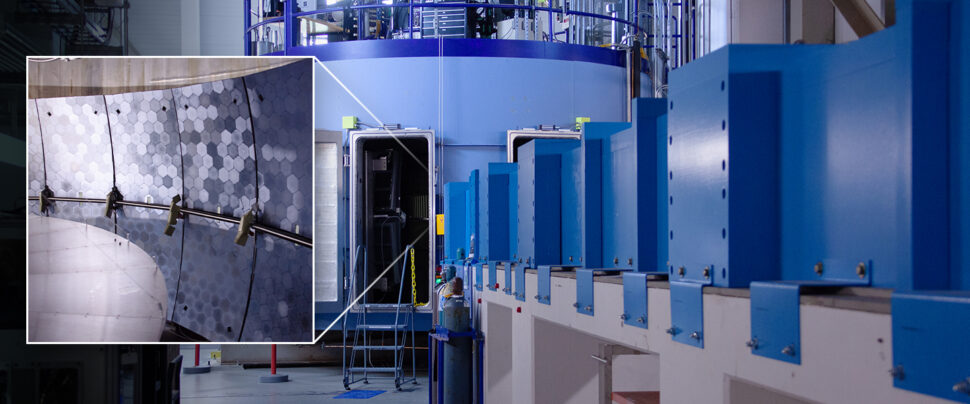
BASIS is a near-backscattering, crystal-analyzer spectrometer that provides very fine energy resolution, as low as 3.0 to 3.5µeV at the elastic peak (depending on sample size). This requires a long initial guide section of 84 m from moderator to sample in order to achieve the timing resolution necessary for obtaining the desired energy resolution. BASIS provides an excellent dynamic range near the elastic peak of about plus and minus 100 µeV in the standard high-intensity operation regime, which, if needed, could be extended to plus and minus 200 µeV and beyond. The spectrometer is optimized for quasielastic scattering but provides about 0.1% resolution in energy transfers up to ~40 meV; the inelastic excitations need to be very sharp in order to be measurable at high energy transfers.
For detailed information about BASIS, please refer to “A time-of-flight backscattering spectrometer at the Spallation Neutron Source, BASIS” Mamontov, E., and Herwig, K. W., Review of Scientific Instruments 82, 85109 (2011).
Applications
BASIS can be used to probe dynamic processes in various systems on the pico- to nanosecond time scale. It is well suited for probing diffusive and relaxation motions. Applicable fields of study include, but are not limited to:
- Water and aqueous materials
- Biosystems and biomaterials
- Polymers and polymer-nanocomposites
- Bulk and confined ionic liquids
- Organic molecules (bulk and confined)
- Metal hydrides and confined hydrogen
- Solid state ionic conductors
- Hybrid perovskites
- Magnetic and quantum materials
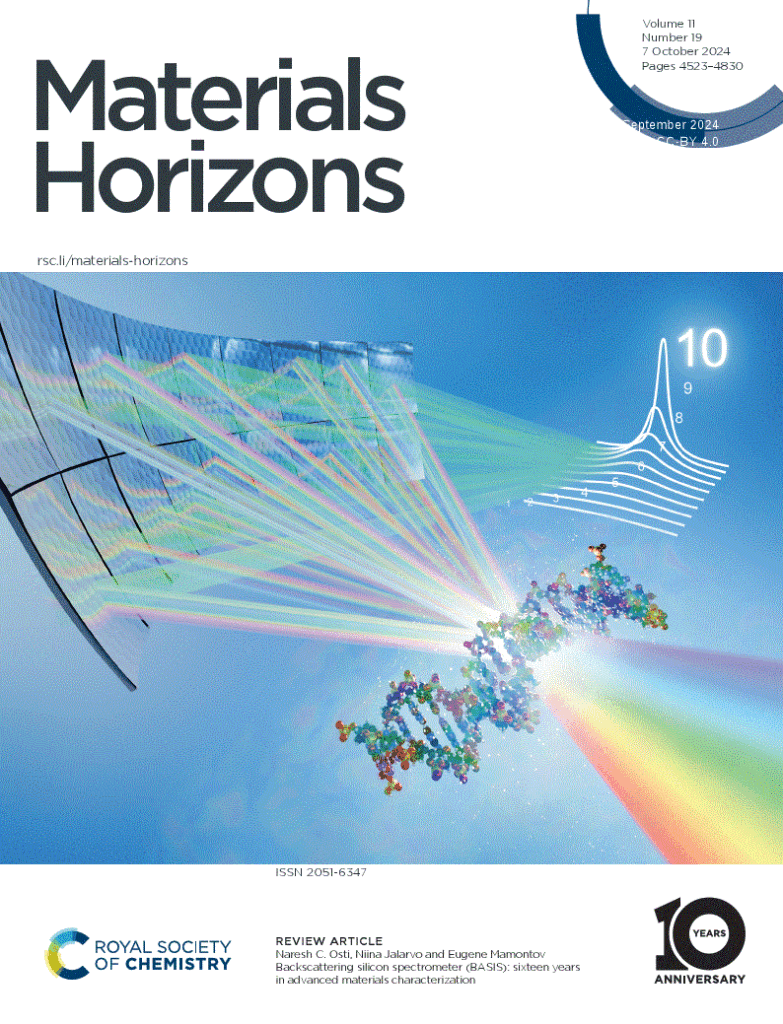
“Backscattering silicon spectrometer (BASIS): sixteen years in advanced materials characterization”, Naresh C. Osti, Niina Jalarvo, and Eugene Mamontov, Materials Horizons, Volume 11, Issue 19, October 07, 2024
Specifications
With Si(111) analyzers
| Elastic energy | 2.08 meV |
| Bandwidth | ±100 μeV or ±200 μeV |
| Resolution (elastic) | 3.5 μeV |
| Q range (elastic) | 0.2 Å-1 < Q < 2.0 Å-1 |
| Solid angle | 1.8 sr |
With Si(311) analyzers
| Elastic energy | 7.63 meV |
| Bandwidth | ±660 μeV or ±1700 μeV |
| Resolution (elastic) | 15 μeV |
| Q range (elastic) | 0.4 Å-1 < Q < 3.8 Å-1 |
| Solid angle | 0.6 sr |
BASIS Instrument Team
Please select link below to email the instrument team. Be sure to include your name and email address.
Contact the BASIS Instrument Team
Eugene Mamontov – Spectroscopy Group Leader
Naresh Osti – Instrument Scientist
Niina H. Jalarvo – Instrument Scientist
Christopher Schmitt – Scientific Associate
Information for BASIS Users
User Manual
Frequently Asked Questions
What kind of sample environment equipment will be available?
Consult the sample environment web page.
How should samples be prepared?
Currently, annular cans are being used to create a cylindrical surface of liquid or to simply pack solids or powders inside. When annular cans are impractical, flat-plate sample holders can be used.
Procedures
- 3.A-1.5.2.2 – Procedure for Operation of the Backscattering Spectrometer User IPPS Panel (.pdf)
- 3.A-3.5.2.1 – Procedure for Entry to the Backscattering Spectrometer Restricted Sample Area
- 5.U-2.1 – Procedure for Alarm Response at the Backscattering Spectrometer
- 7.U-2.8.1 – Procedure for Sample Removal on the Backscattering Spectrometer
- SNS-INST-OA-BL2-46 – Sample Change Guide (.pdf)
Checklists
BASIS Mail-In Program
- Mail-in proposals for BASIS can be submitted at any time.
- Measurements will be allocated on a first-come/first-served basis.
- Mail-in proposals will be evaluated for conflicts with other active proposals at ORNL neutron facilities.
- One researcher (PI) is eligible for one mail-in proposal per run cycle.
- Each mail-in proposal can receive 1 day (24 hours) of beamtime at BASIS.
- Up to 3 samples may be measured. Empty sample can measurements count toward the three samples.
- Mail-in experiments are performed using
- Si111 analyzers with symmetric 60 Hz mode; providing elastic energy resolution 3.5 μeV, bandwidth ±100 μeV and momentum transfer range 0.2 – 2.0 Å-1.
- a standard CCR as sample environment, with temperatures available from 30 to 600 K.
Heating and cooling times are included in the allocated beamtime.
- Standard aluminum sample cans of cylindrical or flat plate geometry are available.
- Sample cans will be shipped to the users or may be collected at SNS and should be filled by the users.
- Samples should arrive to SNS minimum of 7 days before the scheduled Mail-in proposal. More information about sample shipment requirements in shipping guide.
- Mail-in proposals must include a single page written proposal; template available here.
- Choose the “Mail-in” proposal type when submitting your proposal via IPTS system
Related Research Highlights
February 13, 2025
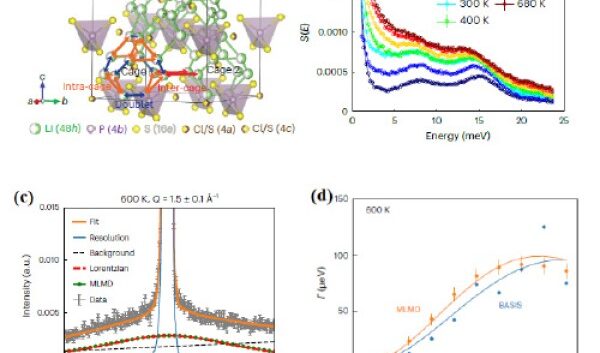
Liquid-like Dynamics in a Solid-state Lithium Electrolyte